
Battle of Hong Kong
The telegram that Winston Churchill sent to the Hong Kong garrison on December 21, 1941 — "We are all watching the glorious stand you are making" — was honest in its admiration and brutal in its implication. Nobody watching from London had the means or the intention to send relief. The garrison of roughly 13,500 defenders, drawn from British, Indian, Canadian, and local Hong Kong units, faced a Japanese force of approximately 35,000 battle-hardened troops supported by artillery and air power. They had held for fourteen days by then. They would hold four more.
The Garrison and the Ground
Hong Kong was always considered indefensible against a determined assault. The colony's mainland position — the Kowloon Peninsula and the New Territories — had no depth: the border with Japanese-occupied China ran just a few kilometers north of the urban center. The garrison's main mainland defensive line, the Gin Drinkers' Line, was an incomplete fortification system that would have required far more troops than available to hold effectively. When Japanese forces attacked on December 8, 1941 — the same morning, across the International Date Line, as the strike on Pearl Harbor — they breached the Gin Drinkers' Line within hours at its weakest point, the Shing Mun Redoubt. The defenders abandoned the mainland within days and withdrew to Hong Kong Island across the narrow harbor. The Japanese bombed and shelled the island for nearly a week before crossing on the night of December 18. After that landing, the fighting fragmented into desperate rearguard actions across the island's broken hills, valleys, and reservoirs — terrain that slowed the Japanese advance but could not stop it.
The Men Who Came from Canada
Among the defenders were 1,975 Canadian soldiers from two battalions: the Royal Rifles of Canada, recruited largely from Quebec and the Maritimes, and the Winnipeg Grenadiers from the Prairies. They arrived in Hong Kong on November 16, 1941 — less than a month before the attack — having been told the posting was a garrison rotation rather than imminent combat. Most had never fought in battle. Against the veterans of the Japanese 38th Division, they fought with what one commander's dispatch described as a courage that could not compensate for the experience they lacked. Over the eighteen days of battle, 290 Canadian soldiers were killed and 493 wounded. All 1,685 survivors became prisoners of war. Many of these men — farmers, fishermen, factory workers, students, still in their twenties — would spend three and a half years in Japanese camps. By the end, 264 Canadians had died in captivity. The survivors came home diminished by malnutrition, disease, and what had been done to them in ways that took decades to begin to name.
Black Christmas
By Christmas Day, the last organized defensive position — the Stanley Peninsula on the south side of Hong Kong Island — was holding but surrounded. Scattered groups of defenders continued to fight at Wong Nai Chung Gap, at the reservoirs, across the hillsides. Governor Sir Mark Young crossed Victoria Harbour to the Peninsula Hotel in Kowloon, where the Japanese command had established its headquarters, and signed the surrender at around 3:15 in the afternoon of December 25, 1941. The date gave the fall of Hong Kong its enduring name: Black Christmas. The total military casualties — defenders and attackers — exceeded 5,600 killed and wounded. Approximately 4,000 civilians died during the battle itself. What followed was nearly four years of Japanese occupation, during which Hong Kong's civilian population experienced severe food shortages, forced labor, mass internment, and documented atrocities. The population fell from roughly 1.6 million at the time of surrender to around 600,000 by liberation in August 1945 — the rest having fled, died, or been driven out.
What Remains
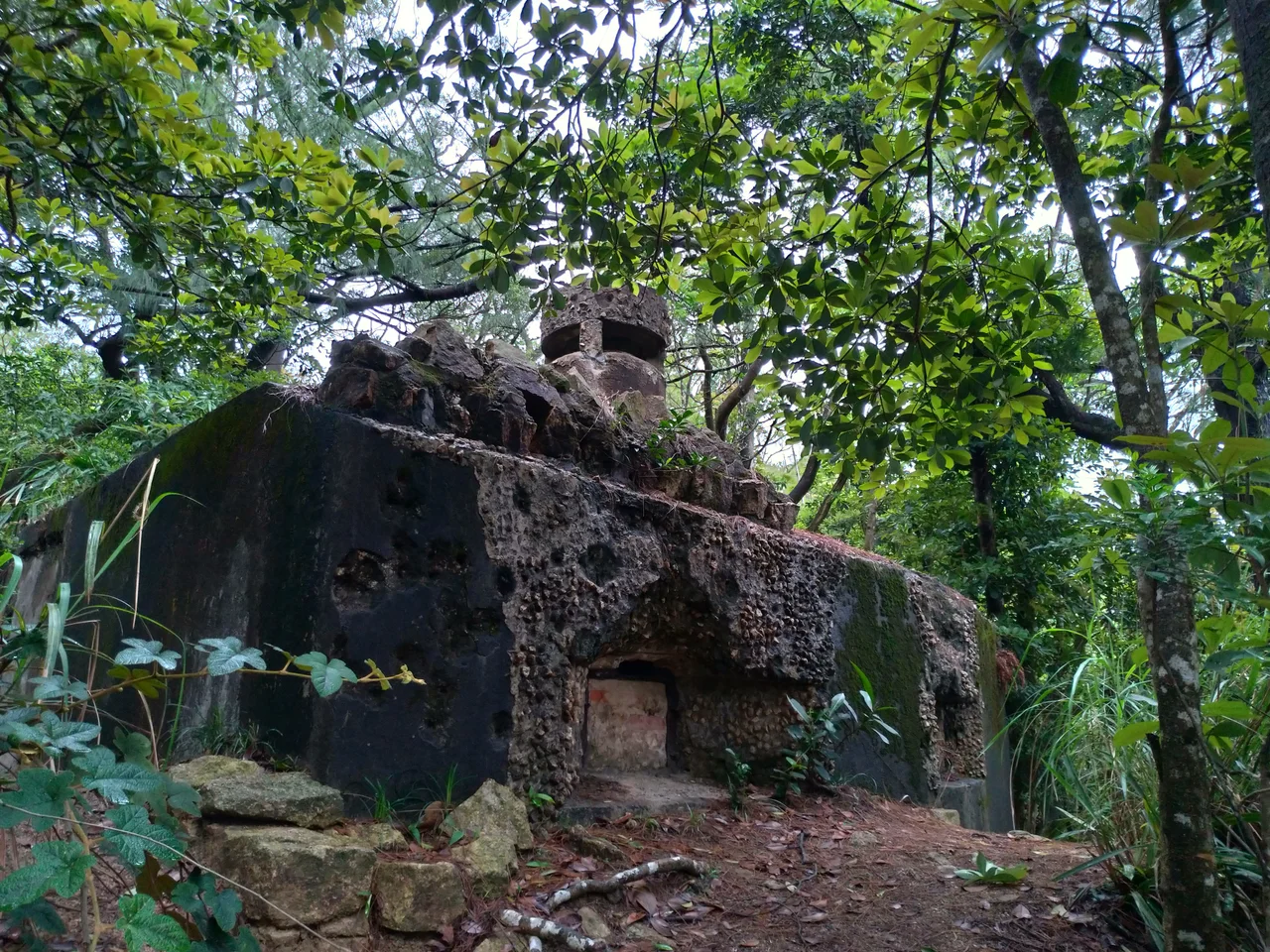
The physical traces of the battle are scattered across the hillsides of Hong Kong Island and the New Territories — pillboxes weathered by eighty years of subtropical rain, sections of the Gin Drinkers' Line overgrown in the hills above Kowloon, the cemetery at Sai Wan where 1,528 Commonwealth soldiers lie buried. The battle's shape — a small, multinational garrison making a stand they knew was hopeless, for long enough to mean something — entered the collective memory of Canada, Britain, India, and Hong Kong in ways that have not entirely faded. For the families of the Canadian prisoners of war, 'Hong Kong' remained a shorthand for a particular kind of abandonment for generations: men sent without adequate preparation to a position that could not be held, who survived it only to endure something worse. Their history is kept by the Hong Kong Veterans Commemorative Association, whose records are among the most detailed accounts of what it cost to defend a place that could not be saved.
From the Air
The Battle of Hong Kong was fought across the entire colony — from the Gin Drinkers' Line in the New Territories to the streets of Kowloon to the hills and reservoirs of Hong Kong Island. The geographic center is approximately 22.283°N, 114.161°E. Flying south along the harbor at 3,000 feet, the Wong Nai Chung Gap — site of the heaviest fighting on Hong Kong Island — is visible as a saddle in the hills between Happy Valley and the south side of the island. Sai Wan War Cemetery lies on the island's eastern tip. The Stanley Peninsula, site of the final defensive positions, extends southward into the South China Sea. Hong Kong International Airport (VHHH) on Lantau Island, about 30 km to the west-northwest, did not exist in 1941; the wartime Kai Tak Airport on Kowloon Bay was destroyed on the first day of the attack.
Nearby Stories
- Lok Ma Chau Loop 2.3 km away
- Portas do Cerco 2.3 km away
- Kweilin Incident 17 km away
- Wanshan Archipelago Campaign 34 km away
- Nanxiong Formation 115 km away
- Battle of Nanpeng Island 148 km away
- Heyuan 169 km away
- Cape Maobitou 632 km away