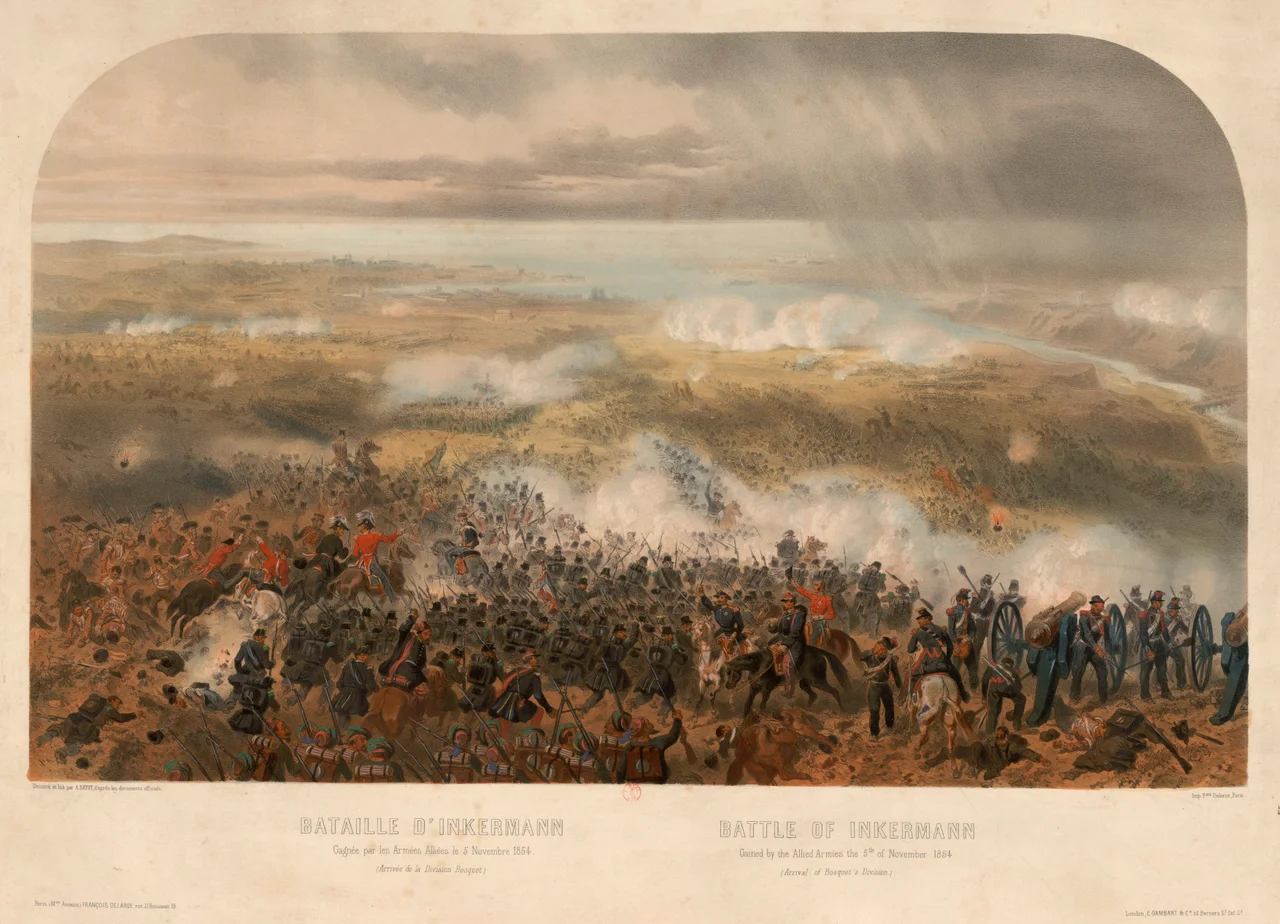

Battle of Inkerman
The fog came first, before the guns. On the ridges east of Sevastopol on the morning of 5 November 1854, a thick autumn mist settled over the heights so completely that a soldier could not see the man fifty paces away - and into that grey nothing the Imperial Russian Army sent forty thousand men. What followed became known as the Soldier's Battle, not for glory but for necessity: the generals, blind in the murk, lost all control, and the day was decided by scattered companies fighting on their own initiative, often at bayonet point, against an enemy who materialized without warning from the white.
The Siege That Set the Stage
The allied armies of Britain, France, Sardinia, and the Ottoman Empire had come ashore on the Crimean coast that September with a single objective: the great Russian naval base at Sevastopol. They beat the Russians at the Battle of the Alma and marched around the city to lay siege from the south, establishing their supply port at Balaclava. But the siege lines stretched dangerously long, and the allies simply did not have enough men to hold them. The Russian commander, Prince Menshikov, saw the weakness. On 25 October his forces struck at Balaclava, and though the attack was turned back, it left the Russians holding strong ground north of the British. Ten days later, Menshikov threw the full weight of his army at the exhausted right flank.
Two Thousand Against Forty Thousand
The assault fell on Home Hill, held by the British Second Division - some 2,700 men and twelve guns against Russian columns numbering in the tens of thousands. General Soymonov attacked at dawn with regiments from Kolyvansky, Ekaterinburg, and Tomsky, the fog hiding his approach until his men were nearly on top of the British pickets. Command of the outnumbered defenders had fallen to Major-General John Pennefather, an aggressive officer who chose not to retreat but to attack. It should have been suicidal. Yet the British carried the new Pattern 1851 Enfield rifle, its Minie balls deadly accurate, while the Russians still fought with smoothbore muskets. Forced into a bottleneck by the shape of the valley, wave after Russian wave was cut down and thrown back. Soymonov himself was killed by a rifleman; the officers who took his place fell in turn, one after another, until no one seemed willing to command.
Chaos on the Ridge
By late morning the battle had dissolved into something close to anarchy. Reinforcements poured in from both sides. British Grenadiers under the Duke of Cambridge fought a savage, seesawing struggle for the Sandbag Battery, a small earthwork that changed hands again and again as men charged down the slope only to be driven back up it. The historian Orlando Figes described the fighting as frenzied and chaotic, one side charging the other only to be counter-attacked by fresh men from higher up the hill. General George Cathcart, sent to close a gap in the line, was shot from his horse and killed leading fifty men of the 20th Regiment of Foot up the slope that now bears his name. Then came the decisive stroke: French troops under Pierre Bosquet arrived with, in the words of one account, marvelous rapidity, their Zouaves overwhelming the Russians and joining the British on Home Ridge. The Russian army broke and fled.
The Reckoning
The cost was terrible on every side. By the official returns, the British lost 2,573 men, 635 of them killed; the French counted 1,800 casualties, 175 dead. Russian losses were far heavier - 3,286 killed among nearly 12,000 casualties. These were not statistics to the families who received the news, but sons and husbands who had died in a fog so thick they could barely see whom they fought. Inkerman broke the Russian will to defeat the allies in open battle, and the long siege of Sevastopol ground on. The name traveled home with the survivors and lodged itself in the streets of Victorian Britain, on road signs in London and Preston and Luton, and in the Grenadier Guards' third company, still called the Inkerman Company today - small, ordinary monuments to a battle no one could truly see.
From the Air
The battlefield lies at approximately 44.59 degrees north, 33.59 degrees east, on the heights east of Sevastopol above the valley of the Chernaya River. From altitude the deep inlet of Sevastopol's harbor is visible to the west and the rugged Crimean uplands roll away to the east. The nearest airport is Sevastopol's Belbek (ICAO UKFB); Simferopol International (UKFF) lies to the north. Morning mist over these heights, exactly as in 1854, is common in autumn.
Nearby Stories
- 1988 Black Sea Bumping Incident 5.4 km away
- Battle of the Alma 7.5 km away
- Yalta 8 km away
- Russian Battleship Ekaterina II 10 km away
- Akmesdzhyt Friday Mosque 12 km away
- Soviet Hospital Ship Armenia 15 km away
- KaZantip 52 km away
- Januarius MacGahan 338 km away