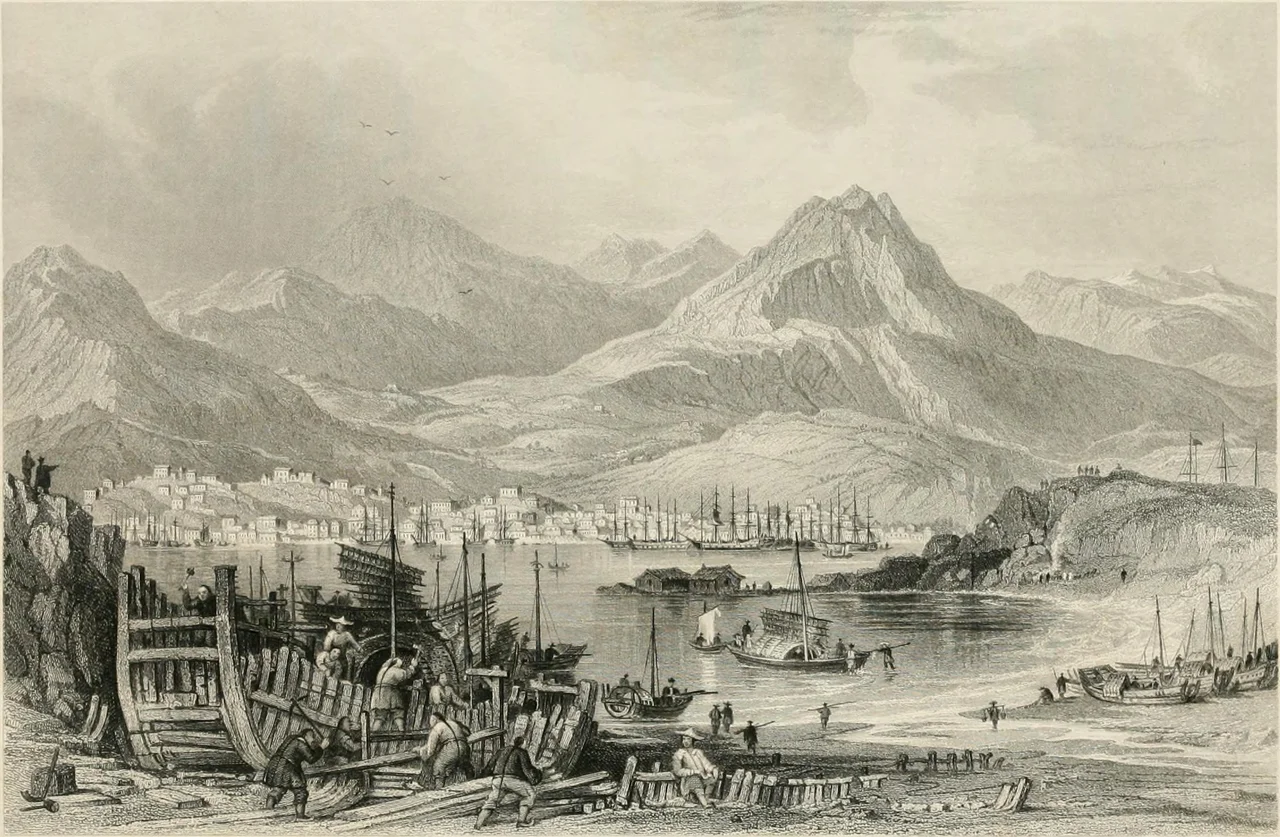

Battle of Kowloon
It started, as colonial conflicts so often did, with something much smaller than an empire. On 7 July 1839, a group of sailors from British merchant ships — crews of the *Carnatic* and the *Mangalore*, owned by Jardine, Matheson & Co. — came ashore in the village of Tsim Sha Tsui on the Kowloon Peninsula. After drinking *samshu*, a rice liquor, they got into a brawl. An innocent local man named Lin Weixi was beaten so severely that he died the following day. The sailors returned to their ships. Lin Weixi did not return to anything. What followed from his death was a chain of diplomatic failures, an embargo, an ultimatum, a brief naval exchange on September 4 — and, ultimately, the First Opium War, which would end with Britain acquiring Hong Kong.
A Death, an Embargo, and a Stalemate
Charles Elliot, the British Chief Superintendent of Trade in China, moved quickly after Lin Weixi's death. He offered $200 for evidence leading to the conviction of those responsible, $100 for information on the instigators, and $1,500 in direct compensation to Lin's family — a sum that included an additional $400 specifically to protect them from officials who might try to extort the money back. Imperial Commissioner Lin Zexu, representing the Qing Dynasty, demanded that British authorities hand over a specific culprit. Elliot declined. He convened a court on board the ship *Fort William* in Hong Kong harbour, presiding as judge with a panel of merchants as jury. Two men were convicted of rioting and sentenced to hard labour in England; three others received sentences for assault. When those men arrived in England, however, the court's jurisdiction was ruled invalid and they were released. Lin Zexu, unsatisfied with a proceeding he had refused to observe and a punishment that evaporated on arrival, ordered a food embargo against the British fleet. By late August, some 2,000 people in over 60 ships sat in Hong Kong harbour without fresh provisions — European merchants, Asian *lascar* sailors, and British families among them.
Interpreter Between Two Ultimatums
On September 4, Elliot sailed to Kowloon in the 14-gun cutter *Louisa*, accompanied by the 6-gun schooner *Pearl* and a 1-gun pinnace from HMS *Volage*, seeking to break the embargo. Three Chinese men-of-war junks anchored off the shore blocked access to food. Elliot sent his interpreter, Karl Gutzlaff, forward by small boat to negotiate. Gutzlaff was a Prussian missionary who had spent years in China and spoke Cantonese and Mandarin; he was also a committed proponent of opening China to Western trade, which colored his interpretation of events that day. He went back and forth between the vessels for hours, carrying Elliot's demands and the Chinese officers' equivocations. At one point a Chinese spokesman told him plainly: they lacked authority to lift the embargo without approval from superiors. Gutzlaff's response — "Suppose you were without food for any length of time, and debarred from buying it, would you wait until the case was transmitted to the higher authorities?" — drew from the Chinese the acknowledgment: "Certainly nobody will like to starve, and necessity has no law." It was a human moment inside a diplomatic impasse. Nothing was resolved. Elliot's 2 p.m. ultimatum expired without result, and the British opened fire.
104 Rounds and a Stalemate
By 3:45 in the afternoon, shore batteries had joined the three junks in returning fire on the British vessels. By 4:30 p.m., the *Louisa* alone had fired 104 rounds. Running low on ammunition, the British began sailing away. The junks, larger than their opponents — the *Pearl* was half the size of the Chinese vessels and the *Louisa* a quarter — gave chase. The British re-engaged after resupplying from the *Volage* and the Chinese retreated to their original position. Three British sailors were wounded, none fatally. Chinese casualties were not recorded reliably: English sinologist Arthur Waley later analyzed the official Chinese reports sent to the Daoguang Emperor and found them to be largely fabricated, the officers having inflated enemy casualties to justify rewards and decorations. The emperor discovered the systematic deception only in 1841 — two years into the war the battle had helped start.
The First Shot and What It Started
Elliot chose not to press the advantage that evening. He wrote to the Kowloon shore authorities that he would hold them accountable for the consequences of continued embargo, circulating this statement publicly — a diplomatic gesture rather than an escalation. Provisions became available again within days, slightly more expensive than before, because the Chinese naval officers, now reluctant to risk another confrontation, accepted smaller bribes from local peasants to look away from trading activity. The larger consequence took years to unfold. The Battle of Kowloon is counted as the first engagement of the First Opium War. The war that followed would result in the Convention of Chuenpi of 1841 and eventually the Treaty of Nanking in 1842, by which Britain acquired Hong Kong Island in perpetuity. The peninsula where Lin Weixi had lived in the village of Tsim Sha Tsui — the same shore where the embargo ships anchored, where Gutzlaff rowed back and forth — was ceded to Britain in 1860 under the Convention of Peking, and occupied its own history from then on. What remained of Lin Weixi's name was a record in Charles Elliot's compensation receipts.
From the Air
The Battle of Kowloon took place off the southern tip of the Kowloon Peninsula at approximately 22.293°N, 114.171°E — the area now occupied by Tsim Sha Tsui, directly across Victoria Harbour from Central on Hong Kong Island. Flying east along the harbor at 2,000 feet, the narrow strait where the skirmish occurred is directly below: the dense urban grid of Tsim Sha Tsui on the left, the towers of Central and the elevated highway of the Island on the right. The former Kowloon-Canton Railway Clock Tower, still standing on the Tsim Sha Tsui waterfront, is the nearest surviving landmark to the historical anchorage. Hong Kong International Airport (VHHH) lies approximately 32 km to the west-northwest on Lantau Island.
Nearby Stories
- Lok Ma Chau Loop 2.3 km away
- Portas do Cerco 2.3 km away
- Kweilin Incident 17 km away
- Wanshan Archipelago Campaign 34 km away
- Nanxiong Formation 115 km away
- Battle of Nanpeng Island 148 km away
- Heyuan 169 km away
- Cape Maobitou 632 km away