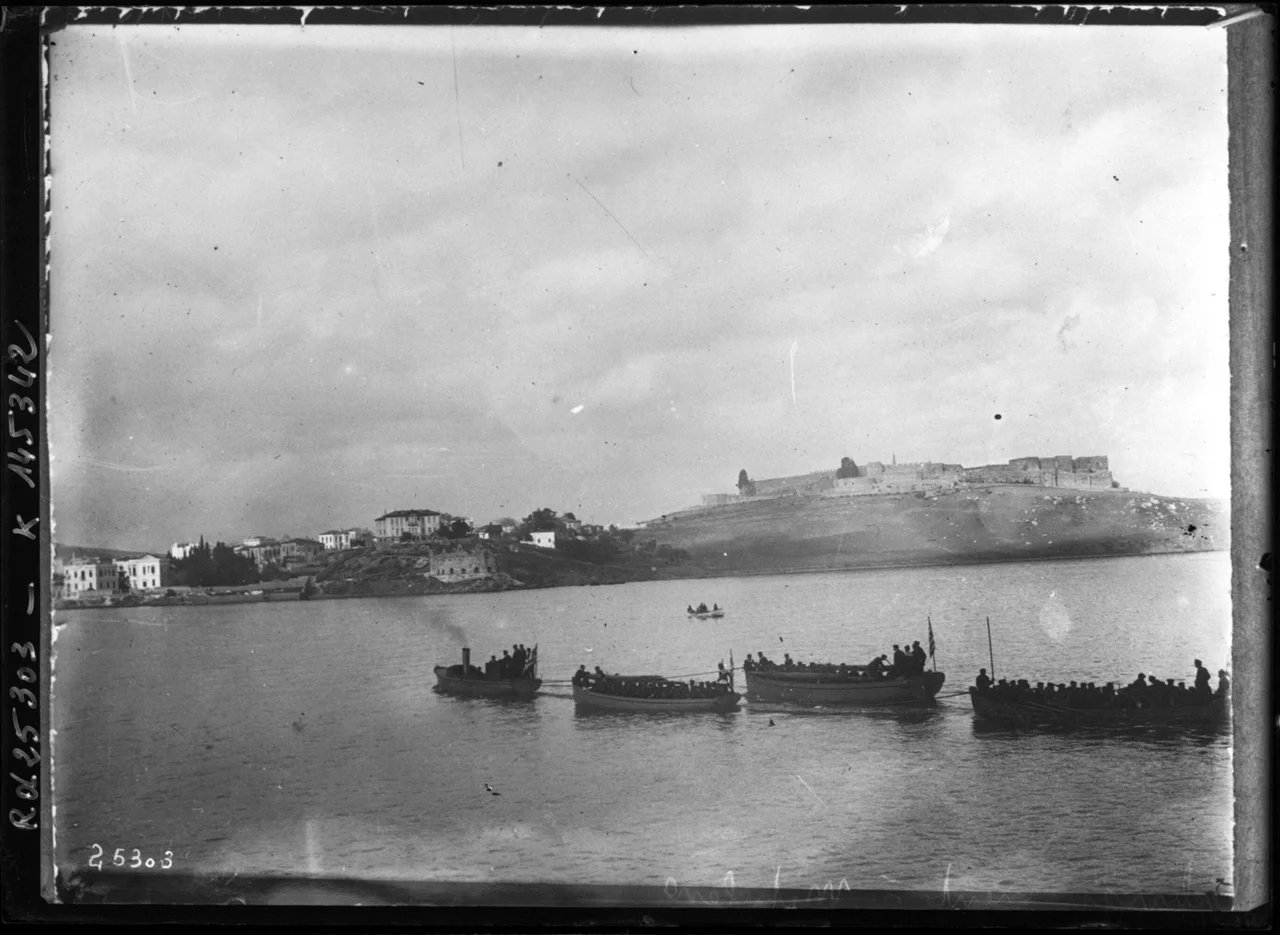

Battle of Lesbos (1912)
For 450 years, Lesbos had answered to the Sultan. The Ottomans took it in 1462 from the Genoese Gattilusio family, renamed it Midilli after its capital, and held it through the centuries while the rest of Greece fought its way to independence. Lesbos sat out that earlier struggle; the island was wealthy from trade, its Greek and Muslim communities lived in generally good relations, and many islanders spoke both Greek and Turkish. Then, in the late autumn of 1912, with the First Balkan War raging on the mainland, a Greek fleet appeared off Mytilene, and the long arrangement came to an end.
The Fleet Arrives
On 21 November 1912, Greek naval forces under Rear Admiral Pavlos Kountouriotis landed at Mytilene. The admiral had already seized Lemnos and thrown a blockade across the Dardanelles, bottling up the Ottoman fleet and leaving the Aegean in Greek hands. At Mytilene he issued an ultimatum, and after negotiations the Ottoman garrison was given time to abandon the city. Kountouriotis then sailed off with the bulk of his ships, leaving only a cruiser squadron and two destroyers, and a militia of local Greeks he had hastily formed. The capture of the capital was the easy part. The Ottoman troops, some fifteen hundred to two thousand men, had not surrendered. They withdrew fifty kilometers northwest to a fortified camp at Filia, well stocked with provisions and munitions, and there they prepared to hold the island's interior.
Village by Village
What followed was a slow, difficult campaign across winter terrain. The small Greek force at Mytilene was not strong enough to finish the job, so general headquarters sent reinforcements and placed the operation under Colonel Apollodoros Syrmakezis, who assembled roughly 3,175 men and eight guns. He split them into two columns, a southern one at Lambou Myloi and a northern one at Thermi, and pushed them toward Filia. The advance was hard. The southern column was halted by stiff Ottoman resistance near the Leimonas Monastery, while the northern column moved faster, reaching the camp's outskirts by nightfall. The fighting was not without cost to the island's people. As they retreated, Ottoman forces carried out reprisals against the local Christian population, most notably at Petra, where they set the houses aflame. These were villagers caught in a war between armies, and the burning of Petra remains part of what the island remembers.
Surrender at Filia
The end came in confusion. As both Greek columns prepared their final assault on Filia, an Ottoman envoy appeared asking for an armistice. It was granted, but when Major Abdul Ghani, the Ottoman commander, arrived, he denied having requested any negotiation and offered nothing. Reading this as a stall for time, Syrmakezis ordered the attack resumed at two in the afternoon. Then, at ten that night, the same envoy returned, this time carrying a letter of surrender signed by the garrison's officers. The instrument of surrender was formalized at eight the next morning, 21 December 1912. The whole campaign had cost the Greeks nine men killed and eighty-one wounded, a small toll for a strategic prize. Lesbos was, for the first time in nearly five centuries, no longer Ottoman.
The Long Diplomatic Tail
Winning the island and keeping it were two different matters. The Ottoman Empire refused to concede the Aegean islands it had lost, and their fate passed to the Great Powers under the 1913 Treaty of London. In February 1914 the Powers ceded most of them, Lesbos included, to Greece, withholding only Imbros and Tenedos near the Dardanelles. Even then the question festered. A naval arms race followed, and by the summer of 1914 a fresh Greco-Turkish war looked imminent, averted only by the outbreak of the First World War. When a German cruiser entered Ottoman service that August, she was pointedly renamed Midilli, the old Turkish name for Lesbos, a token of claims not yet abandoned. Only the Treaty of Lausanne in 1923 settled the matter for good, and made the island's place in Greece final.
From the Air
The Battle of Lesbos ranged across the island, centered near Filia at roughly 39.21°N, 26.28°E, about 50 km northwest of Mytilene. From the air the campaign's geography is legible: the capital and harbor of Mytilene in the southeast, the Gulf of Kalloni cutting into the center, and the inland hills toward Filia where the Ottoman camp stood. The nearest airport is Mytilene International (Odysseas Elytis), ICAO LGMT, in the far southeast. Best appreciated in clear conditions when the island's full breadth, from the eastern port to the interior battle line, is visible at once.
Nearby Stories
- Antandrus 6.8 km away
- Agios Isidoros, Lesbos 19 km away
- Adramyttium 30 km away
- Troy 45 km away
- Destruction of Psara 51 km away
- St. Helena Church 72 km away
- Psara 82 km away
- Battle of Athos 85 km away