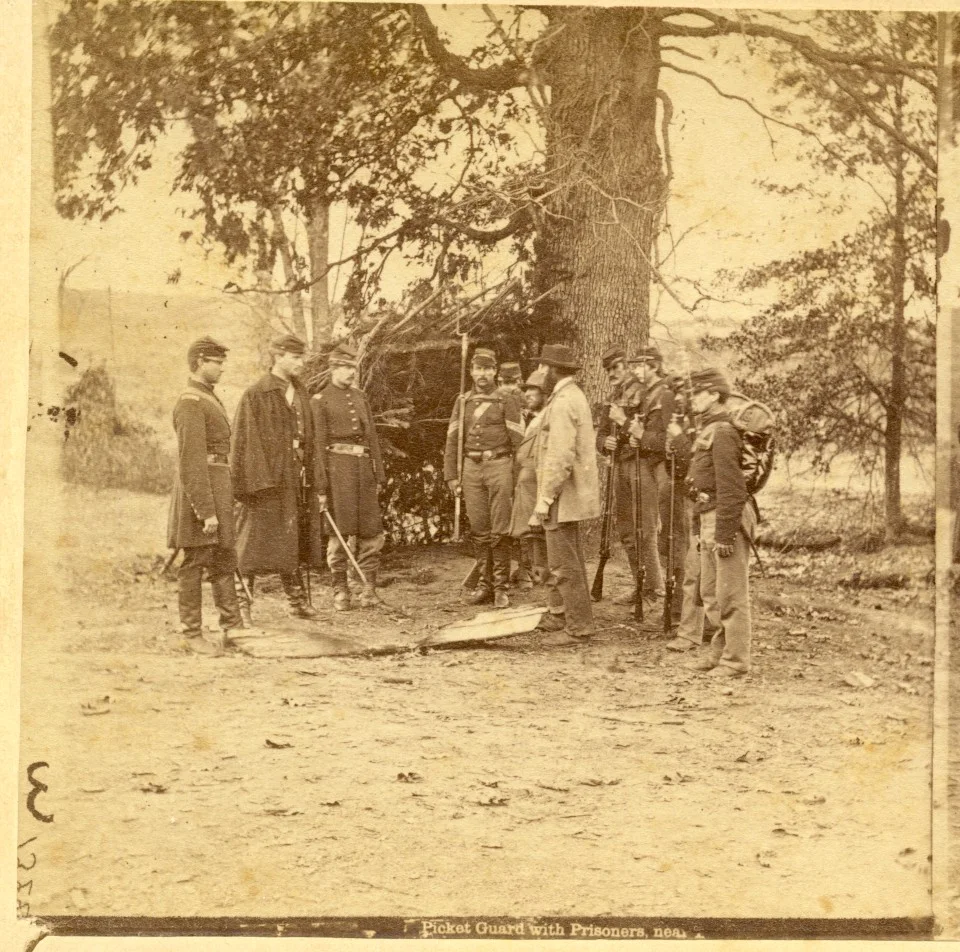

Battle of Lewinsville
Private John Mosby leveled his carbine and put a gaily dressed Union colonel in his sights. The man was riding a splendid horse through the September haze near a Fairfax County crossroads. Mosby was a scout, not yet the Gray Ghost he would become, and the chance was perfect. His commander, Colonel J.E.B. Stuart, leaned over and put a hand on the carbine. Don't shoot, Stuart whispered. He might be one of ours. Mosby never forgot the missed shot. He wrote later that he regretted nothing in his life so much. The colonel rode on. It was September 11, 1861, the Battle of Lewinsville was about to begin, and the man who became the Confederacy's most famous cavalryman was about to make his name.
After Bull Run
The first big battle was over and the Union had lost it. After Bull Run on July 21, 1861, Confederate forces pushed forward and took up positions across Fairfax County, settling at Munson's Hill, Mason's Hill, and other rises within sight of the new federal capital. From the Confederate works on Munson's Hill, sentries could see the unfinished dome of the Capitol on clear mornings. President Lincoln gave command of the Washington defenses to a young Mexican-American War veteran named George B. McClellan. McClellan threw himself into building forts, training raw volunteers, and slowly extending Union control southward. Lewinsville, a hamlet four miles west of the Chain Bridge, lay along the route a future army might take. On September 11, McClellan sent eighteen hundred men under Colonel Isaac Stevens to protect Lieutenant Orlando Poe of the Topographical Engineers while he mapped the ground.
The Highlanders Get Their Colors Back
Among Stevens's regiments was the 79th New York Infantry, known as the Highlanders, recruited from Scottish immigrants in New York City and famous for going into battle in kilts and tartan trews. A month earlier the Highlanders had mutinied over enlistment terms and unpaid wages. McClellan suppressed the revolt with artillery and cavalry, then stripped the regiment of its colors as punishment. The Highlanders carried no flag the morning they marched toward Lewinsville. By eleven they were skirmishing in the woods south of town. By midafternoon they were withdrawing under shell fire, in good order, having taken casualties without breaking. Their conduct that day earned the colors back. The flag was returned within weeks, and the Highlanders would carry it through every major eastern campaign that followed.
Stuart's New Tactic
On the Confederate side, Stuart commanded fewer than five hundred men. He had three hundred infantry under Major James Terrill, two cavalry companies of the First Virginia, and a section of artillery under Captain Thomas Rosser. What made Lewinsville different from earlier skirmishes was how Stuart used those guns. Instead of holding artillery in reserve, he brought it right up with the cavalry, fired into the Union flank at close range, then pulled out before the Federals could respond effectively. It was the kind of fluid, aggressive employment of combined arms that his superiors Joseph Johnston and P.G.T. Beauregard had initially resisted. James Longstreet, Stuart's immediate commander, praised the action and forwarded a recommendation for promotion. Two weeks later, Stuart became a brigadier general and was given the entire mounted force of the Confederate army in Virginia. The cavalry he would shape from that command would dominate the eastern theater for nearly two years.
A Nonconclusive Exchange
Officially, the day ended without a clear winner. The Union mission completed its mapping and withdrew. The Confederates inflicted several casualties without losing a man. Both sides claimed victory in newspaper reports. Historians describe Lewinsville as a nonconclusive exchange of fire. Yet within the small action, the future shape of the war became visible. Stuart, Rosser, Terrill, Stevens, and Griffin would all become generals. Orlando Poe would become William Tecumseh Sherman's chief engineer for the March to the Sea. Isaac Stevens would die a year later carrying his regiment's flag at the Battle of Chantilly. John Mosby would slip behind Union lines and become the cavalry commander Federal forces could never catch. The lieutenant Mosby almost shot rode on through the September smoke, unaware how close he came.
What Survives at Lewinsville
Modern Lewinsville is a residential corner of McLean, swallowed by Northern Virginia suburb. The old crossroads survives as the intersection of Chain Bridge Road and Great Falls Street. A historical marker commemorates the action. Just south, the Lewinsville Presbyterian Church, founded in 1846 and used as a hospital during the war, still stands and still holds services. Most of the woods where the skirmishers crept have been replaced by single-family homes, but a few patches of forest along the streams that drain toward the Potomac suggest the country the soldiers crossed. The Chain Bridge they used to cross the river is still there too, rebuilt many times since 1861, still carrying traffic between Virginia and the District.
From the Air
The Lewinsville battlefield centers at 38.9282 degrees north, 77.1910 degrees west, in McLean, Virginia, about four nautical miles northwest of the Pentagon. Best viewed at 2,500 feet AGL with the Potomac and the Chain Bridge visible to the east. Reagan National (KDCA) is about seven nautical miles southeast; Dulles (KIAD) is fifteen miles west. The site lies just outside the P-56 prohibited area but inside the Washington Class B veil; overflight requires approach clearance from Potomac TRACON.
Nearby Stories
- Gunston Hall 1.1 km away
- 2023 Baltimore Shooting 4.9 km away
- Battle of Middleburg 6.6 km away
- Crownsville Hospital Center 10 km away
- Battle of Loudoun Heights 13 km away
- First Battle of Rappahannock Station 20 km away
- Howard County, Maryland 21 km away
- Harriet Tubman Underground Railroad 50 km away