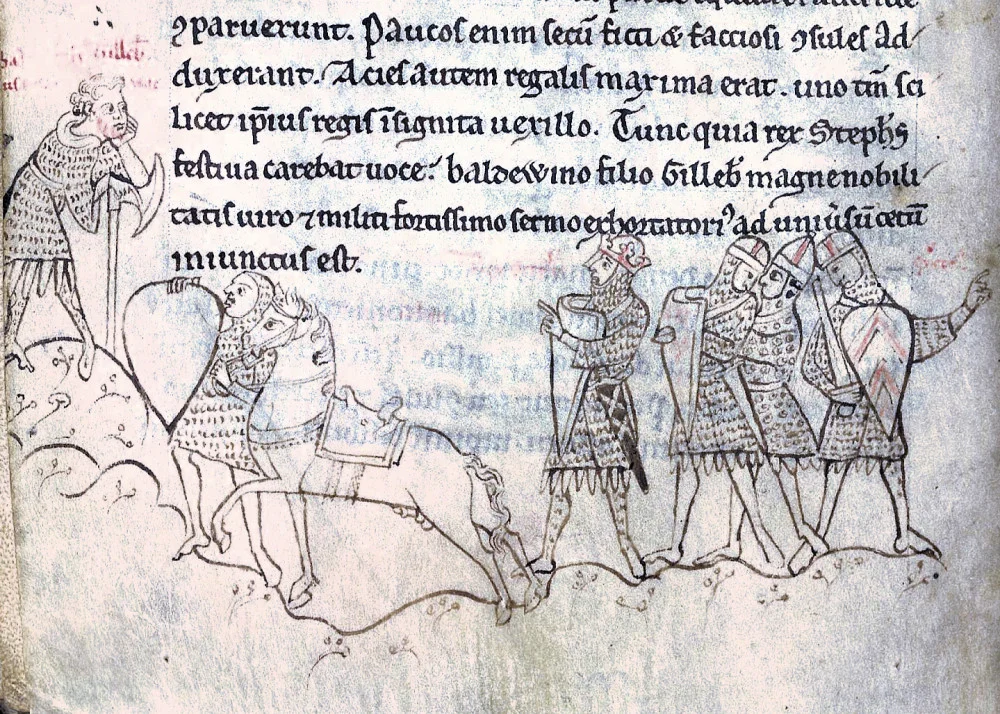

Battle of Lincoln (1141)
It is rare for a reigning King of England to be captured in battle. It has happened twice. The first time was here, beneath the walls of Lincoln Castle, on 2 February 1141 - and the man who would not yield until the last moment was King Stephen, fighting on foot with a battle-axe while the earls who were supposed to protect him spurred their horses away to safety. The chroniclers who watched him remembered the courage even as they cataloged the disaster. Stephen lost his army, lost his crown, lost his freedom, and lost the war - all in a single afternoon - and yet somehow managed to keep his dignity, which in twelfth-century England was almost as valuable.
The Anarchy
England in 1141 was six years into the civil war that historians now call the Anarchy. The trouble had started when King Henry I, who had a single surviving legitimate child - his daughter Matilda - died in 1135 and tried to leave the throne to her. The Anglo-Norman barons had sworn oaths to support her. They had also sworn oaths to themselves that they would never accept a woman as their ruler. Stephen of Blois, Henry I's nephew, exploited the gap. He raced to be crowned before Matilda could even arrive in England from Normandy, and for five years he held the throne while Matilda's supporters - chief among them her formidable half-brother Robert of Gloucester - slowly built a counter-claim from the west. By the start of 1141 the war had stalemated. Stephen was besieging Lincoln Castle, which Ranulf of Chester had treacherously seized for himself. Robert of Gloucester was marching to relieve it. They would meet just outside the city on the morning of Candlemas.
A Plan That Held
Robert's army was a coalition. He had his own household troops. He had Ranulf of Chester's men - including Ranulf himself, who would lead from the centre in bright, conspicuous armour. He had a contingent of knights described in the chronicles as "the disinherited," men whom Stephen had stripped of their estates and who therefore had nothing to lose. And he had a mass of Welsh foot soldiers under Madog ap Maredudd, Lord of Powys, and Cadwaladr ap Gruffydd, brother of Owain of Gwynedd - lightly armed but, as the chroniclers put it, "full of spirits." Stephen had a normal feudal host, drawn from a swathe of earldoms. He was short of cavalry. He arranged his army with the magnates in command of the wings and himself with his household knights in the centre. The Welsh struck first. They were broken by the cavalry of William of Aumale of York and William of Ypres on the left. But then Ranulf of Chester, the man in the bright armour, smashed Aumale's force "in a moment." One after another the earls on Stephen's flanks broke and fled the field. The chronicler is unsparing: it was the earls who fled.
The King Fights On
The barons of the second rank stayed - Baldwin fitz Gilbert, Bernard de Balliol, Roger de Mowbray, Richard de Courcy, William Peverel of Nottingham, Gilbert de Gant, Ingelram de Say, Ilbert de Lacy, Richard fitzUrse, all from respected baronial houses - and so did the king. With his cavalry stripped away, Stephen dismounted and fought on foot in the centre of his collapsing line. The Angevin army closed around him. The chronicles agree on one detail: Stephen's sword broke in the press, and a citizen of Lincoln handed him a heavy two-handed battle-axe, with which the king continued to fight as the ring of enemies tightened. He was eventually felled by a stone thrown from behind, and even then he yielded only when summoned by a knight, William de Cahaignes, who would take the official credit for capturing the king. Baldwin fitz Gilbert and Richard fitzUrse, the chronicler writes, having received many wounds and gained immortal honour by their resistance, were taken alive. The rest of Stephen's centre was killed or captured to the man.
The Prisoner of Bristol
Stephen was bundled out of the city, taken westward, and lodged in the castle at Bristol - in chains, eventually, when his captors decided he had tried to negotiate too freely. Matilda, his cousin, was now effectively queen. She was crowned Lady of the English at Winchester in April. She prepared for her formal coronation in London for the summer. And then she lost everything as quickly as she had won it: the Londoners turned on her, she fled to Oxford, and her brother Robert of Gloucester was himself captured in September during the Rout of Winchester - by, fittingly, the wife of the imprisoned king. Stephen was exchanged for Robert. The two halves of the war reset. The civil war ground on for another twelve years, finally ending with the Treaty of Wallingford in 1153, when Stephen agreed to leave the throne to Matilda's son rather than his own. That son became Henry II. The Plantagenet dynasty - England's longest - traces directly to the wreckage of the day that Stephen swung a battle-axe outside Lincoln.
Walking the Ground Today
The site of the battle is not precisely known. The chroniclers tell us the Angevin army crossed the Fossdyke - a Roman canal still running west out of the city - and the main fighting probably happened on the open ground west of Lincoln Castle, near where Robert of Gloucester's force assembled. The castle itself, where Ranulf and his garrison watched from the walls, still stands as one of only two English castles built by William the Conqueror with two motte mounds. The chroniclers' description of Stephen being captured "after fierce fighting in the city's streets" suggests the final stand happened uphill, in the medieval quarter that now surrounds Steep Hill and the cathedral. Ken Follett novelized this exact battle in The Pillars of the Earth, and Sharon Penman did the same in When Christ and His Saints Slept. The 2021 video game Age of Empires IV reproduces it as a campaign mission. The day is still alive in popular memory because the human shape of it - a king fighting on foot when his nobles ran - reads like myth, except that it is documented in three separate chronicles. The king kept his honour. He lost his kingdom in the doing.
From the Air
The Battle of Lincoln (1141) was fought in and around the city of Lincoln, with the actual ground probably on the western and northwestern approaches to Lincoln Castle near where the modern road network crosses the line of the Roman Fossdyke. Coordinates 53.235°N, 0.555°W mark a point on the western approach. The terrain is gentle limestone uplands, with the city itself rising steeply from the River Witham toward Lincoln Cathedral on the ridge above. Recommended viewing altitude is 2,000 to 4,000 feet AGL, allowing the visual sweep from the cathedral and castle (high on the bluff) down across the Fossdyke and west toward the Trent valley. Nearby airfields include RAF Waddington (EGXW) about six nautical miles south, RAF Scampton (EGXP) seven nautical miles north-northwest, and Humberside Airport (EGNJ) twenty-five nautical miles north-northeast. Visibility along the Cliff escarpment is usually good in clear weather.
Nearby Stories
- Louth Navigation 2.9 km away
- Major Oak 3.6 km away
- Grantham Rail Accident 8 km away
- South Yorkshire Aircraft Museum 9.3 km away
- Gotham, Nottinghamshire 11 km away
- Alford Windmill 16 km away
- RAF Binbrook 21 km away
- Wisbech 29 km away