
Battle of Lincoln (1217)
Picture a seventy-year-old man strapping on a helmet, swinging onto a warhorse, and leading the charge that decides who will rule England. That is not a metaphor. On 20 May 1217, William Marshal, Earl of Pembroke, around seventy years old and serving as regent for a nine-year-old king, rode at the head of an English relief army into the streets of Lincoln to break a French siege. He had been a famous tournament champion in his thirties. He had served four kings before this one. His son had to remind him to put his helmet on. By nightfall the French commander was dead, half the rebel barons of England were prisoners, and the Plantagenet line - and with it the Magna Carta England that had only just been wrenched out of King John - had a future after all.
How England Almost Became French
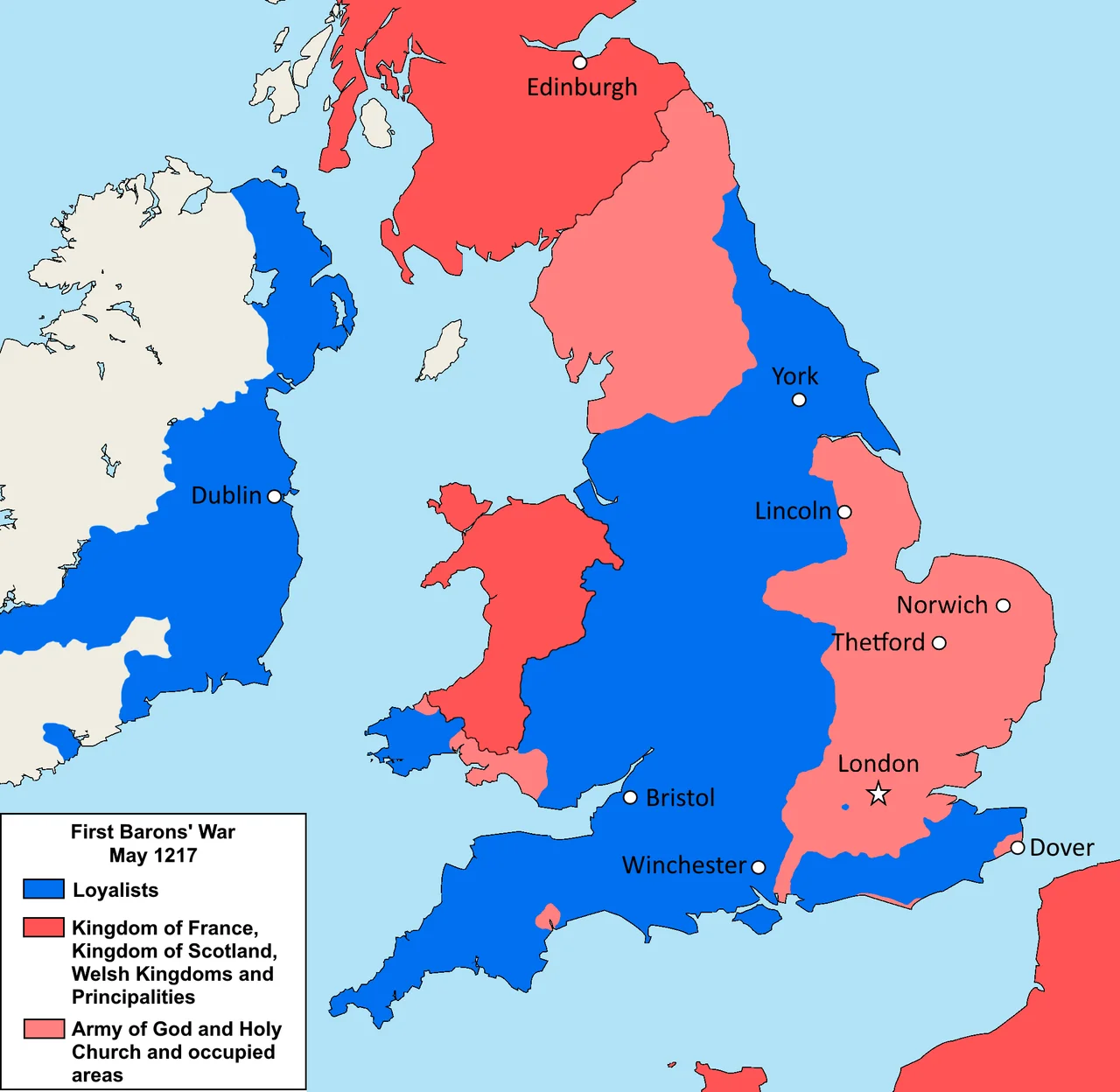
In the autumn of 1215, King John had broken his promises in Magna Carta within weeks of sealing the charter. The rebel barons who had forced him into it concluded they could no longer trust him as king and invited Prince Louis of France - heir to the French throne and married to King John's niece - to come and replace him. Louis landed in Kent in May 1216, took London without a fight, and was proclaimed King of England in St Paul's. He held more than half the country, including most of the major cities, by autumn. Then in October 1216, King John died suddenly of dysentery in Newark. His nine-year-old son Henry was crowned Henry III in a hurried ceremony at Gloucester, using a circlet of his mother's, because the crown jewels had been lost in the Wash. The regency went to William Marshal, the senior surviving statesman of the Angevin court - an old man who had once knocked the future Richard the Lionheart off his horse in a skirmish and who had served every Plantagenet king since Henry II. He was now asked to save Henry's kingdom for him.
Why Lincoln Mattered
Medieval Lincoln sat astride a critical road junction - the crossing of Ermine Street, the great Roman highway running London to York, with the Fosse Way, the equally Roman road running Exeter to Lincoln. Whoever held Lincoln effectively held the spine of northern England. William the Conqueror had understood this and built Lincoln Castle on the hill above the old Roman fort in 1068 to anchor Norman control of the region. By May 1217, Louis's rebel forces had taken the city of Lincoln - the streets, the shops, the cathedral close - but Lincoln Castle was holding out. Its castellan was not a man but a woman: Nicola de la Haie, a hereditary sheriff of Lincolnshire, who had inherited the constableship from her father and was now in her sixties, refusing to surrender the keep to Thomas, Count of Perche, the French commander camped at her gates. King John had visited her shortly before he died and confirmed her in her office. She had given her word. She would keep it.
The Charge
Marshal mustered his army at Newark - about 400 knights, 250 crossbowmen, and a larger force of mounted and foot auxiliaries. He marched on Lincoln from Stow, eleven miles to the northwest. The French and rebel forces inside the city had been told the relief army was coming and prepared accordingly, but underestimated its size. The strategy was simple. Falkes de Bréauté, one of Marshal's captains, would slip his crossbowmen into the besieged castle through the western gate, where they would rain bolts down onto the rebels in the streets below. Marshal and the main force would smash through the north gate and pour into the city. There is a story, recorded by his biographer, that Marshal was so eager he charged in without his helmet and had to be called back by his son to put it on. Whether or not the detail is precise, the spirit of it is documented across multiple accounts: the old man led from the front. The rebel knights, caught between Marshal's cavalry charging downhill and Falkes's crossbow bolts striking from above, broke. Thomas, Count of Perche, was killed - the chronicles say struck through the eye-slit of his helm - while attempting to rally the French. Many of his barons surrendered.
The Lincoln Fair
Then came the part of the day that the chroniclers, looking back, called the Lincoln Fair - their wry name for the systematic looting that followed. The justification was that the citizens of Lincoln had welcomed Louis and supplied his forces, making the city itself fair plunder under the rules of medieval warfare. The reality was that Marshal's army stripped the city, including its cathedral close, of everything portable. The merchants and townspeople of Lincoln paid a terrible price for choosing the wrong side - their goods carried out, their warehouses broken open, their houses pillaged through the long May evening. It is worth saying plainly: the people who suffered most that day were not the French knights or rebel barons but the ordinary citizens of Lincoln, whose only crime was having lived through a siege. The chroniclers gave the looting its festive nickname because they wrote for noble patrons; for the families who watched their city emptied, it was no fair.
What Marshal Saved
The French reinforcement fleet was destroyed three months later at the Battle of Dover by Hubert de Burgh - a sea-battle remembered for English crossbowmen firing through powdered lime that the wind carried into the eyes of the French marines. With his army broken at Lincoln and his reinforcements at the bottom of the Channel, Louis had no choice. In September 1217 the Treaty of Lambeth sent him home in exchange for ten thousand marks and a promise that he would never again claim the English throne. The boy-king Henry III ruled for fifty-six more years and presided over the rebuilding of Westminster Abbey. The Magna Carta that his father had violated and disowned was reissued under Henry's seal and entered English constitutional tradition for good. The Plantagenet line continued for nearly three more centuries. William Marshal, by then loaded with honour and exhausted, died in 1219 - just two years after Lincoln. His tomb effigy lies in Temple Church in London, his hand still gripping a sword. Without his charge at Lincoln, the kings on English coins for the next eight hundred years would have spoken French.
From the Air
The Battle of Lincoln (1217) was fought in the streets and around Lincoln Castle, on the limestone ridge above the River Witham in the heart of the modern city. Coordinates 53.2333°N, 0.5387°W mark the castle, with Lincoln Cathedral immediately east of it. From the air, the castle bailey and the great west front of the cathedral together form an unmistakable medieval complex visible for miles across the Witham valley. Recommended viewing altitude is 2,000 to 4,000 feet AGL to capture the ridge-and-valley topography that gave Lincoln its strategic importance. Nearby airfields include RAF Waddington (EGXW) about five nautical miles south, RAF Scampton (EGXP) seven nautical miles north-northwest, and Humberside Airport (EGNJ) twenty-six nautical miles north-northeast. The Lincoln Cliff escarpment running north from the city makes a clean horizon line in clear weather.
Nearby Stories
- Louth Navigation 2.9 km away
- Major Oak 3.6 km away
- Grantham Rail Accident 8 km away
- South Yorkshire Aircraft Museum 9.3 km away
- Gotham, Nottinghamshire 11 km away
- Alford Windmill 16 km away
- RAF Binbrook 21 km away
- Wisbech 29 km away