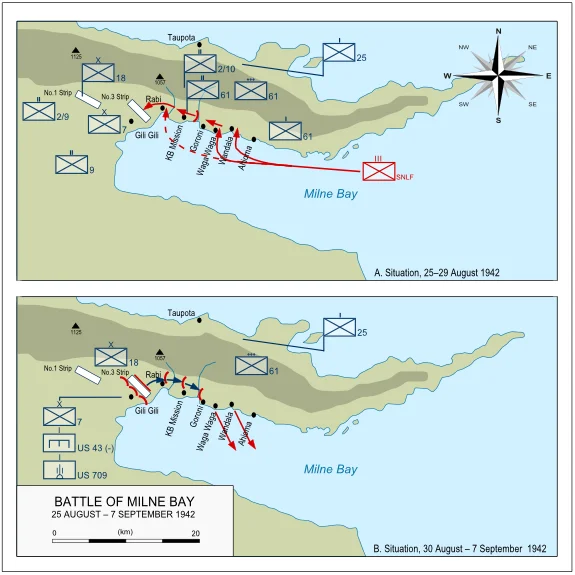

Battle of Milne Bay
For nine months the Japanese had not been stopped on land anywhere in the Pacific. They had taken Hong Kong, Malaya, Singapore, the Philippines, Java, Rabaul. Then, at the eastern tip of New Guinea, in a ninety-seven-square-mile coconut plantation that had been turned into a bog by two hundred inches of annual rain, Australian troops did what no army had managed to do in the Pacific theatre - they pushed a Japanese landing force completely off its objective and sent it back to the sea. The fighting lasted from the night of 25 August to 7 September 1942. Thirteen days of tanks stuck in mud, sticky bombs that would not stick in humid air, infantry grenades rolled down jungle hillsides, and a Japanese force that had come ashore expecting to face three companies of defenders and instead met two brigades. When it ended, the Allied world had its first clear Pacific land victory, and British Field Marshal William Slim later wrote that the men at Milne Bay had proven the Japanese soldier could be beaten - a thing not at all self-evident in the autumn of 1942.
The Bay That Became a Base
Milne Bay sits at the exact southeastern tip of the Territory of Papua, a sheltered inlet twenty-two miles long and ten wide, deep enough for ocean-going ships. In the early months of 1942, with the Japanese pushing down through the Bismarck Archipelago and trying to take Port Moresby, General Douglas MacArthur needed forward air bases from which to protect New Guinea. An Australian officer, Major Sydney Elliott-Smith, suggested Milne Bay as a more practical site than the originally planned Abau. A Catalina flying boat dropped a survey party on 8 June 1942. They came back enthusiastic. The flat ground near the head of the bay - covered in coconut palms, coco, and palm oil plantations - could take airstrips. There were jetties. There were villages linked by a ten-foot-wide dirt track that MacArthur's staff grandly called a road system. By the end of June, Dutch KPM steamers were unloading Australian infantry, American engineers, and anti-aircraft guns onto a pontoon wharf built hastily of petrol drums. The codename for the new base was Fall River. Early shipments of supplies were mistakenly sent to Fall River, Massachusetts.
What the Japanese Thought They Knew
By mid-August the Japanese high command had decided to take Milne Bay from the Allies before the airstrips became operational. Their intelligence assessment concluded that the new base was defended by two or three companies of Australian infantry - perhaps three hundred to six hundred men. The Japanese assembled a landing force of roughly that size to match it: 612 naval infantry from the 5th Kure Special Naval Landing Force, 197 more from the 5th Sasebo SNLF, and a separate force of about 350 meant to land at Taupota on the north coast and flank the airfields overland. They added two Type 95 light tanks for fire support. What the Japanese did not know was that Australian code-breakers under Commander Eric Nave, using Ultra intelligence, had read the plan in full - the timing, the units, the ship names. MacArthur rushed the 18th Infantry Brigade to Milne Bay. By the time the Japanese landed, the defending force at Milne Bay numbered 7,459 Australians and 1,365 Americans, with about 4,500 infantry. The Japanese were coming ashore outnumbered roughly nine to one, and they did not know it.
Landings in the Rain
The force that was supposed to land at Taupota never got there. On 24 August the 350 men of the 5th Sasebo SNLF beached their landing craft on Goodenough Island, about a hundred miles north, to rest through the daylight hours. A coastwatcher at Cape Nelson reported them. Nine RAAF Kittyhawks of No. 75 Squadron found them at midday, destroyed all seven landing craft with strafing runs, and left them stranded - a group of men who would spend the next two months as the unintended subject of a different campaign. The main Japanese force came ashore at Waga Waga on the night of 25 August, three kilometres east of their intended landing site, in the middle of the kind of tropical thunderstorm Milne Bay stages every evening in the wet season. They moved west along the coastal track before dawn, with their two tanks leading. They hit the Australian Militia positions of the 61st Infantry Battalion at KB Mission at first light. Australian troops without anti-tank weapons tried to stop the tanks with sticky bombs - anti-tank devices that were supposed to adhere to armour plate. In the equatorial humidity, the adhesive failed. The bombs slid off.
Tanks in the Mud
For six days the fighting moved back and forth along a track that turned, with every heavy shower, into what one Australian officer called a glutinous mud quagmire. The Japanese pushed the Militia units back through KB Mission and along the Gama River towards the half-built No. 3 Airstrip at Kilarbo. At dawn on 28 August they launched their main assault on the airstrip itself. Their two tanks, advancing through the swampy approaches at the runway's end, bogged down and had to be abandoned. An Australian patrol found them there the following day, silent in the ooze. Without armoured support, the Japanese infantry charged across the open airstrip into machine-gun fire from the Australian 25th and 61st Battalions and the American 709th Anti-Aircraft Battery - the first U.S. Army ground combat in New Guinea. They made a second charge. A third. Each one failed. The commander of the Japanese naval landing force, Commander Shojiro Hayashi, was killed during these assaults. Command passed to Minoru Yano, who had arrived with reinforcements two days earlier. The Japanese force that had come ashore sure of its numerical mismatch was now broken by it.
Corporal French at Goroni
The Australian counterattack began on 31 August. The veteran 2/12th Infantry Battalion - men from Queensland and Tasmania who had fought in the siege of Tobruk - moved east through the mud under sniper fire, retook KB Mission, and pushed on. Four days later, at a place called Goroni, the 2/9th Battalion ran into three Japanese machine-gun positions dug into a stream bank. Corporal John French ordered his section to take cover. He went forward alone, grenading two of the gun positions. He then attacked the third with his Thompson submachine gun, and was mortally wounded in front of it. When the Australian section advanced, they found the Japanese gunners dead and French still conscious, able to speak, aware of what he had just done. He died shortly afterwards, and was posthumously awarded the Victoria Cross. He was twenty-eight. By the end of 4 September the Japanese force had about fifty fully fit soldiers left. All the company commanders were dead. On the night of 5 September the Japanese high command ordered the survivors evacuated.
Why It Mattered
The numbers are these. The Japanese lost approximately 750 men killed, the Australians 167 killed and 206 wounded, with 14 more missing. In terms of the enormous battles of the Pacific war that were still to come, these are modest figures. But Milne Bay was the first fight in which Allied land forces did not simply resist a Japanese attack, they decisively defeated it and drove it from its objective entirely. The earlier setbacks the Japanese Army had taken elsewhere in the Pacific had been local and had not forced abandonment of the strategic goal. This one did. After the battle, British Field Marshal William Slim wrote that Australian soldiers at Milne Bay had given the Allies their first proof that the Japanese Army could be beaten in the jungle. The psychological weight of that proof, in September 1942, with the Pacific war nine months old and mostly going the wrong way, was enormous. Milne Bay itself became a major Allied staging base for the rest of the war - the eventual launching point for operations against Buna, Gona, and Lae. And the stranded Japanese force on Goodenough Island, forgotten nowhere but relentlessly watched, would be dealt with in October by the same 2/12th Infantry Battalion that had just walked out of this fight.
From the Air
The battle area is centered near 10.32S, 150.48E at the head of Milne Bay, Papua New Guinea's southeastern tip. Gurney Airport (GUR/AYGN) at Alotau sits on the ground where No. 3 Airstrip was fought over in August-September 1942; the modern town of Alotau is roughly where Gili Gili stood. The bay is a long sheltered inlet running east-west, flanked by the Stirling Ranges to north and south rising to 3,000 feet. KB Mission, Waga Waga, and Rabi villages lie along the north shore. Rainfall around 200 inches annually creates persistent afternoon buildups; the wet season is November through April. Cloud bases frequently below 2,000 feet in weather.
Nearby Stories
- Samarai 8.1 km away
- Milne Bay Province 13 km away
- D'Entrecasteaux Islands 42 km away
- Tufi 136 km away
- Misima Island 173 km away
- Woodlark Island 202 km away
- Louisiade Archipelago 224 km away
- Cod Hole 666 km away