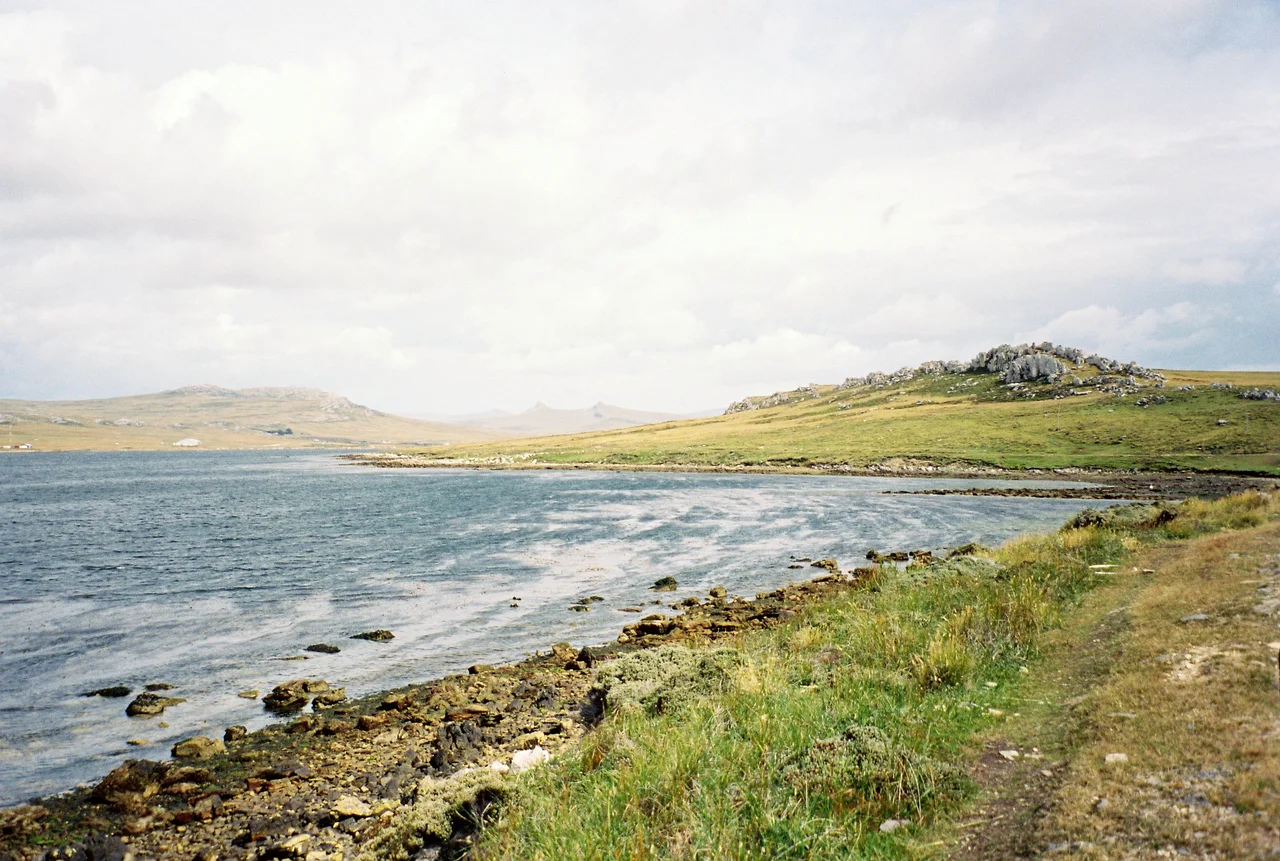

Battle of Mount Tumbledown
Pipe Major James Riddell composed the tune during the battle, scribbling it on the back of a cigarette packet between bursts of fire. When the shooting stopped he climbed near the summit of Mount Tumbledown and played his bagpipes over ground where men had died hours before. He called the march The Crags of Tumbledown Mountain. The crags were the whole problem: a spine of rock and frozen peat rising directly west of Stanley, held by some of the best troops Argentina had on the islands, and the last serious obstacle between the British advance and the capital. Taking it would end the war. Doing so would cost a night of close, brutal fighting in the dark.
The Last High Ground
By mid-June 1982, the British had fought their way across East Falkland and stood within sight of Stanley's street lights. Tumbledown, Mount William, and Sapper Hill were the final ridges guarding the town, and whoever held them held the city. The job of taking Tumbledown fell to the 2nd Battalion, Scots Guards, with four light tanks of the Blues and Royals, Gurkhas in reserve to seize Mount William, and the Welsh Guards waiting to push through to Sapper Hill. The defenders were no conscript afterthought. Commander Carlos Hugo Robacio's 5th Marine Infantry Battalion was cold-weather trained, well dug in, and reinforced to brigade strength. A daylight assault up that long, exposed slope, the British commanders agreed, would be suicidal. They would go in at night, in silence.
Pipes and Drums in the Dark
The attack opened with a feint. Major Richard Bethell, a former SAS officer, led the battalion's Reconnaissance and Pipes and Drums platoons in a diversionary assault on the lower slopes of Mount William, backed by the light tanks. It was a strange sight: regimental musicians fighting as infantry in the South Atlantic night. The firefight that followed was real enough - two hours of hard contact, two Guardsmen killed, a tank disabled by a landmine, and a long withdrawal back through a minefield under mortar fire. Soft peat absorbed many of the shell bursts and saved lives, but the diversion still cost two dead and sixteen wounded. It had done its work, drawing Argentine attention south while the main assault formed up to the west.
Crag to Crag
At nine in the evening, G Company began its two-mile advance and found the western end of Tumbledown undefended. Then Major John Kiszely's Left Flank pushed into the centre of the ridge and the mountain came alive. Argentine Marines and Army platoons - veterans of earlier fighting on Two Sisters and Mount Harriet - poured mortar, machine-gun, and grenade fire from the rocks. For four or five hours the attack stalled. The defenders held their bunkers, singing the Marcha de las Malvinas and shouting in English between volleys. Kiszely finally broke the deadlock himself, leading a bayonet charge into the Argentine position; he was the first man in, and the sight of their company commander among the enemy drove the rest of his men across the open ground. For a moment he and six Guardsmen stood on the summit, looking down on Stanley's lit streets - then a counterattack swept in, and a burst of machine-gun fire struck the compass on his belt. Kiszely was awarded the Military Cross.
Until the Order to Stop
Dawn did not end it. On the eastern crags, Lieutenant Robert Lawrence led 3 Platoon's bayonet charge to clear the last positions - and at the moment of victory a single round struck the side of his head. He survived, but spent a year confronting the wounds; his story later became the BBC film Tumbledown, with Colin Firth in the lead role. The Argentine defenders fought their retreat hard. One conscript, Private Oscar Poltronieri, covered his comrades' withdrawal with such courage across Two Sisters and Tumbledown that he received Argentina's highest military decoration - the only conscript of his generation to earn it. In the end it was a senior Argentine officer who called the fighting off, ordering the Marines back into Stanley rather than throw away more lives. The 2nd Battalion, Scots Guards lost eight men killed and dozens wounded. Within hours, Stanley fell and the war was over. A cross now stands at the summit, and every name on it belonged to someone's son.
From the Air
Mount Tumbledown rises just west of Stanley at roughly 51.70 degrees south, 57.97 degrees west, a low but rugged rock-and-peat ridge that dominates the western approaches to the Falklands capital. From the air it forms part of a chain of hills - Two Sisters, Mount Harriet, Tumbledown, Mount William, and Sapper Hill - that screen the town; the summit memorial cross marks the high ground the Scots Guards took. Recommended viewing altitude is 3,000 to 5,000 feet to read the relationship between the ridgeline and Stanley below. Stanley Airport (ICAO SFAL, IATA PSY) lies a few nautical miles to the east; RAF Mount Pleasant (ICAO EGYP, IATA MPN) is about 20 nautical miles to the southwest. Expect strong winds, fast-moving cloud, and short winter daylight - and note that uncleared minefields from the war remained fenced off across this terrain for decades.
Nearby Stories
- Volunteer Point 3.8 km away
- Argentine Military Cemetery 40 km away
- Sea Lion Island 67 km away
- Pebble Island raid 89 km away
- HMS Sheffield (D80) 118 km away
- Sinking of ARA General Belgrano 447 km away
- South Georgia Island 1404 km away
- Villa Gesell 1585 km away