.jpg)
Battle of Newburn
Charles I lost his throne at a river crossing near Newburn six miles from Newcastle. He didn't know it yet on 28 August 1640. He still had nearly nine years to live, a civil war to fight and lose, and a scaffold at Whitehall waiting. But the battle that began that afternoon at low tide on the River Tyne would force him to recall the English Parliament he had ruled without for eleven years. That Long Parliament, once summoned, refused to be dismissed. Everything that followed - the Civil War, the regicide, the Republic - flowed from a Scottish artillery position on a hill north of the Tyne ford.
The Bishops' Wars
The trouble had started over prayer books. In 1638, after years of Charles imposing Anglican-style reforms on the Scottish kirk, signatories to the National Covenant vowed in Edinburgh to resist any further changes; bishops were expelled from the Scottish church in December. Charles tried to crush the Covenanters militarily in 1639 - the First Bishops' War, which fizzled to an inconclusive Treaty of Berwick. In April 1640 he recalled the English Parliament for the first time in eleven years to fund a second campaign. Parliament refused him taxes without concessions and was dissolved after three weeks. Charles went to war anyway. His English army, raised in the south, was poorly equipped, unpaid, and openly mutinous; on the march north some units murdered officers suspected of being Catholics, then deserted. The Scottish Covenanter army that crossed the Tweed on 17 August 1640 under Alexander Leslie was 20,000 strong, experienced, and well led.
The Wrong Ground
Lord Conway, the English commander, had nowhere near enough men to defend Newcastle and meet Leslie's army in the field. Newcastle's strong defences sat north of the river; the south bank was weaker. Leslie chose to cross the Tyne at Newburn, a small village six miles upstream, where the river is fordable at low tide. On the evening of 27 August, Conway arrived with 1,000 cavalry and 2,000 infantry and began building earthworks on the south bank under Colonel Thomas Lunsford. Sir Jacob Astley joined the next morning with another 2,000 infantry. They were heavily outnumbered, but worse - their positions were almost indefensible. Leslie's artillery commander Alexander Hamilton, a veteran of years of Continental wars, placed his guns on the high ground north of the river with a clear field of fire down onto Conway's earthworks. Sir Jacob, also a Thirty Years' War veteran, proposed withdrawing into the woods behind to neutralise the Scottish advantage. He was overruled.
Low Tide
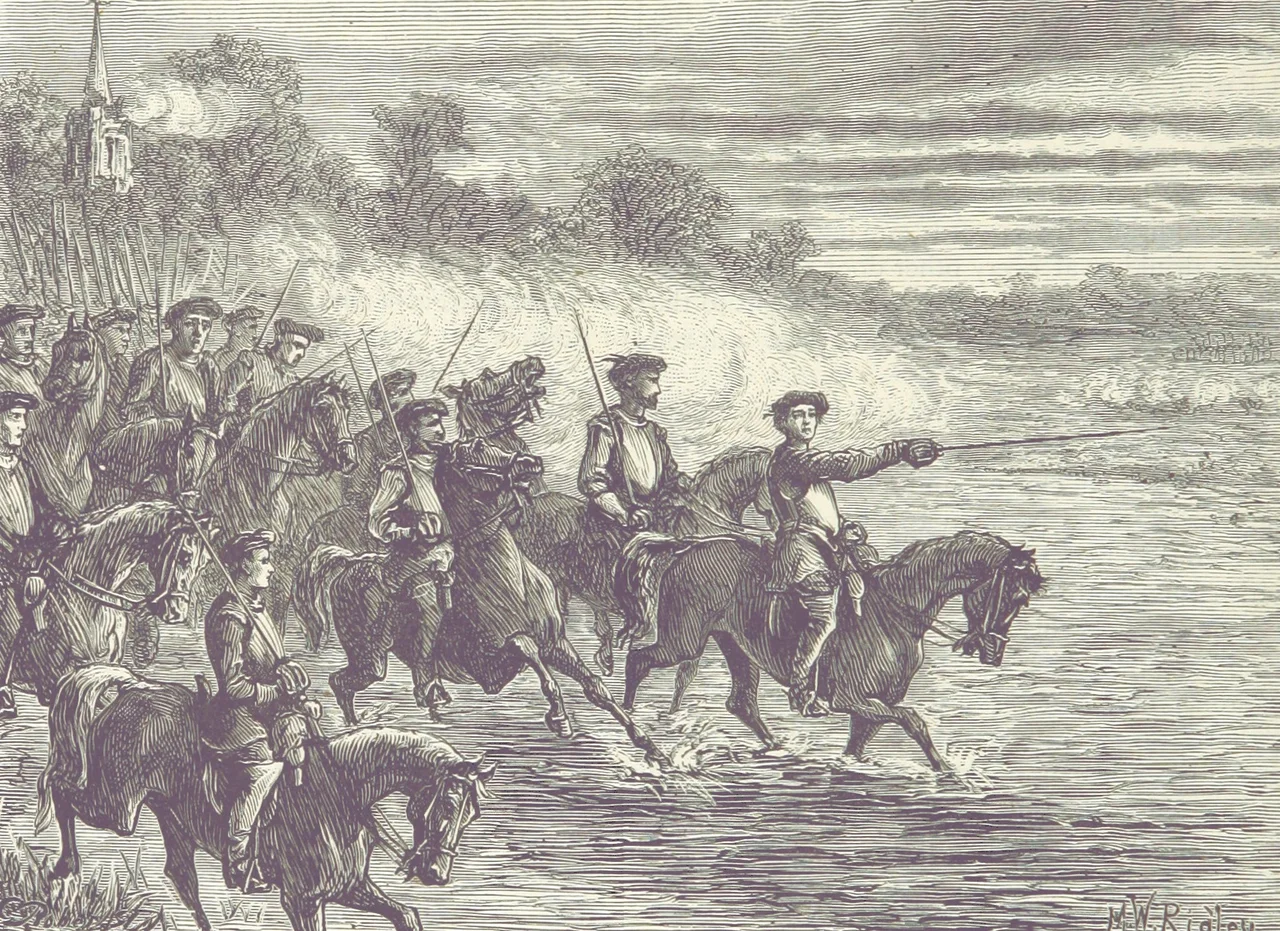
The Scots had eight days of rations and needed Newcastle. Leslie, with his usual political instincts, sent a request across the river asking permission to cross peacefully and 'deliver a petition to the king.' Conway refused. Strafford then sent orders explicitly forbidding any crossing of the ford. The battle began around 1 pm when a Scottish officer ventured too close to the ford and was shot. Around 300 Covenanter cavalry tried to splash across the river and were thrown back by Lunsford's musketeers. Then Hamilton's artillery on the high ground opened up. The bombardment dismantled the hastily built earthworks. Lunsford's troops abandoned their positions despite his efforts to rally them. A counter-attack by English cavalry briefly succeeded before being driven back, with its commander Henry Wilmot captured. The Scots crossed the ford. By early evening, the English army was in full retreat toward Newcastle, cavalry and infantry fleeing in opposite directions.
One Man Emerged with Credit
George Monck, then a junior officer, managed to extract the English artillery intact - one of the few competent actions of the day on the English side. Casualties on both sides were roughly equal at around 300 each, but the tactical reality was decisive: the Scots now controlled the southern Tyne. Leslie, in secret contact with John Pym and the Parliamentary opposition in London, ordered his troops not to pursue the fleeing English. Making enemies in England was not the point. By 30 August, when Leslie reached Newcastle expecting another fight, he found that Conway had abandoned the city and withdrawn south to Durham. The town fell without further violence. The bulk of London's coal supply was now in Scottish hands.
The Long Parliament
Under the October 1640 Treaty of Ripon, Charles was forced to pay the Covenanters £850 per day and to allow them to occupy Northumberland and County Durham pending final terms. Funding this required taxes. Taxes required Parliament. Charles summoned what became the Long Parliament in November 1640 - the same body that would, two years later, go to war with him. The Scots evacuated northern England only after the August 1641 Treaty of London. By then it was too late: the Long Parliament had attainted and executed Strafford, the Irish Rebellion of 1641 had broken out, and the constitutional dam was burst. The Covenanters had overestimated their leverage. English Independents like Oliver Cromwell had no intention of accepting a Scottish-style Presbyterian settlement. But on that August afternoon at a Tyne ford, the certainty of the king's defeat was already being measured out in cannon shots.
From the Air
54.983N, 1.751W. The battlefield lies at Newburn on the north bank of the Tyne, about 6 miles west of Newcastle city centre and just downstream of where the river widens out of the gorge. Best viewed at 1,500-3,000 ft AGL; the high ground from which Hamilton's artillery fired is still distinct above the modern floodplain. Nearest airport: Newcastle International (EGNT), 4 nm to the northeast. The A1 crosses the Tyne immediately east.
Nearby Stories
- Cresswell Lifeboat Station 5.2 km away
- Auckland Castle 5.7 km away
- Battle of Otterburn 7.1 km away
- Saltburn Pier 11 km away
- Hadrian's Wall Path 11 km away
- Battle of Stainmore 18 km away
- Saltburn-by-the-Sea 39 km away
- Alexander L. Kielland (Platform) 296 km away