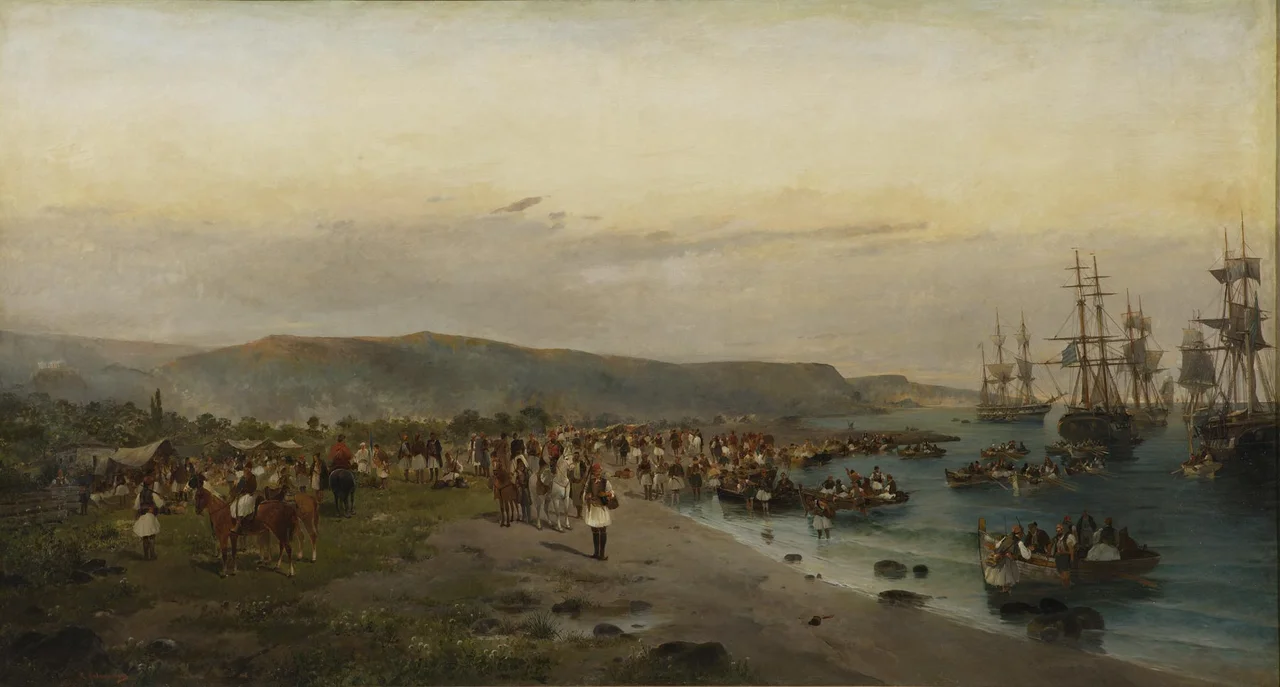

Battle of Phaleron
The men defending the Acropolis of Athens had held out for months. Through the winter and into the spring of 1827, Greek rebel fighters occupied the ancient citadel while Ottoman forces under Mehmed Reshid Pasha encircled them below. Outside the city, Greek commanders had been massing relief forces, planning to break the siege. On 6 May, those relief forces tried — and failed. The defeat at Phaleron was not just a lost battle. It was the moment that came closest to extinguishing the Greek War of Independence on mainland Greece.
The General Who Died Too Soon
Two days before the battle, on 22 April 1827, Georgios Karaiskakis — the general of Central Greece and the most capable Greek commander operating in the region — was fatally wounded in a minor skirmish with Ottoman forces. He died the following day. His death could not have come at a worse moment. Karaiskakis was the organizing intelligence behind the Greek relief effort, and his sudden absence damaged morale throughout the Greek forces and emboldened the Ottomans who opposed them. What followed his death one day later at Phaleron was a battle fought without the commander who had planned it, against an enemy that knew its opponent had been destabilized.
The Worst Day of the War
The engagement at Phaleron, also known as the Battle of Analatos after the nearby locality, was fought along the Attic coast southwest of Athens, where Greek forces attempted to advance on the Ottoman besiegers of the Acropolis. The attack failed. Greek losses were catastrophic — the sources record between 1,500 and 2,000 men killed, a range that itself speaks to the disorder of the defeat. Contemporary accounts described it as the greatest Greek defeat of the entire War of Independence, a judgment that held through the rest of the conflict. The men who died at Phaleron were fighters in a war for national survival; they had families and communities they left behind in a Greece that did not yet exist as an independent state.
The Surrender of the Acropolis
The defeat at Phaleron sealed the fate of the garrison holding the Acropolis above. Cut off from any realistic hope of relief, the defenders held on for another month before surrendering on 5 June 1827. The French army, present in the region as part of European involvement in Greek affairs, escorted the surrendered garrison to the coast. Athens — the symbolic heart of Greek civilization, the city whose ruins European Romanticism had made into a cause — was now firmly in Ottoman hands. On the mainland, only two places remained in Greek control: the Mani Peninsula in the deep south, and Nafplio on the Argolic Gulf, where the rebel government had its seat.
Navarino and the Turn of Fortune
Greece's position in the summer of 1827 looked desperate. Then, in October of that same year, events at sea transformed the war. The Great Powers — Imperial Russia, France, and Great Britain — had grown increasingly committed to Greek independence, for reasons mixing Romantic sympathy with strategic calculation. Their combined fleet encountered the Egyptian and Ottoman naval forces in the Bay of Navarino and destroyed them. The Battle of Navarino eliminated Ottoman sea power in Greek waters, cutting off the ability to reinforce and resupply Ottoman land forces. What the Battle of Phaleron had nearly ended, the Battle of Navarino reopened. Greek independence was formally recognized in 1830. The site of the defeat, on the shore of the bay that took its name from the ancient harbor of Phaleron, now lies within the southern Athens urban area, a quiet stretch of coast that holds a catastrophic memory.
From the Air
The Battle of Phaleron was fought near the ancient harbor of Phaleron along the Attic coast at approximately 37.933°N, 23.700°E, in the area now occupied by the southern Athens suburbs of Paleo Faliro and Neos Kosmos. From the air, the bay of Phaleron — now Faliro Bay — is readily identifiable as the wide coastal arc southwest of central Athens, where the city's southern neighborhoods run down to the Saronic Gulf. The modern Peace and Friendship Stadium and the coastal promenade are visible landmarks. Athens International Eleftherios Venizelos (LGAV) lies approximately 20 kilometers to the east-southeast; aircraft on departure or approach over the Saronic Gulf pass near this stretch of coast. A viewing altitude of 2,000 feet gives a clear perspective on how the Attic plain slopes to the sea here, and how the Acropolis rock — where the besieged garrison held out until June 1827 — remains visible inland to the north.
Nearby Stories
- Parnitha 3.4 km away
- Kea (island) 7.3 km away
- Sanctuary of Apollo Maleatas 11 km away
- Sousaki Volcano 12 km away
- Battle of Leuctra 14 km away
- Great Sand Beach 18 km away
- Agios Georgios (island) 23 km away
- Skyros 84 km away