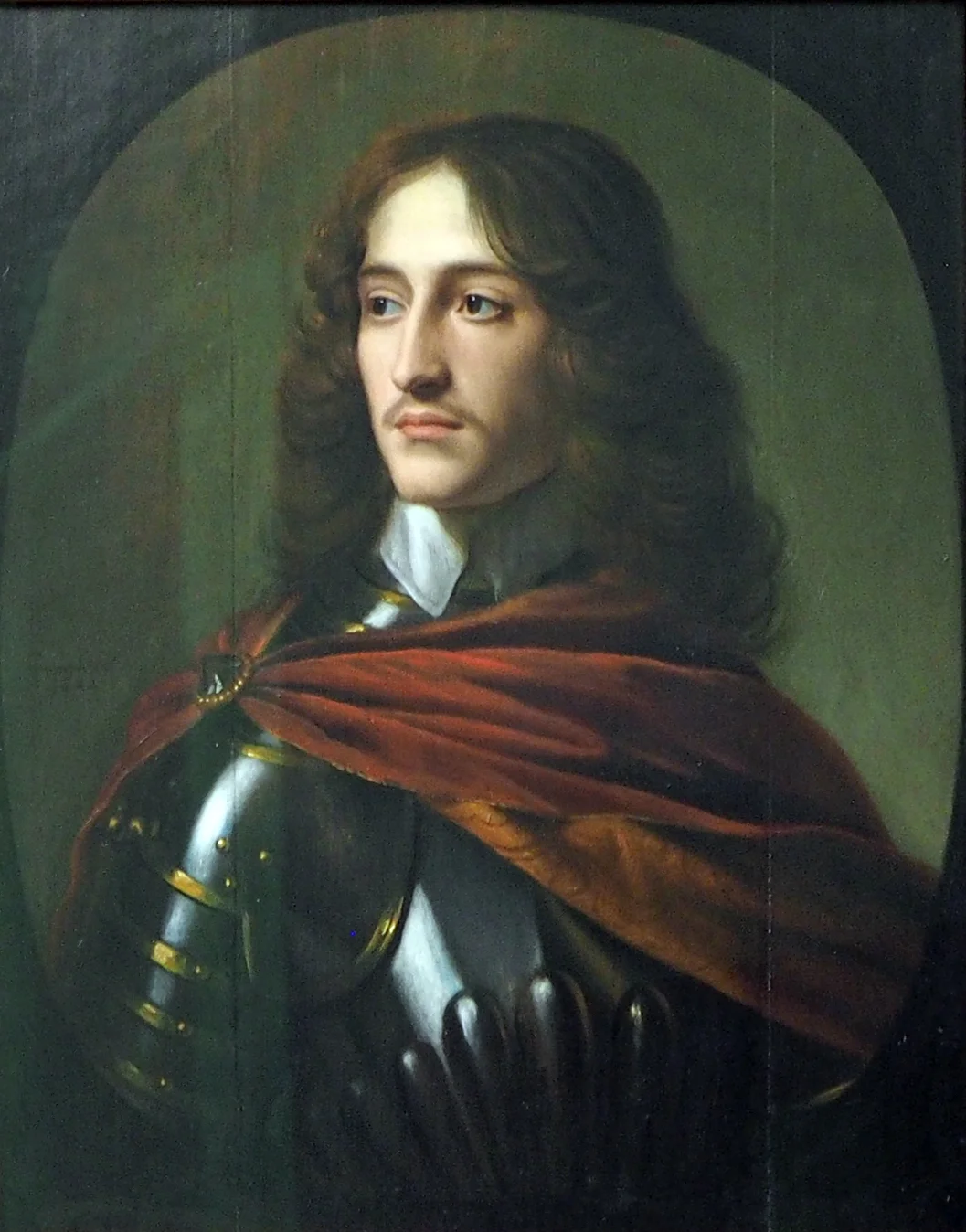

Battle of Powick Bridge
It was a Friday afternoon in late September 1642, and Prince Rupert's troopers had taken off most of their armour to rest in a field called Wick Field, sometimes Brickfield Meadow, just north of the River Teme. They had ridden hard from Shrewsbury. The summer harvest still lay in stooks in the surrounding fields. None of them quite expected what came next. Around four o'clock, the sound of approaching horsemen broke the calm. A Parliamentarian detachment of about a thousand cavalry and dragoons was coming up a narrow country lane that emptied directly into the meadow. They had no idea Rupert was there. Rupert had perhaps half a minute to react.
Treasure on the Road
Sir John Byron was a Nottinghamshire gentleman and one of King Charles I's most committed supporters. In August 1642 he raised what was probably the first Royalist cavalry regiment of the war and based himself in Oxford. When a larger Parliamentarian force pushed him out on 10 September, he left with something valuable: a convoy of gold and silver plate donated by Oxford University to fund the king's war effort. The plate had to reach Charles, who was at Shrewsbury raising an army in Wales and the north-west. The route ran through Worcester. On 16 September Byron arrived at the city - a large town on the Severn, surrounded by medieval walls in poor repair - and waited for reinforcements before continuing. Worcester had declared for Parliament three days earlier, but the population was uncertain, and the walls would not stop a determined attack.
Two Approaching Forces
The Parliamentarians, commanded by the Earl of Essex with his main field army at Northampton, had been watching the Royalist movements. When intelligence arrived about Byron's convoy, Colonel John Brown convinced Essex to send a detachment to intercept it. Brown took about 1,000 mounted troops - ten troops of cavalry and five companies of dragoons - and reached Worcester on 22 September. They found the eastern gate well-defended. They withdrew south, crossed the Severn, and camped at Powick, a village just south of the River Teme, expecting Byron to flee that way. Meanwhile Prince Rupert, the king's 22-year-old nephew and his newly appointed general of horse, had ridden hard from Shrewsbury with about 1,000 of his own troopers to reinforce Byron. He arrived north of the Teme the morning of 23 September, posted his men in Wick Field, and let them rest. He had no idea the Parliamentarians were a mile away. Or perhaps he did, and underestimated them.
The Charge
Around 4 pm Colonel Edwin Sandys led the Parliamentarian advance across Powick Bridge and up the narrow lane toward Worcester. The lane was so tight only three riders could pass abreast. The Royalist dragoons in the hedges opened fire at point-blank range. Sandys's troopers panicked forward into Wick Field, the gunfire alerting Rupert's resting cavalry. Rupert had perhaps a minute to form up. He drew his men into open order in the meadow - shallower than the Parliamentarian formation, with greater frontage - and charged. The Parliamentarian cavalry tactics were Dutch, the caracole, designed to use firepower from the saddle. Rupert's tactics were Swedish, learned in the Thirty Years War from Gustavus Adolphus: charge at speed, use the sword, leave the pistols for after impact. The shock was decisive. Sandys was mortally wounded in the first clash. His troopers broke. Nathaniel Fiennes held one troop together long enough to fire at the charging Royalists - so close, he later wrote, that their horses' noses almost touched ours - but he was outflanked and forced to retreat.
Panic All the Way to Pershore
Colonel Brown made a rearguard stand with his dragoons at Powick Bridge to cover the cavalry's retreat. Rupert pursued only as far as Powick village before turning back. But the Parliamentarian cavalry kept fleeing. They rode all the way back to Pershore, more than ten miles away, where they met the Earl of Essex's Lifeguard. Their account of the disaster - and their conviction that Rupert was still chasing them - broke the Lifeguard, which was carried away in the panic. About 30 men died on each side. Brooks, the modern historian, estimates Parliamentarian losses might have reached 100 to 150 when you count drownings, desertions, and prisoners. The Royalists claimed no losses of note. Prince Maurice, Rupert's younger brother, was wounded. Henry Wilmot was wounded. The valuable plate convoy continued north to the king at Shrewsbury.
The Reputation That Was Made
Powick Bridge was a small fight. About 2,000 troops total. It lasted less than an hour. But Edward Hyde, the Royalist chronicler who later became Earl of Clarendon, wrote that the victory rendered the name of Prince Rupert very terrible - and the modern historian Austin Woolrych described the battle's significance as disproportionate to its scale. It proved the Royalists had cavalry that could beat anything Parliament could put in the field. For the next year and a half, the words Prince Rupert is coming were enough to break Parliamentarian morale before the fighting started. The battle also gave Worcester a curious distinction: nine years later, on 3 September 1651, the final battle of the Wars of the Three Kingdoms would also be fought in and around Powick. Oliver Cromwell's New Model Army would crush a Scottish Royalist army led by Charles II in the same hedgerows where Rupert had won. The Puritan preacher Hugh Peter, the day after, told Cromwell's men they should say they had been at Worcester, where England's sorrows began, and where they were happily ended.
From the Air
The Battle of Powick Bridge was fought around 52.170 N, 2.242 W just south of the city of Worcester, where the River Teme joins the Severn. From the air the site is just south-west of the Worcester city centre, around the village of Powick. Wick Field (Brickfield Meadow) was approximately where the modern A449 crosses the Teme. The Severn winds north from this confluence past Worcester Cathedral (243 ft tower, a clear landmark). Best viewed from 2,000-4,000 ft AGL. Nearest airports: Gloucestershire (EGBJ) about 18 nm south, Wolverhampton/Halfpenny Green (EGBO) about 22 nm north, Shawbury (EGOS) about 35 nm north-west.
Nearby Stories
- Kidderminster 2.5 km away
- Stokesay Castle 5.4 km away
- White Castle, Monmouthshire 6.2 km away
- National Motorcycle Museum (UK) 7.7 km away
- Church of the Holy Trinity, Stratford-upon-Avon 8.2 km away
- Prinknash Abbey 8.3 km away
- Dore Abbey 18 km away
- Woodstock Palace 27 km away