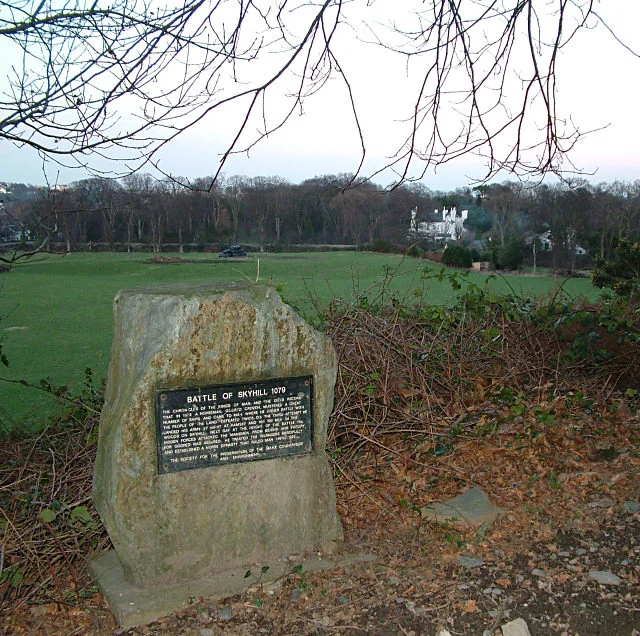

Battle of Skyhill
What is unusual about the Battle of Skyhill is the way it ends. According to the Chronicles of the Kings of Man and the Isles, the Manxmen lost. Three hundred warriors hidden in the woods above Ramsey rose at the rear of their line and broke them. The tide had flooded the riverbed behind them. There was nowhere to retreat. The survivors, the chronicle says, begged for their lives "with pitiful cries." And Godred Crovan, the invader, listened. "Moved with compassion and taking pity on their plight, since he had been reared among them for some time, he called off his army and forbade them to pursue them further." Whether or not that compassion was real, someone thought it important enough to record.
The Kingdom of the Isles
In 1079, the Isle of Man was part of a larger political body called the Kingdom of the Sudreys, which embraced both Mann and the Hebrides. It was a Norse-Gaelic realm with shifting loyalties to mainland kings in Scotland, Ireland, and Norway. Godred Crovan was a Norse-Gael, the son of a man the chronicles call "Harald the Black of Ysland" - of whom nothing further is known, though other sources suggest he may have been a brother or son of Ivar Haraldsson, who died in 1054. The ruling king of Mann at the time of the battle was Fingal Godredson. King Godred Sitricson had died in 1070, and the years since had been turbulent. By the time Godred Crovan returned in 1079, it was his third attempt on the island. The first two had failed.
A Wood Above the Harbour
Godred came by night to the harbour at Ramsey and hid three hundred men in a wood on the sloping brow of the mountain called Sky Hill. The position was a mile or so west of Ramsey, on rising ground that gave a clear view of the coast. At dawn the Manxmen formed up in battle order and charged. According to the chronicles the fighting was vehement and well-matched, until the men hidden in the wood rose at the rear of the Manx line and broke its cohesion. The Manxmen tried to retreat and found their way blocked - the tide had risen and filled the riverbed at Ramsey, cutting them off. With the enemy pressing them from the other side, the survivors begged for their lives. It is a small mercy of the medieval record that we have something other than a body count. The chronicler took the time to note compassion. It has been suggested that King Fingal died in the battle, since he disappears from the record from this point on, though the chronicle itself - usually detailed - does not say so explicitly.
A Sanctioned Plundering
Mercy in battle did not mean mercy after it. The Manx submitted to Godred's rule, and a sanctioned plundering of the island followed. The next day Godred offered his army a choice: divide the country among themselves and stay to inhabit it, or take everything worth carrying and return to the Hebrides. The chronicle records that the soldiers preferred plundering and going home enriched. So the men from the Hebrides took the southern half of the island; the surviving Manxmen kept the north - on the condition, the chronicle says firmly, that none of them should ever presume to claim any of the land by hereditary right. It was a settlement designed to break the inherited authority of the old Manx ruling families and to anchor Godred's own followers as the new landed class in the south.
Seventy-Four Years of His Line
Godred Crovan moved on after the conquest. He went to Dublin and held it for a time before returning to the Hebrides. He kept the Isle of Man until his death in 1095. His descendants held the island for nearly another six decades, until Olaf - his son - died in 1153 - a Norse-Gaelic dynasty rooted in the violent dawn at Skyhill. The battlefield itself remains a recognisable place: a slope above Ramsey harbour where a wood once concealed three hundred fighters. The chronicle's account, written down at some distance from the events, is the principal source. It records the strategy, the betrayal of position, the trap of the rising tide, and - unusually - the moment when the killing stopped. That is the kind of detail that gets remembered for a thousand years.
From the Air
The Battle of Skyhill was fought at approximately 54.319°N, 4.408°W, about one mile west of Ramsey on the slopes of Sky Hill (Scacafell). The hill rises gently from the coastal plain at Ramsey, providing concealing woodland in the medieval period. Ronaldsway Airport (EGNS) is approximately 21 nautical miles south. Best viewed at 2,000-3,000 feet AGL; the modest rise of Sky Hill is clearly distinguishable above the Ramsey lowlands and the harbour mouth where the tidal river once trapped the Manx forces.
Nearby Stories
- Kirkmaiden 3.2 km away
- Isle of Whithorn 4.1 km away
- Santon Railway Station 13 km away
- Solway Firth 16 km away
- St Bees Lighthouse 19 km away
- Portavogie 34 km away
- Walney Island 40 km away
- German submarine U-1024 55 km away