.jpg)
Battle of the Hellespont (321 BC)
Craterus was perhaps the most beloved general in Alexander the Great's army — admired by the Macedonian infantry, trusted by Alexander himself, and considered by ancient sources to be one of the finest commanders of his generation. Neoptolemus was experienced enough to have commanded his own forces and ambitious enough to switch sides for personal advantage. Eumenes of Cardia was a Greek — not a Macedonian — who had served Alexander as a secretary and administrator, and who was widely regarded by the Macedonian military establishment as a capable bureaucrat rather than a real soldier. At a battlefield near the Hellespont in 321 BC, Eumenes killed both of them.
The Empire That Broke Apart
Alexander the Great died in Babylon in 323 BC without a viable heir and without a designated successor. What followed was not a transition but a fracture. His generals — the Diadochi, or 'Successors' — began maneuvering immediately for control of the empire he had built. Perdiccas inherited the main Macedonian army and claimed the title of regent of the Asiatic Empire. He also pursued a marriage to Alexander's sister Cleopatra of Macedon, which would have given him a bloodline claim to the Macedonian throne itself. That was too much for the other successors. A coalition formed against Perdiccas, and Craterus — one of the most respected figures from Alexander's campaigns — marched an army toward Asia to confront him.
Treachery Before the Battle
Perdiccas sent Eumenes and Neoptolemus jointly to the Hellespont to prevent Craterus from crossing into Asia. The two commanders were not a natural partnership. Neoptolemus resented being subordinate to a Greek administrator with no background in Macedonian military culture. Before the armies had even engaged, Neoptolemus deserted — taking a few hundred cavalry with him and joining Craterus on the other side of the strait. It was a betrayal that seemed to doom Eumenes: now he faced both Craterus's formidable veteran infantry and the defecting Neoptolemus, while commanding a force without the prestige of either commander it faced. What Eumenes had, however, was cavalry — more numerous and better organized than Craterus had anticipated.
The Battle and Its Outcome
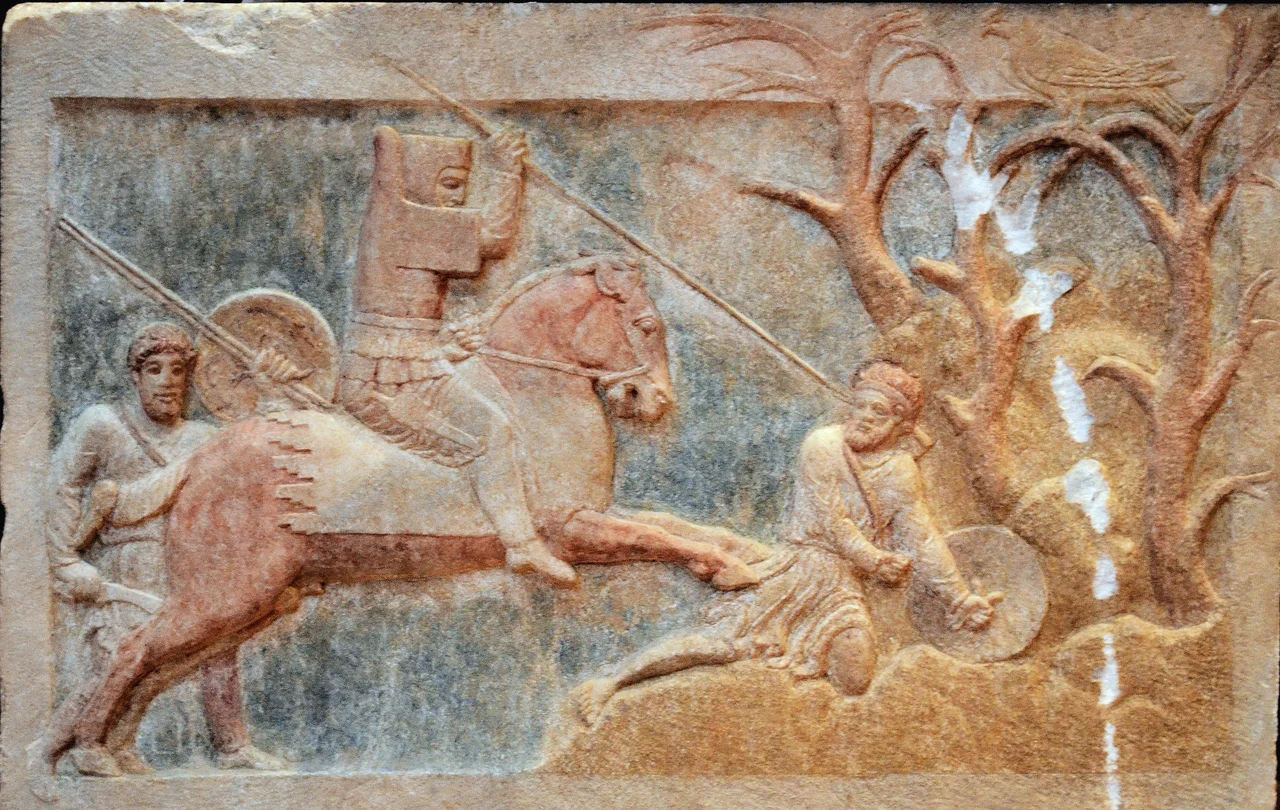
When the armies met, both sides deployed in the classical Macedonian formation: phalanx in the center, cavalry on the wings. Craterus's infantry phalanx was composed of veteran Macedonians who had fought under Alexander — hardened soldiers whose discipline and experience made them formidable. Eumenes' infantry was weaker. He compensated by entrusting his cavalry to Phoenix of Tenedos and Pharnabazus III — the former Persian satrap of Phrygia — and kept his own Macedonian horsemen away from Craterus deliberately, knowing they might hesitate to charge a general they revered. The Asiatic cavalry did not hesitate. They broke Craterus's horse before he could stabilize his line, and Craterus himself was killed in the confusion. On the other wing, Neoptolemus and Eumenes met in direct personal combat, and Neoptolemus died. With both commanders gone, Craterus's surrounded infantry surrendered.
Victory That Changed Nothing
Eumenes won completely and gained almost nothing. The surrendered Macedonian infantry agreed to join him — then slipped away by night to rejoin Antipater, the regent of Greece and Macedonia, who was also Craterus's father-in-law. Removing two powerful contenders from the board did not resolve the succession struggle; it merely redistributed the pieces. The Wars of the Diadochi continued for another four decades, grinding through coalitions and betrayals and battles across the ruins of what had been the largest empire the ancient world had known. Eumenes himself survived this battle but was eventually captured and executed years later, in 316 BC. The Hellespont battlefield — somewhere near the strait that separates Europe from Asia — returned to farmland and silence.
The Hellespont Then and Now
The Hellespont — known today as the Çanakkale Strait — has been a strategic crossing point for as long as armies have moved between Europe and Asia. Xerxes crossed it with his Persian army in 480 BC. Alexander himself crossed it in 334 BC at the start of his eastern campaigns. The battle of 321 BC was fought in its vicinity, the exact location unspecified in ancient sources but positioned somewhere in the low terrain of what is now northwestern Turkey near modern Çanakkale or eastern Balıkesir Province. The strait today is a major shipping lane, its shores lined with monuments to more recent conflicts — the Gallipoli battlefields of 1915–1916 lie just to the west. The Diadochi fought here when the earth above them was already old.
From the Air
The battle's approximate location is at 40.00°N, 28.00°E in the low terrain near the Hellespont (Çanakkale Strait), the narrow waterway separating Europe and Asia. The nearest commercial airport is LTFD (Balıkesir Koca Seyit Airport) near Edremit, approximately 90 km to the south, with daily Istanbul connections. LTBG (Bandırma Airport) lies roughly 70 km to the southeast and serves as a regional alternative. At 5,000–7,000 m altitude, the full geography of the battle becomes visible: the Hellespont narrows to approximately 1.2–7 km at various points, and the rolling agricultural terrain on the Asian side where the armies deployed is clearly distinguishable. The European shore (Gallipoli Peninsula) is visible across the water. Morning light from the east illuminates the strait most dramatically.
Nearby Stories
- Balıkesir 10 km away
- Bandırma 11 km away
- Biga Çayı 18 km away
- Altıkulaç Sarcophagus 26 km away
- Edremit 37 km away
- Green Mosque of Bursa 55 km away
- 1509 Constantinople Earthquake 74 km away
- Antalya Museum 370 km away