
Battle of the Medway
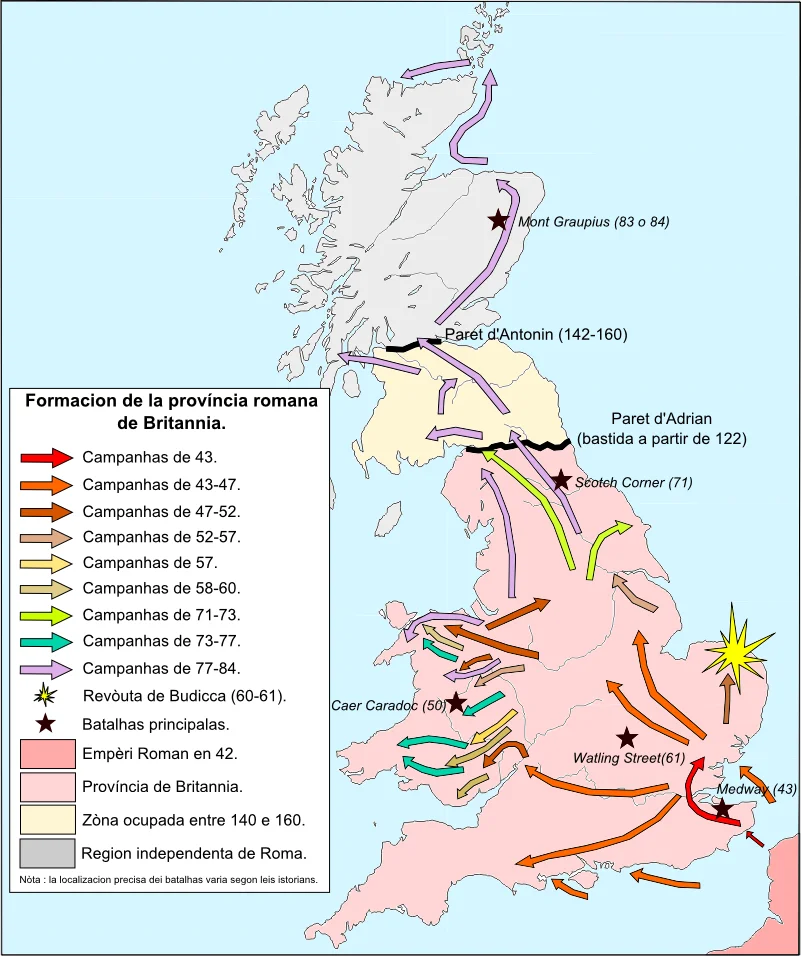
Cassius Dio, writing nearly two hundred years after the fact, said the Romans were astonished. Some of them - probably Batavians from the Rhineland, men who had grown up swimming the wide, cold rivers of northern Europe - had stripped off their armour, slipped into the Medway under the noses of British scouts, and gone straight for the chariot horses. The horses panicked. The chariots were the heart of the British army. By the time the rest of the legions began their crossing, the Cantiaci and Catuvellauni warriors defending the ford had already lost their decisive weapon. It was the summer of AD 43, and the conquest of Britain was about to begin.
Why Claudius Came
For almost a century after Julius Caesar's two expeditions in 55 and 54 BC, the southern British tribes had managed their relationship with Rome through trade and diplomacy rather than submission. By the AD 40s, however, the powerful Catuvellauni - based north of the Thames around what is now St Albans - had been pressing south, displacing the exiled king Verica of the Atrebates, who appealed to Rome for help. Claudius, the new emperor of a still-uneasy regime, needed a victory to legitimise his rule. He authorised an invasion under Aulus Plautius. Four legions and roughly equal numbers of auxiliary troops - perhaps forty thousand soldiers in total - crossed the Channel and landed, almost certainly, at Richborough on the Kent coast. The British high kings, brothers Togodumnus and Caratacus, gathered the tribes to meet them.
The Land They Defended
The people who took up positions on the western bank of the Medway were not a horde. They were the Cantiaci, whose name later gave Kent its name; the Catuvellauni, who held the heartlands north of the Thames; and warriors from allied tribes summoned to a common defence. They lived in a Britain criss-crossed with trackways - including the prehistoric route that later became the Pilgrims' Way - and dotted with hillforts, farms and trading settlements. Their craftsmen worked in gold and bronze. Their chariots, drawn by small native ponies, were faster and more manoeuvrable than anything in the Roman army. They had a script for some purposes, an oral memory for others, and centuries of accumulated experience defending their land. Two skirmishes had already gone against them in eastern Kent. They knew the invaders would not stop. So they chose a river crossing where they thought the geography would favour them, and they waited.
The Crossing
The Romans came up the Pilgrims' Way and arrived at the ford to find no bridge - and no possibility of forcing one against the British line. Plautius sent his swimmers first. The Batavian auxiliaries went in armed for swift, brutal work: cutting tendons on horses, slashing harness straps, sowing chaos behind the British front. Even Dio, hundreds of years later and an apologist for Roman arms, sounds slightly shocked by it. Then the bulk of the army began to cross under cover of the auxiliary attack - Legio II Augusta in the vanguard, commanded by a competent young senator named Vespasian who would, twenty-six years later, become emperor. Overall command lay with Titus Flavius Sabinus, his elder brother. The Britons fought hard. The first day ended with the Romans across but pinned, the British line intact. Nothing in ancient warfare was supposed to take two days.
Geta's Day
On the second day the fighting resumed. Gnaeus Hosidius Geta, leading a Roman force on the field, was nearly captured by British warriors who had identified his standard and pushed hard for him. His own men rallied, fought their way to him, and in the confused melee that followed the British line finally broke. The Britons retreated north toward the Thames. Togodumnus, who had commanded the army with his brother, was either killed in the fighting on the Medway or died of wounds soon after - the sources are not clear. Caratacus survived. He would lead British resistance westward into Wales for another eight years, finally betrayed in AD 51 and taken to Rome, where his proud speech to Claudius reportedly so impressed the emperor that he and his family were spared and given a stipend to live out their lives in the city. Geta got a triumph for the day's work - a rare honour for a man who had never been consul. For the men and women on the British side of the river, what had been lost was not a battle but a way of life.
Where the River Met Empire
The exact site is disputed. The Roman army's most plausible route west from Richborough would have been the Pilgrims' Way, which forded the Medway at Aylesford. Other historians prefer a site closer to Rochester, where an Iron Age settlement of the Cantiaci stood near the river mouth. At Bredgar, twelve miles east, archaeologists found a hoard of Roman coins from this period - thirty-four gold aurei buried by an officer who, for reasons we cannot know, never came back for them. The Britons fell back to the Thames, fought again, and lost again. By autumn Claudius had arrived in person to accept the surrender of eleven British kings at Camulodunum - modern Colchester. The province of Britannia had begun. The river that fed the Romans their first hard fight runs on, past Maidstone and Rochester to Sheerness and the sea, indifferent to which empire claims it.
From the Air
The Battle of the Medway is conventionally located around 51.44°N, 0.74°E - somewhere between Aylesford and Rochester in the lower Medway valley of Kent. Recommended viewing altitude is 2,000-3,000 feet to take in both candidate sites at once. Look for the Medway snaking north into its broad estuary, the chalk ridge of the North Downs running east-west across the southern horizon, and the M2 motorway crossing the river just below Rochester. Nearby airfields: London City (EGLC) about 25 nm west, Rochester Airport (EGTO) about 4 nm south of the likely battle site, London Southend (EGMC) 12 nm north across the Thames Estuary. The London TMA constrains flight at higher altitudes.
Nearby Stories
- Royal Tunbridge Wells 6.6 km away
- Broadstairs 6.8 km away
- Belmont Castle 8 km away
- White House Farm murders 10 km away
- Port Lympne Mansion 12 km away
- North Weald Airfield 14 km away
- Battle of the Narrow Seas 17 km away
- Maunsell Forts 25 km away