
Battle of Ty-ho Bay
By August 1855, the pirates of Kuhlan had been raiding with near-impunity for years. They controlled a harbor on the South China coast, maintained a war fleet of fourteen large cannon-armed junks and twenty-two smaller vessels, and commanded roughly 1,500 men. In late July, they made a mistake: they seized merchant ships escorted by HMS Eaglet, a Royal Navy paddle steamer. What followed was one of the last great fleet actions of the Age of Piracy in Asia — and the first recorded joint combat operation between British and American naval forces.
The Sea That Piracy Never Left
While Atlantic piracy had been largely suppressed by 1830 — the golden age of Caribbean buccaneers a century gone — the South China Sea operated under different rules. Chinese and Japanese pirate fleets had contested these waters for centuries, and by the mid-1850s, hundreds of pirate strongholds were scattered along the Chinese coast. The Qing Dynasty was in no position to clear them. The Taiping Rebellion had erupted in 1850 and was consuming the empire's attention and military capacity. Western merchant shipping, meanwhile, was expanding rapidly as the First Opium War had opened new Chinese ports to foreign trade. The pirates filled the space that disorder left open.
Kuhlan's fleet was formidable by any measure. Their fourteen large junks were cannon-armed fighting vessels, not fishing boats with swords. The twenty-two smaller craft gave them speed and numbers for pursuit and boarding. When they seized four merchant vessels in September 1855 — ships sailing under British protection — they miscalculated what that protection actually meant.
Rattler, Powhatan, and the Shallow Bay
HMS Rattler, a Royal Navy sloop-of-war, was dispatched to recover the captured merchants. Rattler's captain, recognizing the scale of what he was facing, sought reinforcement. He found it in an unlikely ally: USS Powhatan, an American steam frigate operating in Asian waters. The United States had its own reasons to suppress piracy that threatened maritime commerce, and Powhatan's commander agreed to join the operation.
On 4 August 1855, HMS Eaglet — the same paddle steamer the pirates had originally seized cargo from — towed six assault boats into the shallow water of Ty-ho Bay, off the village of Tai O on the northwestern edge of Lantau Island. Packed into those boats were roughly 100 U.S. Marines and armed sailors, and approximately an equal number of British Marines and sailors. The combined force of around 200 men faced a pirate fleet holding a thirty-six-vessel harbor.
Forty Vessels Burning
The battle was decisive and brutal. All fourteen of the large pirate junks were sunk or burned. Six of the smaller craft were destroyed alongside them. Of the approximately 1,500 pirates in and around the harbor that day, around 500 were killed, drowned, or wounded in the fighting. Another 1,000 were captured.
The Western forces suffered what, by the grim arithmetic of nineteenth-century naval engagements, counted as light casualties: five Americans dead and six wounded; four British dead and an unspecified number wounded. For the pirates, it was annihilation. The Kuhlan fleet ceased to exist.
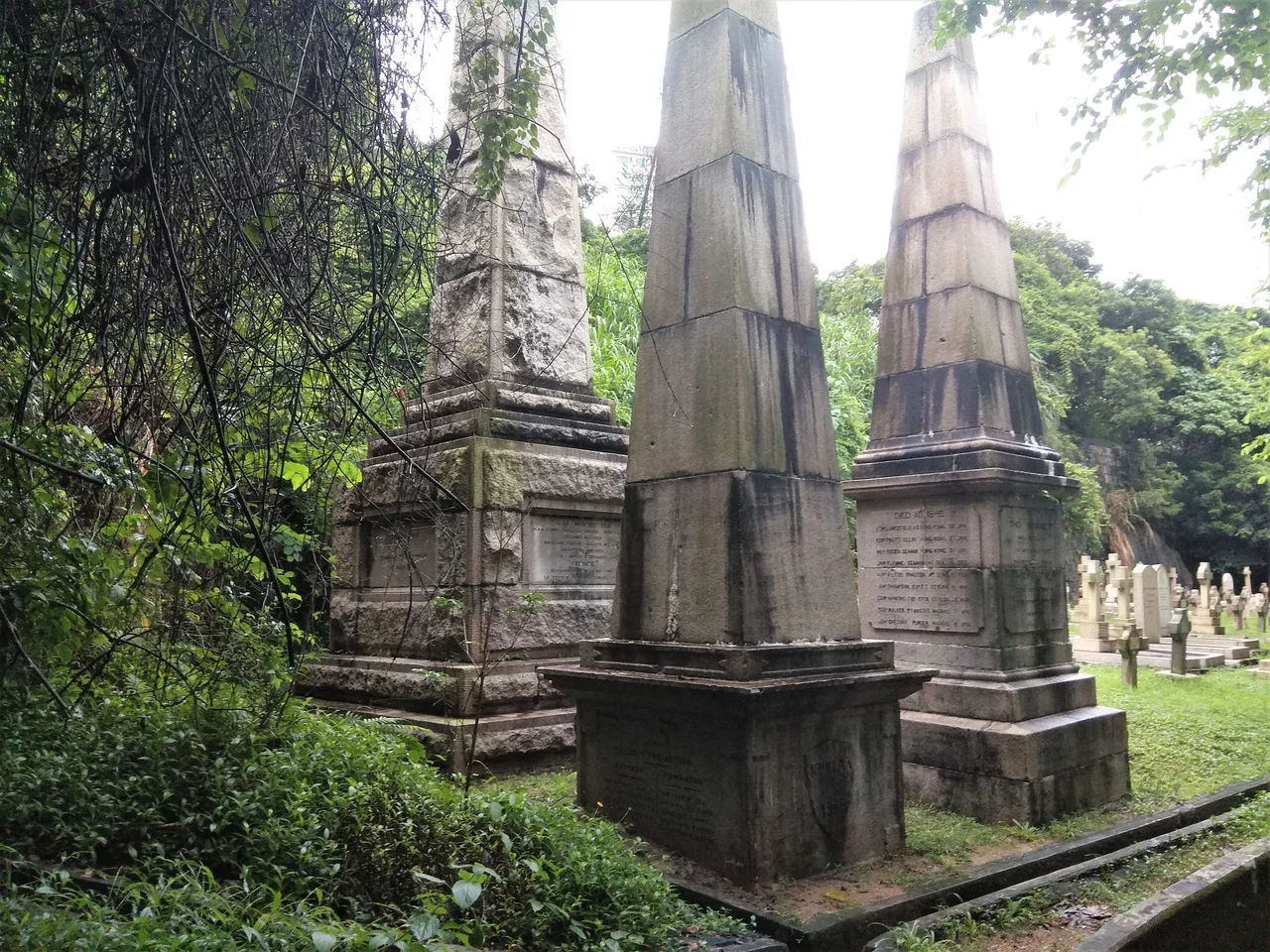
British losses are memorialized in Hong Kong Cemetery, where two obelisks stand together — the Fronde Memorial and the HMS Vestal Memorial, which commemorates officers and crew of HMS Vestal who died in Chinese waters between 1844 and 1847. The monuments were later relocated to Happy Valley Cemetery. They mark not just the men who fell at Ty-ho Bay but the broader cost of maintaining a naval presence in this corner of Asia through the mid-nineteenth century.
The Last of the Fleets
The Battle of Ty-ho Bay is remembered in naval history for two reasons beyond its immediate outcome. It was one of the last major fleet engagements between Western navies and organized Chinese piracy — an era of large-scale pirate armadas that had shaped South China Sea commerce and conflict for centuries was effectively ending. Within a generation, steam-powered gunboats would make such fleets obsolete on both sides.
It was also, more quietly, a rehearsal. The British and American forces improvised their cooperation under combat conditions, sorted out command and communication, and came away with a functioning model of joint operations. The two nations would not fight side-by-side again in significant numbers for another ninety years, at which point the stakes would be considerably higher. Ty-ho Bay was where they first learned they could.
From the Air
The battle took place in Ty-ho Bay, off the village of Tai O on the northwestern tip of Lantau Island, Hong Kong, at approximately 22.267°N, 113.85°E. From the air, Tai O is immediately recognizable — a small stilt-house fishing village on an island at Lantau's western end, separated from the main island by a narrow waterway. The broader bay opens to the southwest toward the Pearl River Delta. Hong Kong International Airport (VHHH) is approximately 12 km to the east on reclaimed land between Lantau and the mainland. For aerial viewing, a pass at 1,500–2,500 feet from the northwest reveals the bay's shallow geometry and Tai O's distinctive layout. Macau International (VMMC) lies about 45 km to the west-southwest across the delta.
Nearby Stories
- Tai Tau Chau (Southern District) 0.7 km away
- Lai Chi Wo 3 km away
- Wanshan Archipelago Campaign 3.2 km away
- Pearl River Delta 3.7 km away
- Battle of Yamen 13 km away
- Jiangmen 15 km away
- Hong Kong 12 32 km away
- Battle of Nanpeng Island 114 km away