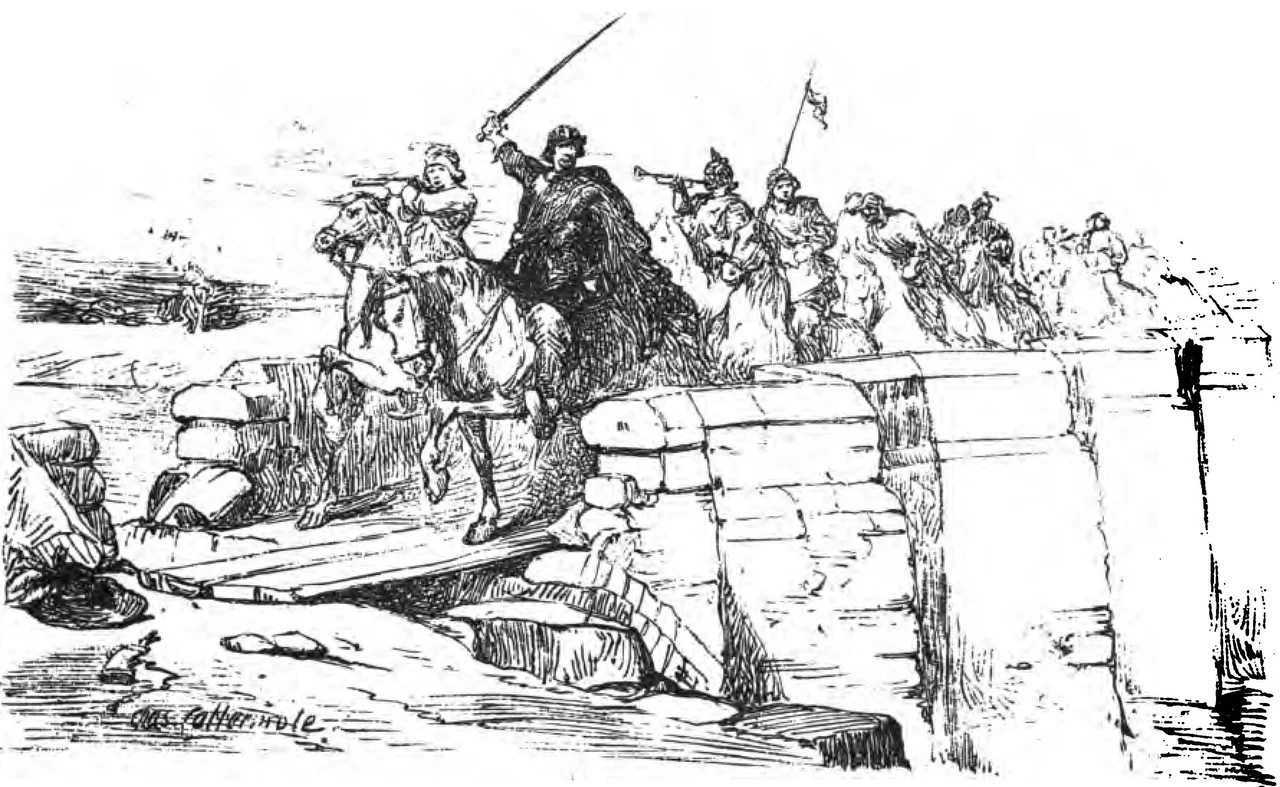

Battle of Upton
Eighteen men. A single plank, laid across the broken arches of the bridge over the Severn at Upton, twelve feet above a dark river running fast in late August. The plank was narrow enough that the men, finding they could not walk it without looking at the water below, sat down and straddled it instead - scrambling across one at a time in the grey dawn of 28 August 1651, hoping the Royalists encamped on the far bank were still asleep. They reached the other side. Then the shooting started. What happened over the next three hours decided whether Oliver Cromwell would be able to encircle Worcester - and whether Charles II's last army would have any chance of escape.
Cromwell's Plan
Oliver Cromwell had returned from Scotland in pursuit of an invading Scottish-Royalist army led by the young Charles II - son of the executed Charles I. The Scots had marched south through the spring and summer of 1651, gathering few English recruits, before settling at Worcester on 22 August. Cromwell concentrated his own forces at Evesham, fifteen miles east, blocking any Royalist move toward London. By 27 August he had assembled an army of around 28,000, roughly twice the Royalist strength. His plan had two parts. First, block London. Done. Second, cut the Royalists off from Wales and the western counties. For that, he needed to control the west bank of the River Severn. The crossing at Upton-upon-Severn, six miles below Worcester, was the key. The Royalists held it. Cromwell had to take it.
The Plank
On 28 August, Colonel John Lambert marched a strong detachment of cavalry and infantry the thirteen miles from Evesham to Upton, arriving on the east bank of the Severn that evening. They found the bridge broken down. But a single plank had been left across the ruined arches - presumably for foot traffic that had been crossing in the days since the Royalists had broken the structure. Lambert hid his men at the village of Ryall through the night to avoid raising any alarm. The Royalist commander, Major General Edward Massey, was a former Parliamentary governor of Gloucester who had defected to the king during the Second Civil War. Massey had quartered himself a mile away at Severn End, the Lechmere house in Hanley Castle village. His 300 men were billeted in Upton. He had posted no sentries. He believed no Parliamentary force was within striking distance.
The Burning Church
At first light Lambert chose eighteen of his best men. They were ordered to cross the plank, secure shelter in Upton, and hold a bridgehead until reinforced. The plank was a service of difficulty and danger, the records say drily. The eighteen had to sit and scoot. When they reached the far bank they ran straight into Royalists, who attacked them at once. The eighteen retreated to the churchyard, then into the church itself, barred the door, and fired through the windows on their attackers. The Royalists set the church on fire. They tried to push pikes through the windows and shoot the survivors down. The eighteen kept firing. Massey, woken by the noise, rode in and personally directed the attack. The eighteen should have died there. The historian J. W. Willis-Bund wrote that in all the Worcestershire fighting of the Civil War no braver act is recorded than that of the eighteen who held the burning church against 300 Royalists.
The Ford at Fisher's Row
Lambert, unwilling to leave his men to die, decided to test the rumour that the river was fordable just below the bridge - at a spot now called Fisher's Row. He ordered his dragoons in. The river was low; the tide was out; the dragoons floundered through, partly fording, partly swimming. They formed up on the far bank and charged the Royalists' rear. The Royalists turned, gave way, then rallied and counter-charged, killing several dragoons and many horses. But Lambert kept sending more men across the ford. The Royalists were being squeezed between the dragoons and the men in the church, who were still firing through the burning windows. The remaining eighteen were rescued. Then Lambert pressed on. He stormed the Royalist earthworks on the Worcester road. Massey had a horse shot under him, then fell badly wounded with injuries to his head and thigh. The 300 Royalists abandoned camp, baggage, and wounded and fled north toward Worcester. Massey himself, unable to ride without support, rode at a walk the whole way back to the city.
What Upton Made Possible
Cromwell himself rode to Upton later that day to thank Lambert's men in person. He understood what had just been done. Cromwell ordered the bridge repaired immediately so that troops could pass over. He sent his second-in-command, General Charles Fleetwood, to take command at Upton with the brigades of Lambert and Richard Deane. Within twenty-four hours a Parliamentary force of 12,000 was encamped on the west bank of the Severn. Their outposts pushed forward to the Old Hills, nearly to Powick. Their scouts were sent up the Teme valley to cut off any Royalist communication with Wales or the west. The encircling movement had begun. Six days later, on 3 September 1651 - the anniversary of Cromwell's victory at Dunbar - the Battle of Worcester would destroy the last Royalist field army of the Wars of the Three Kingdoms. None of it would have been possible without the eighteen men, the plank, and the burning church at Upton.
From the Air
The Battle of Upton was fought around 52.065 N, 2.218 W at Upton-upon-Severn, on the River Severn 8 miles south of Worcester. The medieval bridge has been replaced; the town's distinctive bell tower of the old church (the Pepperpot, surviving from the 14th-century parish church) marks the original action site. The river makes a broad straight reach here. Best viewed from 2,000-3,500 ft AGL. The Severn winds north past Worcester Cathedral (243 ft tower) and south through the Malvern Hills - the Malverns themselves are a long, clear ridge to the west, rising to 1,395 ft at the Worcestershire Beacon, one of the great inland landmarks of the West Midlands. Nearest airports: Gloucestershire (EGBJ) about 12 nm south, Wolverhampton/Halfpenny Green (EGBO) about 28 nm north, Shawbury (EGOS) about 40 nm north-west.
Nearby Stories
- Kidderminster 2.5 km away
- Stokesay Castle 5.4 km away
- White Castle, Monmouthshire 6.2 km away
- National Motorcycle Museum (UK) 7.7 km away
- Church of the Holy Trinity, Stratford-upon-Avon 8.2 km away
- Prinknash Abbey 8.3 km away
- Dore Abbey 18 km away
- Woodstock Palace 27 km away