
Battle of Vienna, Virginia
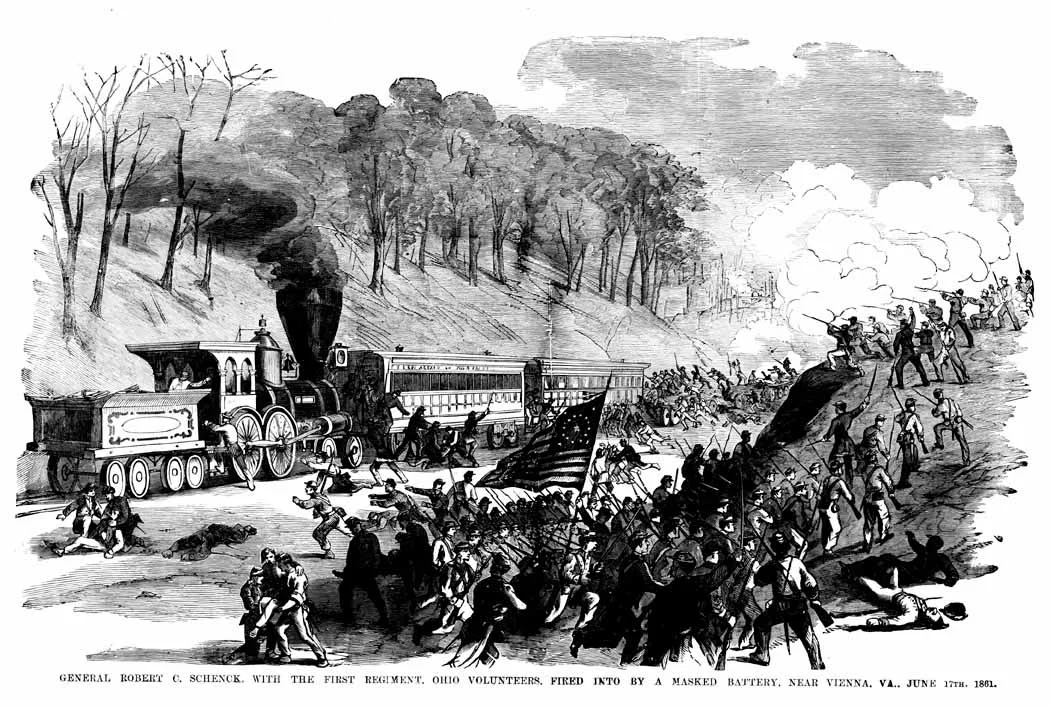
An old farmer ran down the tracks waving his arms. He had seen the Confederate cannons swing into position around the curve just east of Vienna, hidden behind the brush along the Alexandria, Loudoun and Hampshire Railroad. He was a Union sympathizer. He understood what was coming. The men on the slow-moving train, two hundred and seventy-four Ohio infantry riding in open gondola cars and on platforms, mostly waved him off. They were tired. The sun was setting on June 17, 1861. Their officers had been told the line was clear. The train continued around the bend. The first cannonball came through it like paper.
A New Way to Move Troops
The Alexandria, Loudoun and Hampshire Railroad ran fifteen miles west from Alexandria out into the Virginia countryside, ending at a small farming town called Vienna. By June 1861, Union forces controlled the eastern end of the line, the Confederates controlled the country beyond it, and the railroad itself had become the highway by which the war would be fought. Brigadier General Robert C. Schenck loaded the 1st Ohio Infantry onto open rail cars that afternoon and steamed slowly westward with orders to extend the Union foothold in Fairfax County. The notion of moving infantry by train was new. Most generals on both sides still thought in terms of marching columns and horse-drawn supply trains. Vienna would be remembered, somewhat grandly, as the first time the railroad was used in warfare. It would also be remembered as a cautionary tale about what happens when a slow, loud, predictable iron machine rolls into territory the enemy controls.
The Trap at the Curve
Confederate Colonel Maxcy Gregg had been out scouting with the 1st South Carolina Infantry, roughly seven hundred and fifty men with two cannon. As they made their way back toward Fairfax Court House, they heard a train whistle. Gregg had time to think. He positioned his guns at a sharp curve between what are now Park and Tapawingo Streets, sighted along the rails, and arranged his infantry on the bank above the cut. The first shot tore through the open cars, killing and wounding men where they sat. The next shot kept the survivors disorganized as they tumbled off the cars and into the trees. The locomotive, uncoupled and abandoned by an engineer who had no interest in becoming a target, steamed away down the track without them. The Union infantry was stranded with no transportation, half its officers down, and an enemy force more than twice its size on the high ground above.
Into the Woods
Schenck did what could be done. He pulled the survivors of the 1st Ohio off the open cars and into the woods south of the tracks. Eight of his men were dead. Four were wounded. The cars themselves had become a target, and so they were abandoned. Gregg's cavalry tried briefly to pursue, but the woods were thick, the dusk was falling, and the South Carolinians were skittish about whether the Ohioans might be the advance of a larger force. The pursuit was called off. The Ohio men walked back toward the Union lines in the dark, footsore and humiliated. The Confederates burned a passenger car and five flatcars on the tracks behind them and carried away what supplies they could. Local Union sympathizers brought in six of the Ohio dead the next morning.
Bigger Echoes
By the standards of what was coming, Vienna was nothing. The casualties combined would not have made a footnote at Antietam fifteen months later. But in June 1861 the war had barely begun, the press was hungry for stories, and the 90-day enlistments of the volunteer regiments were running out without a single Union victory to show for them. The papers seized on Vienna as evidence that the army Lincoln had assembled could not handle even a small fight. Historian William C. Davis noted that people were beginning to ask when the Federals would gain some victories. The political pressure that fed into the disaster at Bull Run a month later was building, and Vienna was one of the early ingredients. The lessons of the ambush, that an unscouted railroad was an invitation to slaughter, that warning from civilians should be taken seriously, that an iron engine moving at twelve miles an hour through enemy country was as visible as a beacon, would be learned again and again by both armies over the next four years.
What the Trail Remembers
The Alexandria, Loudoun and Hampshire eventually became the Washington and Old Dominion Railroad. The W&OD ran trains through Vienna until 1968, when the line was abandoned. The tracks were pulled up, the right-of-way was paved, and today it is the Washington and Old Dominion Trail, a forty-five-mile rail-trail that carries cyclists and runners through the western suburbs of Washington. The curve where Gregg placed his guns is still there, near where Park Street crosses the trail in the town of Vienna. A historical marker stands at the spot, easy to miss between the joggers and the dog walkers. The Town of Vienna has a Battle Street nearby, and reenactments have marked the centennial, the 125th, and the 150th anniversaries of the engagement. The 1961 reenactment ran a steam train on the still-active W&OD tracks. The 2011 commemoration leased a replica steam locomotive from Strasburg, Virginia for $2,500 and trucked it east. The fight that night lasted minutes. The trail it left runs all the way back to Alexandria.
From the Air
The ambush site sits at 38.9008 degrees north, 77.2564 degrees west, in the Town of Vienna, Fairfax County, Virginia. Best viewed at 2,000 to 3,000 feet AGL, looking down on the linear scar of the Washington and Old Dominion Trail as it runs west toward Leesburg. Dulles International (KIAD) is six nautical miles west; Reagan National (KDCA) is twelve nautical miles east. The site sits inside the Washington Class B veil and below Dulles approach corridors; overflight requires ATC clearance.
Nearby Stories
- Gunston Hall 1.1 km away
- 2023 Baltimore Shooting 4.9 km away
- Battle of Middleburg 6.6 km away
- Crownsville Hospital Center 10 km away
- Battle of Loudoun Heights 13 km away
- First Battle of Rappahannock Station 20 km away
- Howard County, Maryland 21 km away
- Harriet Tubman Underground Railroad 50 km away