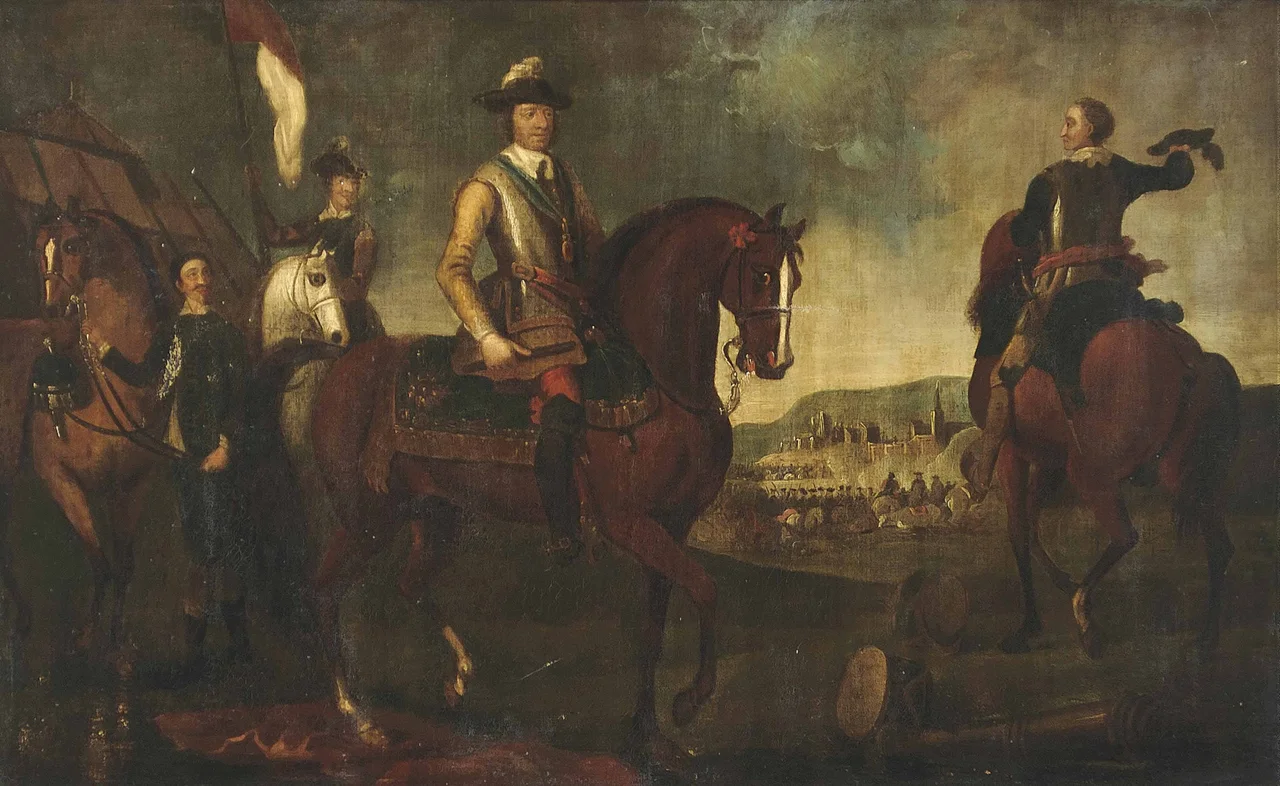

Battle of Worcester
From the top of Worcester Cathedral's tower on the morning of 3 September 1651, the 21-year-old Charles II could see his fate being arranged in the surrounding fields. To the south-east, Oliver Cromwell's pontoon bridges were being laid across the confluence of the Severn and the Teme. To the west, the river's hedgerow meadows were already filling with the New Model Army. Charles had 16,000 men, mostly Scots, who had marched 300 miles in three weeks. Cromwell had 28,000. The day below was his last as an active player in his father's war. By nightfall some 3,000 of his soldiers would be dead. By dawn 10,000 more would be prisoners. And Charles himself would be on the run, beginning a journey that took six weeks of hedges and disguises and luck before a fishing boat off the Sussex coast finally took him to France.
The Long March South
Charles I had been executed in January 1649. His son was crowned king at Scone in January 1651 by the Scottish Presbyterian Covenanters, who had not approved of the regicide and were willing to fight Cromwell to restore the Stuart line. The Scots argued for fighting in Scotland, where Royalist support was strongest. Charles insisted on invading England. He calculated that the English Presbyterians who had backed Parliament a decade earlier would now back him against the Independents who had killed his father. He was wrong. The 16,000-strong army that crossed the border in August 1651 picked up few English recruits. It was a foreign army on English soil - a foreign, Scottish army, as the records noted - and most of England recognised it as such. The Royalists covered 150 miles in a single week. Cromwell, marching south from Scotland with his own army, ran the same distance in seven days. By the time Charles reached Worcester on 22 August, the trap was nearly closed.
Cromwell's Closing Net
Charles spent five days at Worcester resting his troops. The delay was fatal, but unavoidable - his men were exhausted and the few recruits trickling in needed arming. On 28 August, Colonel John Lambert seized the Severn crossing at Upton in a desperate dawn action, severely wounding Major General Edward Massey and severing the Royalist line of retreat to Wales. Cromwell built two pontoon bridges across the Severn and the Teme near their confluence. He delayed his attack until 3 September - the anniversary of his great victory at Dunbar the year before. For the only time in his military career, he had a two-to-one numerical superiority. The Royalists held Worcester itself, fortified hedgerows around Powick to the south-west, and the high ground at Red Hill and Perry Wood to the south-east. The city, against the king's hopes, was not really loyal to him. Worcester had taken the pragmatic position of declaring for whichever side was in occupation. The epithet 'the Faithful City' came later, as a cynical claim for compensation after the Restoration.
The Battle
Fleetwood's brigades forced the Teme over the pontoon bridges against Major General Montgomery's defence. Colonel Richard Deane attacked Powick Bridge - the same bridge where Prince Rupert had won his first victory in 1642 - and was held off for hours by Scottish Highlanders under Colonel Keith. The Royalists contested every hedgerow. Cromwell crossed the Severn bridge with reinforcements to press the west bank. Charles, watching from the cathedral tower, saw the eastern flank of the Parliamentary line momentarily weak. He ordered two sorties: the Duke of Hamilton through St Martin's Gate to attack Perry Wood, and Charles himself through Sidbury Gate to attack Red Hill. The Scottish cavalry on Pitchcroft meadow, under David Leslie, did not move. They had not received orders. For an hour the Parliamentarians retreated before the unexpected attack. Then Cromwell's three brigades arrived. The Royalist sortie was reversed. The Essex militia stormed Fort Royal redoubt and turned its captured guns on Worcester itself. The Royalist position collapsed into the city.
The Cost
About 3,000 men - most of them Scots, most of them young, most of them conscripts who had marched 300 miles for a king they did not know - were killed in and around Worcester that day. Another 10,000 were taken prisoner. These were not abstract numbers. They were sons and husbands and brothers from the lowlands and highlands of Scotland, many of them Gaelic-speakers who could not have explained in English why they were dying in an English city. The Earl of Derby was executed. The English prisoners were conscripted into the New Model Army and shipped to fight in Ireland. Around 8,000 Scottish prisoners were sent abroad - to New England, to Bermuda, to the West Indies - to work for English landowners as indentured labourers, or to be assigned to the back-breaking work of draining the East Anglian fens. Indentured labour in the West Indies in this period was barely distinguishable from enslavement. Many of the Scots sent to the Caribbean would never return; many would not survive the first year. Around 1,200 more Scots were taken to London, where they died in prison camps at Tothill Fields and elsewhere from disease and starvation. Parliamentary casualties numbered in the low hundreds.
Charles in the Oak
Charles II removed his armour inside the city and tried to rally his troops. He could not. A desperate cavalry charge down Sidbury Street and High Street, led by the Earl of Cleveland and Major Careless and the few Midland English Royalists who had joined him, allowed the king to escape by St Martin's Gate. So began the great escape - six weeks of hiding in priest holes and gentry houses, wearing borrowed clothes, learning a working accent. Near Boscobel House in Shropshire, with Parliamentarian patrols searching the woods, Charles spent a day concealed in the branches of an oak with Major Careless. The Royal Oak passed into legend. The king walked, rode, and hid his way south, eventually reaching the Sussex coast at Shoreham where a coal brig took him across the Channel to France. Cromwell, writing to William Lenthall, the Speaker of the House of Commons, called the victory a crowning mercy. He meant that God had given him the greatest of all favours. The expression was inscribed on a plaque near the site of Sidbury Gate centuries later: IT IS FOR AUGHT I KNOW A CROWNING MERCY.
What Was Ended and What Was Owed
The Battle of Worcester ended the Wars of the Three Kingdoms after nine years of fighting. The New England preacher Hugh Peter gave the militia a farewell sermon, referring to the Battle of Powick Bridge nine years earlier almost to the day: when their wives and children should ask them where they had been and what news, they should say they had been at Worcester, where England's sorrows began, and where they were happily ended. The sentence has a clean elegance. But it elides the cost. For the families of the 3,000 dead and the 8,000 transported, the sorrow did not end at Worcester. It travelled with the prison ships to Barbados and Massachusetts, and it stayed in the lowland villages where men did not come home. Charles II did return - nine years later, restored to the throne in 1660 - but he never paid the bill he had run up with the Worcester Clothiers Company for outfitting his army. In June 2008, the then Prince of Wales, the future Charles III, paid off the 357-year-old debt of 453 pounds and three shillings on behalf of his namesake. The interest, had it been charged, would have been around 47,500 pounds.
From the Air
The Battle of Worcester was fought around 52.189 N, 2.221 W in and around the city of Worcester, with major action at the confluence of the Severn and Teme rivers south-west of the city, at Powick Bridge, on Red Hill and Perry Wood to the south-east, and around Fort Royal redoubt. Worcester Cathedral (243 ft tower, on the east bank of the Severn) is visible from miles away in clear weather and the dominant landmark. The Severn loops broadly past the city. Best viewed from 2,500-5,000 ft AGL. Nearest airports: Gloucestershire (EGBJ) about 18 nm south, Wolverhampton/Halfpenny Green (EGBO) about 22 nm north, Shawbury (EGOS) about 35 nm north-west. The long ridge of the Malvern Hills, rising to 1,395 ft at the Worcestershire Beacon, lies 8 nm south-west and is one of the great visual features of the West Midlands.
Nearby Stories
- Kidderminster 2.5 km away
- Stokesay Castle 5.4 km away
- White Castle, Monmouthshire 6.2 km away
- National Motorcycle Museum (UK) 7.7 km away
- Church of the Holy Trinity, Stratford-upon-Avon 8.2 km away
- Prinknash Abbey 8.3 km away
- Dore Abbey 18 km away
- Woodstock Palace 27 km away