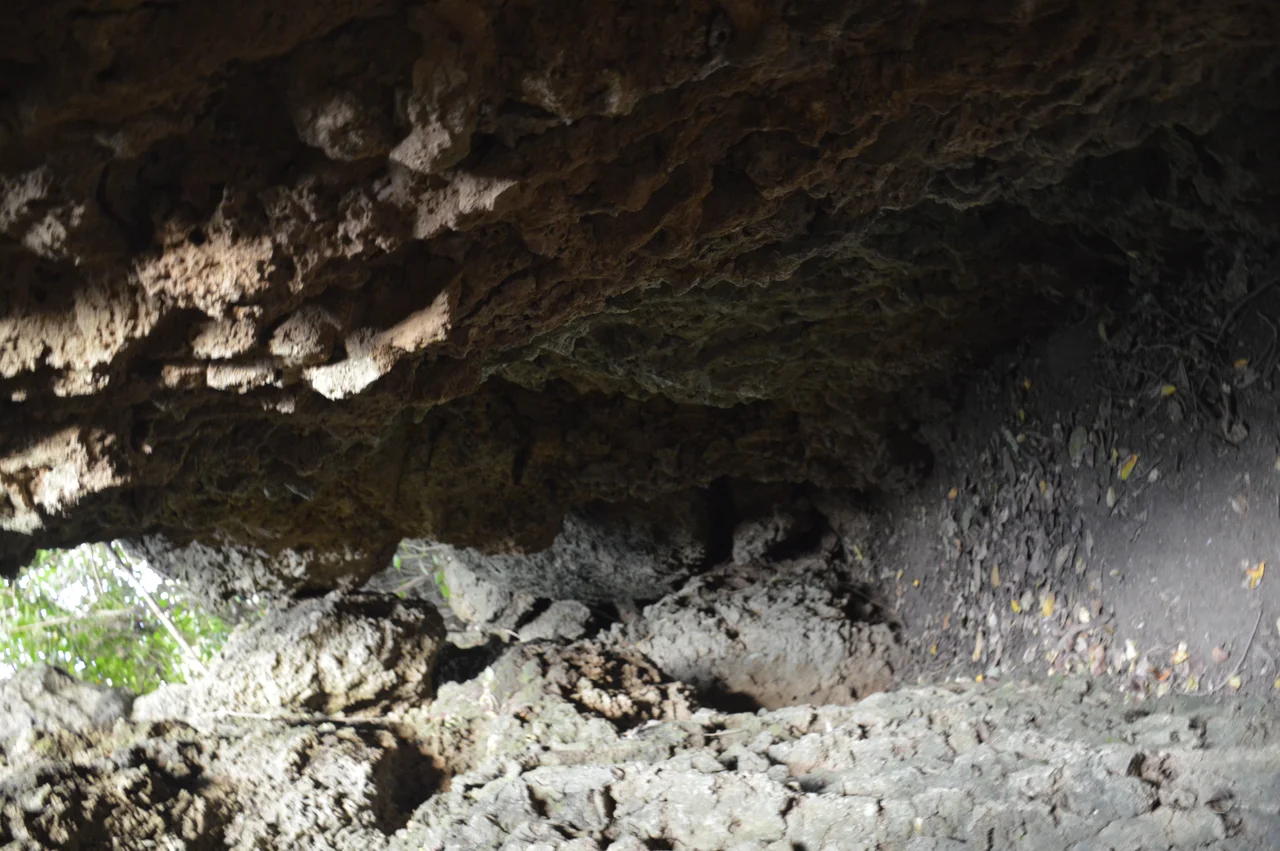

Beauty Cave
The island of Xiaoliuqiu floats in the Taiwan Strait about 15 kilometers off the coast of Pingtung County, small enough to circle by scooter in an afternoon. Its geology is coral limestone — the same material that defines the Hengchun Peninsula across the water — and rain has spent thousands of years carving that limestone into caves, notches, and sinkholes. One of those caves has a name that needs no elaboration: Beauty Cave. The name comes from a story, and the story has outlasted everything else that might have been said about the place.
The Woman in the Cave
Local legend says the cave took its name from a young woman who once lived inside it. In one version of the story, during the Wanli Era of the Ming Dynasty — somewhere between 1573 and 1620 — she survived a shipwreck in the Taiwan Strait and swam or drifted to Xiaoliuqiu. Finding no one to help her and no easy way off the island, she made the cave her home, surviving on spring water that seeped through the limestone and on wild fruits growing nearby. The story doesn't record her name, only the impression she left — beauty, endurance, and an attachment to a particular piece of underground darkness that the island's residents decided to honor by naming the cave after her. She remains an unnamed figure in the local memory, her biography compressed into a place name that has survived the Dutch colonial period, Japanese rule, and the tourism industry that now routes visitors through the cave on wooden walkways.
Limestone Carved by Water
Beauty Cave is a solutional cave — formed not by volcanic activity or tectonic force but by the patient chemistry of slightly acidic rainwater dissolving the calcium carbonate in limestone over long stretches of time. Xiaoliuqiu's entire island is composed of uplifted coral limestone, which means the island itself is essentially a giant piece of ancient reef raised above sea level by tectonic movement. Water finds every crack and works at it, widening passages and smoothing surfaces, depositing dissolved minerals as stalactites hanging from ceilings and stalagmites rising from floors. The cave is divided into two distinct sections connected by thirteen paths, giving visitors a choice of routes through the interior. The passageways stay cool and damp year-round — a sharp contrast to the warm, humid air outside, where the island's subtropical vegetation presses close to the cave entrance.
A Scenic Area with Neighbors
Beauty Cave is not a standalone attraction on Xiaoliuqiu. It is administered as part of a unified scenic area, and a single admission ticket includes access to two nearby sites: Mountain Pig Ditch and Black Dwarf Cave. The three together form a compact circuit of the island's underground and semi-underground geology. Mountain Pig Ditch is a narrow ravine carved into the limestone; Black Dwarf Cave, smaller and lower than Beauty Cave, has its own local mythology attached. Visiting all three in a half-day is a standard itinerary, and the combination gives a sense of how thoroughly water has worked through the island's rock over the centuries. Xiaoliuqiu is also known for sea turtle sightings in its surrounding waters, and the combination of cave touring and snorkeling makes it a destination that draws visitors looking for something different from the resort beaches of Kenting across the water.
An Island Apart
Reaching Beauty Cave means reaching Xiaoliuqiu first, which means a ferry from Donggang on the Pingtung coast — a crossing of roughly 30 minutes. The island is small: most visitors arrive on one ferry, rent an electric scooter from one of the shops near the pier, make a circuit of the major sites, eat lunch somewhere in the small main village, and return on a later ferry. The pace is necessarily unhurried. Xiaoliuqiu has none of Kenting's commercial intensity; the streets are narrow, the guesthouses are family-run, and the cave sits in the island's interior without a large parking lot or a gift shop. The legend of the shipwrecked woman feels appropriate to the place. Xiaoliuqiu has always been slightly set apart from the mainland across the water — geographically, atmospherically, and in the particular kind of quiet that islands at a comfortable remove from everything tend to accumulate.
From the Air
Beauty Cave is located on Xiaoliuqiu (Liuqiu Island) at approximately 22.3529°N, 120.3718°E — a small coral limestone island off the southwest coast of Taiwan in the Taiwan Strait. The island is visible from the air as a roughly oval landform with a pale limestone interior rising above the surrounding sea. From the south, both the Hengchun Peninsula to the southeast and the Pingtung coast to the northeast are visible on clear days. The ferry port of Donggang on the mainland is approximately 15 kilometers to the northeast. Nearest major airport: RCKH (Kaohsiung International), approximately 50 kilometers north of Donggang on the mainland coast. Recommended viewing altitude: 3,000–5,000 feet to see the island in full, with the Taiwan Strait extending west toward China.
Nearby Stories
- Zhiben Hot Spring 8.7 km away
- Fo Guang Shan 8.8 km away
- Duoliang Station 11 km away
- Checheng Fu'an Temple 32 km away
- Orchid Island 62 km away
- Dongji Island 68 km away
- South Penghu Marine National Park 96 km away
- Hong Kong 12 548 km away