
Bell of Chersonesos
Stand at the western edge of Sevastopol where the ruins of ancient Chersonesos meet the sea, and you will find a great bronze bell hanging in the open air, framed against the Black Sea like a threshold to the water. It has been a weapon, a piece of plunder, a diplomatic gift, and a warning to sailors - a single object that has been captured, exiled to Paris, and ceremonially brought home again. Few bells have traveled so far or meant so many things, and fewer still have ended their working life not in a tower calling worshippers to prayer, but on a windswept coast, tolling through the fog to keep ships off the rocks.
Forged From War
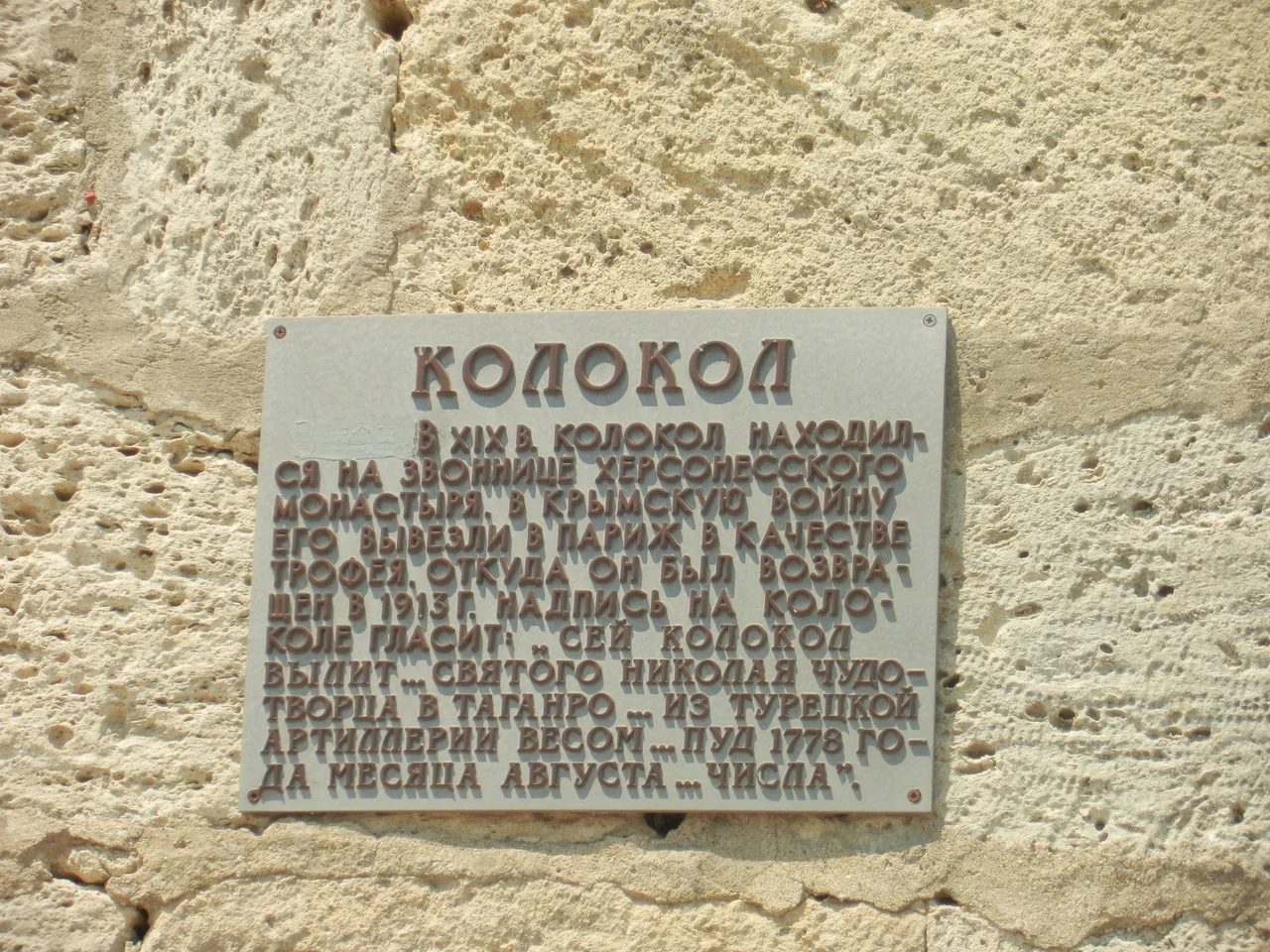
The bell began as artillery. It was cast in 1778 from Turkish cannons captured by the Russian Imperial Army during the Russo-Turkish War of 1768 to 1774 - bronze that had once been aimed at Russian soldiers, melted and recast into something meant to be heard rather than fired. Its makers gave it two protectors, Saint Nicholas and Saint Phocas, both patron saints of sailors, and an inscription that can still be read today: that the bell was cast at the Saint Nicholas the Wonderworker Church in Taganrog from trophy Turkish guns, in the month of August, 1778. Taganrog was then the Russian Navy's base, and the bell was made for its church. Only later, when Sevastopol rose as the empire's great southern naval fortress, did Emperor Alexander I order it moved south to the new city.
Exile in Paris
Then came the Crimean War, and the bell was carried off. When French forces took part in the long assault on Sevastopol in the 1850s, they seized the bell as war booty and shipped it to France, where it was hung in the cathedral of Notre-Dame de Paris - a Russian bell, inscribed in Cyrillic, ringing over the Ile de la Cite. For decades it hung there almost anonymously, until someone noticed the Russian lettering and began asking questions. What followed was a small act of grace between nations. Through the diplomatic efforts of both governments, and above all the French consul in Sevastopol, Louis Ge, the bell was returned. On 13 September 1913 it came home to the monastery at Chersonesos and was raised on a wooden belfry near the St. Vladimir Cathedral. President Raymond Poincare wrote that France gave it back as a sign of alliance and friendship.
The Voice on the Cliff
The bell's homecoming did not last long in peace. In 1925 Soviet authorities closed the monastery, and two years later its bells were sent away to be melted down and recast - all but this one. It was spared for a strictly practical reason: the agency responsible for the safety of navigation on the Black and Azov Seas asked that it be placed on the coast as a signal, a fog bell. And so the bronze that had begun as a cannon and passed through a Paris cathedral found its final purpose facing the open sea, tolling through mist and darkness to warn passing ships of the shore. It served in this humble role until the 1960s, its deep voice carrying over the water long after the church it was cast for had fallen silent.
A Landmark by the Sea
Today the Bell of Chersonesos is one of the enduring symbols of the city, a fixture in photographs and even a small piece of cinema history, appearing in the beloved 1975 Soviet children's film The Adventures of Buratino. It hangs where the ancient Greek colony of Chersonesos once stood, near the cathedral, its bronze weathered green by sea air. Visitors come to frame the Black Sea through its silent mouth and to run a hand over metal that has outlived empires, wars, and the several purposes it was made and remade to serve. It is, in the end, a survivor - a bell that refused to be melted down, and instead stayed to watch the sea.
From the Air
The bell stands at approximately 44.61 degrees north, 33.49 degrees east, on the coast at the Chersonesos archaeological site on Sevastopol's western Heracles Peninsula. From lower altitudes in clear conditions the ruins of ancient Chersonesos and the domes of St. Vladimir Cathedral mark the spot, with the Black Sea stretching west. The nearest airport is Sevastopol's Belbek (ICAO UKFB); Simferopol International (UKFF) lies to the north.
Nearby Stories
- 1988 Black Sea Bumping Incident 5.4 km away
- Battle of the Alma 7.5 km away
- Yalta 8 km away
- Russian Battleship Ekaterina II 10 km away
- Akmesdzhyt Friday Mosque 12 km away
- Soviet Hospital Ship Armenia 15 km away
- KaZantip 52 km away
- Januarius MacGahan 338 km away