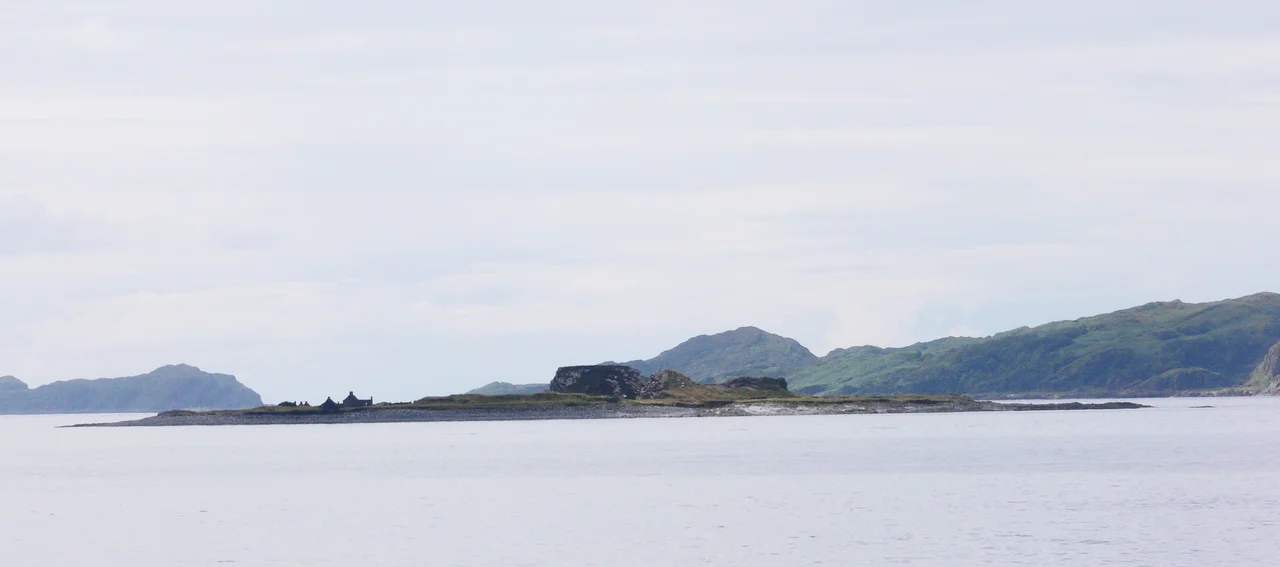

Belnahua
In August 1914 the men of Belnahua put down their picks, crossed the sound to Luing, and went off to fight. None of them came back to quarry. Their cottages still stand on the small green island, roofs gone, windows empty, walls open to the Atlantic wind. The hollow heart of the island where they once worked is now a saltwater lagoon, the sea having reclaimed the holes they cut into it. A century later Belnahua remains as the war found it: a village paused mid-sentence, slowly being unwritten by weather.
A Quarry Pretending to Be an Island
Belnahua sits in the Sound of Luing, a low green slab barely a third of a mile across, surrounded by some of the most ferocious tides on Britain's west coast. The Gulf of Corryvreckan roars ten kilometres to the south, and skerries swarm the surrounding water "like bees on a branch," in one old description. The island's name comes from the Gaelic Beul na h-Uamha, the mouth of the cave. Its bedrock is Neoproterozoic slate of the Jura Slate Member, the same dark, smooth rock that gave the Slate Islands their name. For most of two centuries the islanders did not so much live on Belnahua as remove it. Wherever quarrymen worked, the island grew shallower, the sea grew closer, and one day the two would meet.
Roofing the World
Quarrying on Belnahua began around 1632, but the boom came in the 1790s, when the Stevenson brothers leased the island to supply slate for the growing town of Oban. They built rows of two-up two-down cottages in the southeast corner, a school, a company store, and a fine two-storey house for the quarry master. At its peak the island held thirty quarry workers and over a hundred and fifty souls in total. Drinking water and almost every provision arrived by boat from Luing; rainwater was collected in reservoirs for the steam engines that pumped the workings dry. Belnahua slate sailed to Campbeltown, Glasgow, Liverpool, and onward to Nova Scotia, New Zealand, and the West Indies. The roofs of half the British Empire were once partly Belnahua.
A Hard Country for Hope
Life on the island was bleak in ways the postcard cannot reach. The cottages were rented from the workers' feudal superior, the Campbell Marquis of Breadalbane, and supplies had to be bought from his store; one historian, Paul Murton, has flatly called the arrangement slavery. There was no shelter from the wind. Scarba's black cliffs loomed across the water to the south. At the centre of the village were the deep slate pits themselves, their dark mouths open to the sky. The writer Hamish Haswell-Smith described a place that could "surely have engendered little more than tension, fear, agitation and anxiety." The miracle is not that Belnahua emptied. The miracle is that it stayed full for as long as it did.
August 1914
When war was declared in August 1914, the quarry workers of Belnahua, like men in villages across Britain, answered the call. They locked their doors, walked down to the jetty on the east side of the island, and crossed to the mainland. The pumps stopped. The pits flooded almost at once. By the time the war ended in 1918, the workings were a lake and the market for slate had largely collapsed; clay tiles were cheaper. The men who survived found work elsewhere. The cottages were never reoccupied. Belnahua became one of the saddest of all British places, a village where you can still read names on lintels but where no chimney has held smoke for more than a hundred years. The Breadalbane estate was sold off in the 1930s, and the island has passed quietly through private hands ever since.
What Remains
Today Belnahua belongs to otters, seals, and the field vole that has the island to itself. Seals fish for ling, saithe, and cod in the sea-flooded quarry pits, an industrial wound now perfectly habituated by wildlife. The grass grows waist-high among the abandoned machinery, and rusting pump cylinders sit where they were left in 1914. Two km north, the Apollo lies in ten metres of water with its cargo of granite cobbles from 1900. Closer in, the 1936 wreck of the Latvian steamer Helena Faulbaums rests in sixty metres, claiming seven crewmen whose graves still stand on Luing. The Slate Islands Heritage Trust visits to record, photograph, repoint a wall here and there, but otherwise leaves Belnahua to do what it has done since 1914: weather, settle, and wait.
From the Air
Belnahua lies at 56.250N, 5.688W in the Sound of Luing, between Luing to the east and Lunga to the south-west. From altitude the island shows as a low green slab with a dark central lagoon - the flooded quarry pit - distinctive against the surrounding water. Easdale and Seil lie to the north, the white whirl of Corryvreckan ten km south between Jura and Scarba. The nearest airport is Oban (EGEO), about 25 km north-east. Visibility on the west coast is highly variable; clear winter days give the best contrast.
Nearby Stories
- Fingal's Cave 1 km away
- Bonawe Iron Furnace 3 km away
- Torosay Castle 7.7 km away
- Jura Distillery 12 km away
- Strachur 13 km away
- Erraid 15 km away
- Bruichladdich Distillery 15 km away
- Rothesay Castle 15 km away