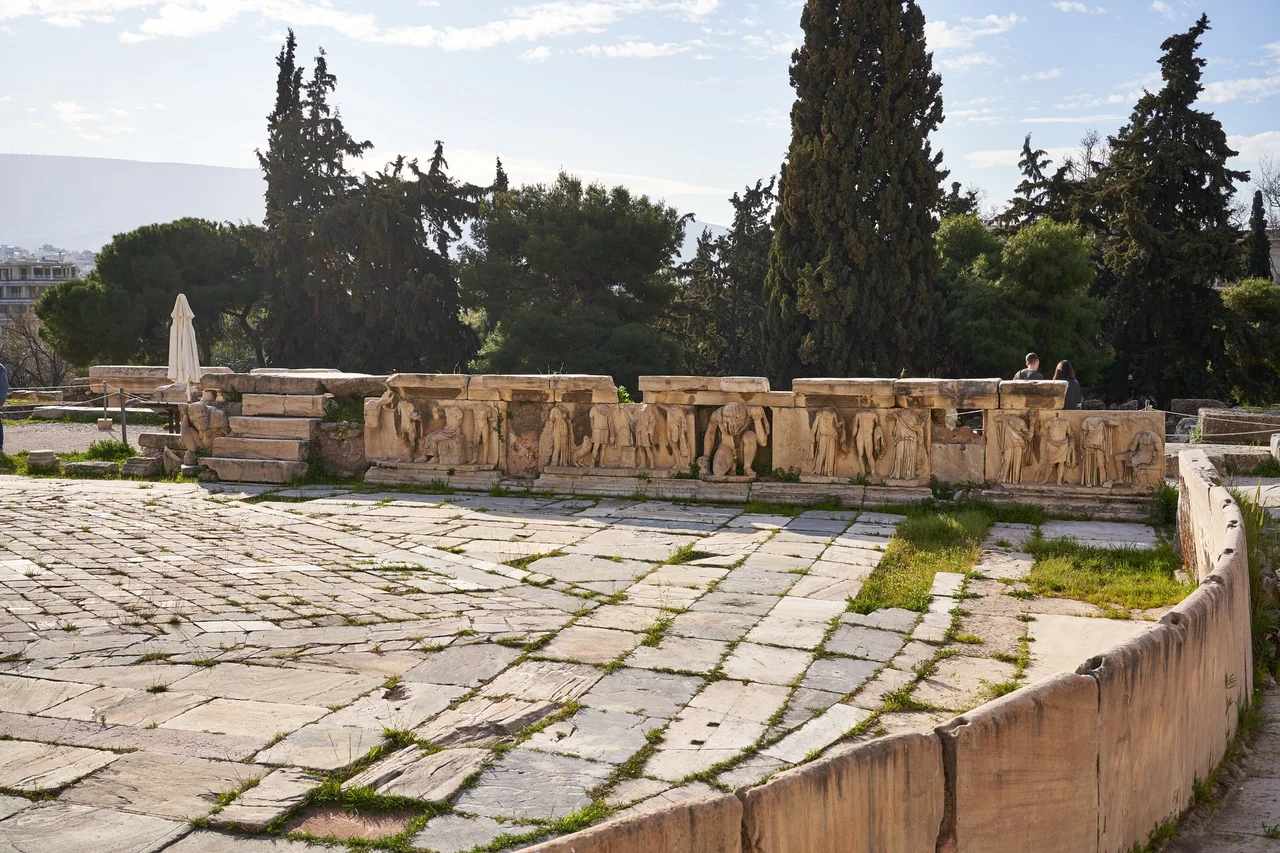

Bema of Phaidros
Stand at the foot of the Theatre of Dionysos and the stone stares back at you. A row of crouching figures hunches along the stage front, bearded and grimacing, their shoulders bent as if they have been holding up the platform for seventeen centuries. These are Silenoi, the wine god's companions, and they frame four marble panels that tell the story of Dionysos himself. The platform they decorate is the Bema of Phaidros, and almost nothing about it is as old as it pretends to be.
The God Born Twice
Read the panels left to right and the myth unfolds. The first shows a seated figure, likely Zeus, and a youth cradling an infant - Hermes, scholars think, delivering the baby Dionysos at the moment of his second birth from the thigh of his father. Two nude warriors with shields stand guard at the edges. The next slab brings the gift of wine to Attica, where a man identified by his grapevine, leopard skin and high theatrical boots can only be Dionysos, met by a small altar, a tethered goat, and a figure who may be Ikarios with his faithful dog Maera. The third and fourth panels move toward a sacred marriage and an enthronement, with goddesses, the queen-priestess called the Basilinna, and the hero Theseus crowding in. The carving is confident, theatrical, alive with the rituals that once filled this hillside.
Marble That Doesn't Fit
Look closely and the seams give the secret away. The reliefs have been trimmed and shaved to wedge into their current frame, the kind of violence no sculptor inflicts on his own fresh work. This marble was carved earlier, in the Neo-Attic style of the Hadrianic or Antonine age, somewhere else entirely, then dismantled and hauled here. No one knows where it first stood or exactly when it was made. One theory holds the panels were meant for the towering stage building of a second-century theater, abandoned and later scavenged. The Bema is a collage of borrowed grandeur, ancient Athens reusing its own past because new monuments had grown too expensive to commission.
The Man Who Signed It
The platform takes its name from Phaidros, an archon of Athens in the third century CE, who assembled these older panels into a stage front for the Theatre of Dionysos. By his day the theater was already ancient ground - the birthplace of Greek drama, where the tragedies of Aeschylus, Sophocles and Euripides had premiered before audiences of thousands on the southern slope of the Acropolis. Phaidros did not invent the imagery he installed. He curated it, fitting Roman-era marble into the most storied performance space in the Western world, ensuring that the wine god still presided over his own theater even as the classical age receded into memory.
What You See Today
The Theatre of Dionysos sits on the Acropolis's south flank, its weathered stone seats sweeping up the hillside above the modern city. The Bema of Phaidros marks the front edge of the stage, where actors once stood and where the crouching Silenoi still keep their watch. Walk the lower tiers and you trace the footprint of an art form's birthplace. The reliefs have faded and chipped, their figures softened by time, but the procession of myths remains legible to anyone willing to slow down and look - a Roman patron's tribute, built from secondhand marble, to a god who refused to stay dead.
From the Air
The Bema of Phaidros lies at 37.9703°N, 23.7278°E on the southern slope of the Acropolis in central Athens, within the Theatre of Dionysos. Best appreciated on foot rather than from the air, but the Acropolis itself is an unmistakable landmark from above - a flat-topped limestone rock crowned by the Parthenon, rising abruptly from the dense low-rise sprawl of Athens. The nearest airport is Athens International (LGAV), about 33 km east-southeast. Clear Mediterranean skies prevail through the long dry summer; haze can settle over the basin in still conditions.
Nearby Stories
- Great Sand Beach 5 km away
- Battle of Delium 7.7 km away
- Tower of Aliartos 9 km away
- HMHS Britannic 10 km away
- Saronic Gulf 15 km away
- Sousaki Volcano 17 km away
- Sanctuary of Apollo Maleatas 24 km away
- Skyros 66 km away