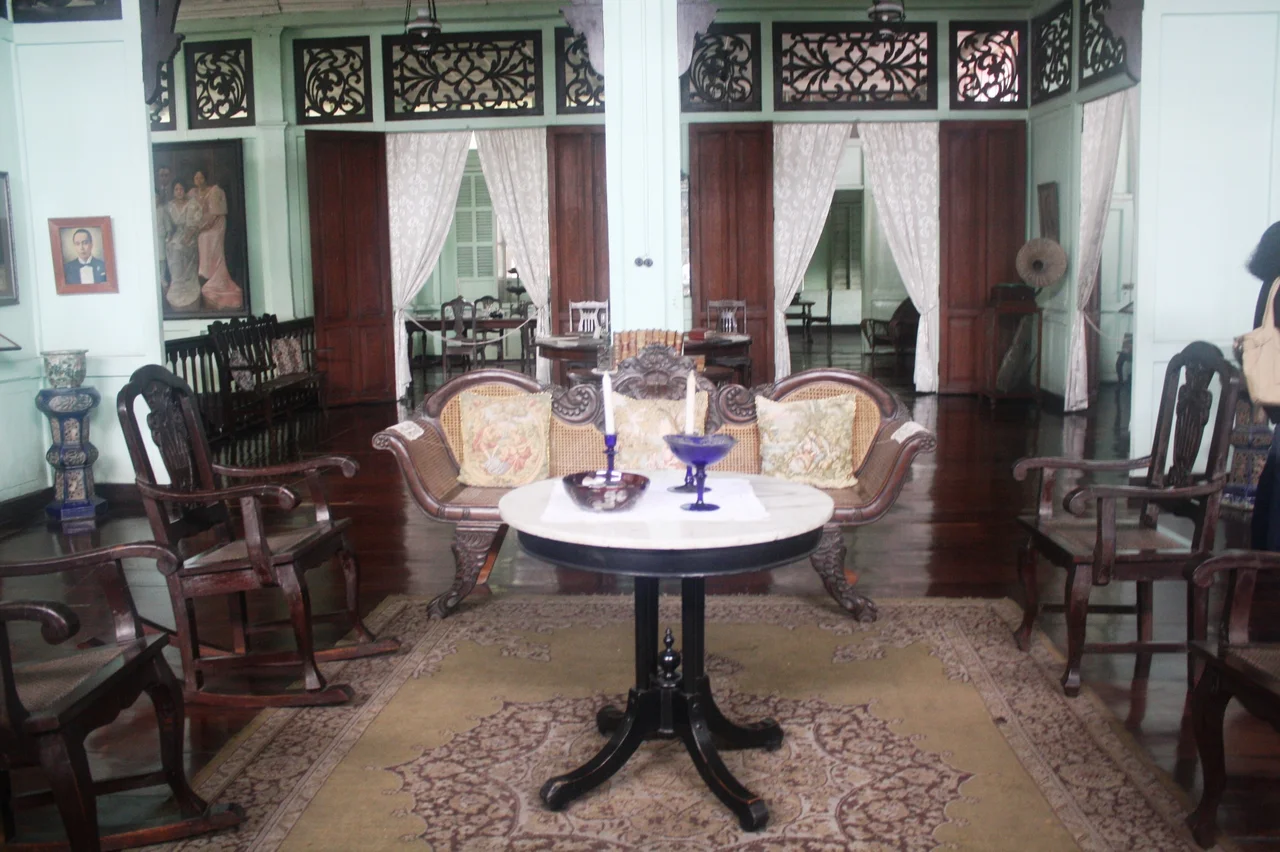

Bernardino Jalandoni Museum
You can find it by color alone. On Rizal Street in Silay City, where the heritage houses of Negros Occidental's sugar elite line the road in muted earth tones, one building breaks ranks in conspicuous pink. The Bernardino Jalandoni Museum, known simply as the Pink House, has been grabbing attention since 1908, and the story of how it survived to keep doing so involves a road, a fight, and a community that decided its past was worth more than a wider highway.
From Iloilo to Negros
Don Bernardino Jalandoni and his wife Dona Ysabel Lopez Ledesma were not Silay natives. They migrated from Jaro, Iloilo City, crossing the Guimaras Strait to settle in the sugar country of western Negros. In Silay, along the main highway, they built a house that matched the opulence of the early twentieth century's landed class. The structure was completed in 1908, a two-story bahay na bato built from balayong hardwood shipped from the island of Mindoro. From the outside, its proportions follow the traditional nipa hut's silhouette, elevated on posts with a steep roof, but scaled up dramatically and rendered in materials meant to last centuries.
The Road That Narrowed
Walk along Rizal Street today and you will notice something odd: the road narrows directly in front of the Jalandoni House. This is not a quirk of colonial-era surveying. When a modern road expansion project threatened to demolish the heritage houses along its path, a group of Silaynons intervened. They fought for the preservation of these structures, arguing that widening a road was not worth erasing the physical record of their city's golden age. The campaign succeeded, and the road bends around the old houses rather than through them. On November 6, 1993, the National Historical Institute declared the Jalandoni House a National Historical Landmark, the first building in Silay to receive the designation.
Hamburg Ceilings and Capiz Windows
Inside, the house reveals how globally connected the Philippine sugar aristocracy actually was. Look up in any room and the ceilings are embossed steel trays imported from Hamburg, Germany. The wooden transoms are carved in callado style, an intricate cut-out technique that channels elaborate French design into tropical hardwood. The windows use capiz shells instead of glass, the translucent, wafer-thin shells of the windowpane oyster that admit a soft, diffused light while providing privacy. Downstairs, two carts and a horse carriage occupy what was once the garage. Upstairs, where the family actually lived, the receiving area displays an old Steinway piano, a gramophone, and several paintings. In the bedrooms stand four-post beds with chamber pots tucked beneath them, alongside a birthing chair. The kitchen preserves the heavy wooden prinsa de paa and prinsa de mano, and the round irons once used to press clothes.
A Living Heritage
The museum is now maintained by the Silay Heritage Foundation, entrusted by Antonio J. Montinola, Bernardino's grandson through his only daughter Angeles Jalandoni Montinola. Rather than existing as a static exhibit, the Pink House serves as a venue for artistic, cultural, and educational events. Performances fill the rooms where a sugar baron's family once entertained. Exhibitions occupy the spaces where children once played. The building's pink exterior, which might seem whimsical, is in fact the most honest thing about it: a house that refuses to blend in, on a street that refused to let it disappear.
From the Air
Located at 10.80N, 122.98E on Rizal Street in Silay City, Negros Occidental. The nearest airport is Bacolod-Silay International Airport (RPVB), just a few kilometers south. From the air, Silay's heritage district is distinguishable as a dense cluster of older buildings along the main road corridor. The flat coastal plain of western Negros offers excellent visibility.
Nearby Stories
- Escalante, Negros Occidental 11 km away
- Baroque Churches of the Philippines 22 km away
- Kanlaon Volcano 32 km away
- Jalaur Dam 46 km away
- Cebu 60 km away
- Maniguin Island Lighthouse 92 km away
- Canatuan Mine 313 km away
- Sinking of MV Sewol 2588 km away