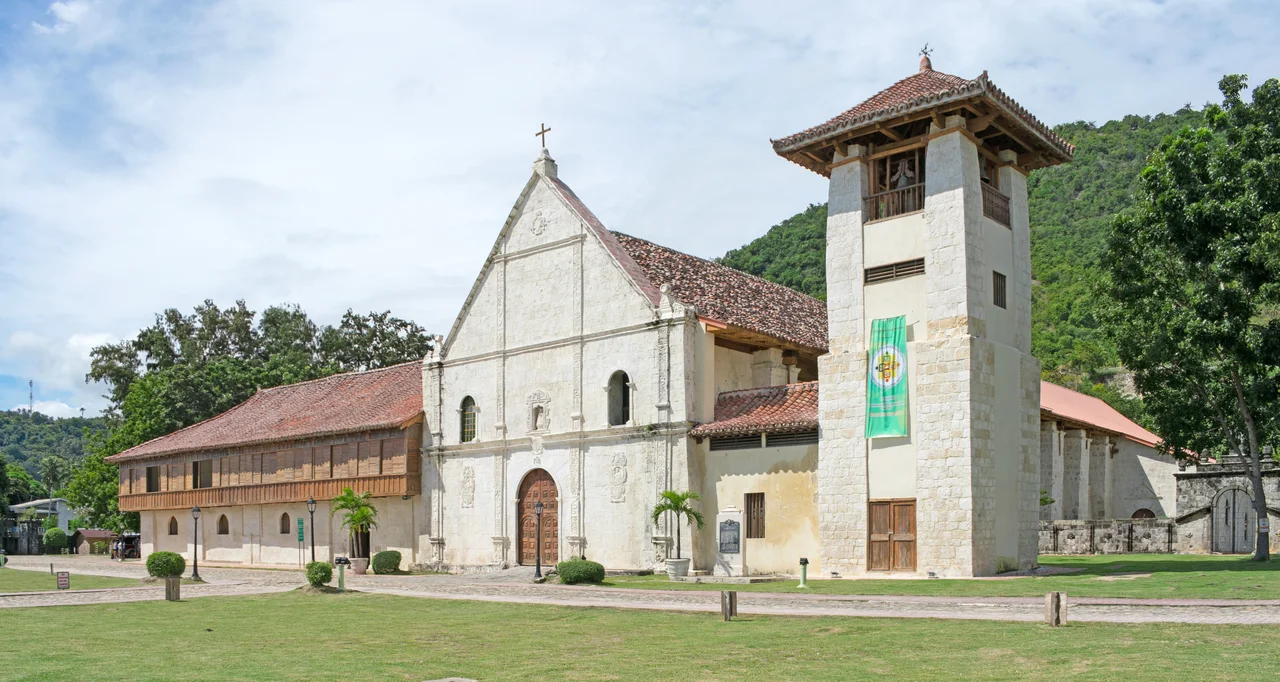

Cebu
Before it was Cebu, it was Singhapala, the Lion City. The pre-colonial kingdom that occupied this narrow island in the central Philippines traced its founding to Sri Lumay, a half-Malay, half-Tamil ruler from Sumatra, and its capital bore a Tamil-Sanskrit name that shares the same root as modern Singapore. When Antonio Pigafetta, the Italian chronicler sailing with Ferdinand Magellan, tried to write it down in 1521, he mangled it into 'Cingopola.' The Visayans themselves had no standardized spelling. The island's name drifted through Zubu and Cubu before settling into the form the world knows now. But Cebu has always been a place where names and identities layer over one another, each era adding its own.
The Cross and the Battle
Magellan arrived on March 16, 1521, guided to Cebu by Rajah Kolambu of Mazaua. With Enrique of Malacca translating, the Portuguese explorer befriended Rajah Humabon, the local chief, and persuaded him to accept baptism along with some 400 Cebuanos. Magellan erected a large wooden cross on the shore, the same relic now preserved as Magellan's Cross in downtown Cebu City. But the expedition's triumph was brief. Across a narrow channel on Mactan Island, Datu Lapu-Lapu refused to submit. On April 27, the Battle of Mactan became one of the earliest recorded acts of resistance against European colonization in Southeast Asia. Magellan was killed. His body was never recovered. His second-in-command, Juan Sebastian Elcano, sailed the remaining ships home to Spain, completing the first circumnavigation of the globe while leaving Cebu to forty more years of independence before the Spanish returned.
Colony, Conquest, and the Child
Miguel Lopez de Legazpi arrived on April 27, 1565, exactly 44 years after Magellan's death. He came prepared for war but hoping for trade. The reception was hostile. After a brief confrontation, Spanish artillery scattered the defenders into the forest. Among the salvage from an abandoned settlement, a soldier named Juan de Camuz found a carved image of the Child Jesus, almost certainly the one Magellan had presented to the consort of Rajah Humabon decades earlier. A church was built on the spot, becoming the Minor Basilica of the Holy Child, one of the oldest Christian shrines in Asia. Legazpi established a fort, negotiated terms with Rajah Tupas, and made Cebu the first capital of the Spanish East Indies. By the 1700s, the island was home to 625 Spanish Filipino families and 28,112 native families.
An Island of Earthquakes and Resistance
Cebu's modern history is written in tremors, both seismic and political. In February 2012, a magnitude 6.7 earthquake off neighboring Negros shook the island, the largest quake in the area for 90 years. The following October, a record-setting 7.2 magnitude earthquake struck Cebu and Bohol, killing 222 and collapsing five historic churches. Typhoon Haiyan devastated the northern part of the province a month later. In December 2021, Typhoon Rai swept across the province, prompting a declaration of calamity. The political tremors have been no less significant. During the Marcos dictatorship, Cebu became a center of resistance. When martial law was declared in September 1972, columnist and future National Artist Resil Mojares was among those immediately arrested. Redemptorist priest Rudy Romano, a prominent critic of the regime, was abducted on June 11, 1985, and never seen again.
Coral and Commerce
The province's 167 surrounding islands and islets occupy waters identified as a site of highest marine biodiversity importance in the Coral Triangle. Endemic species include the Cebu Flowerpecker, a bird once featured on the official stamp of Cebu; the Cebu Slender Skink; and the Kawasan Paper Kite Butterfly, found only near the waterfalls of Badian. But Cebu's economy extends far beyond its reefs. The province has transformed into a global hub for business process outsourcing, with the industry generating hundreds of millions of dollars in annual revenue. Mactan-Cebu International Airport, on Mactan Island, is the second busiest in the Philippines. The city's lechon, a whole roasted pig with crackling skin, has achieved near-mythic status in Philippine cuisine, while rosquillos cookies from Liloan and otap pastries are carried home by visitors as edible proof of having been there. In 2019, Cebu welcomed 1.4 million foreign tourists, making it one of the most visited destinations in the country.
From the Air
Coordinates: 10.317N, 123.891E, the main island of Cebu province in the Central Visayas. Cebu Island is long and narrow, stretching 196 km north to south and only 32 km at its widest. It is flanked by Negros to the west, Bohol to the southeast, and Leyte to the east. Mactan-Cebu International Airport (RPVM) is the primary gateway, located on Mactan Island connected to the main island by bridges. From cruising altitude, the island's distinctive elongated shape is unmistakable, with the densely urbanized Metro Cebu area visible roughly midway along the eastern coast.
Nearby Stories
- Republic of Negros 5.6 km away
- Argao Church 16 km away
- Daku Balay 17 km away
- Negros Occidental 32 km away
- Escalante, Negros Occidental 33 km away
- November 2023 Mindanao Earthquake 504 km away
- Sinkyo Maru 558 km away
- Sinking of MV Sewol 2641 km away