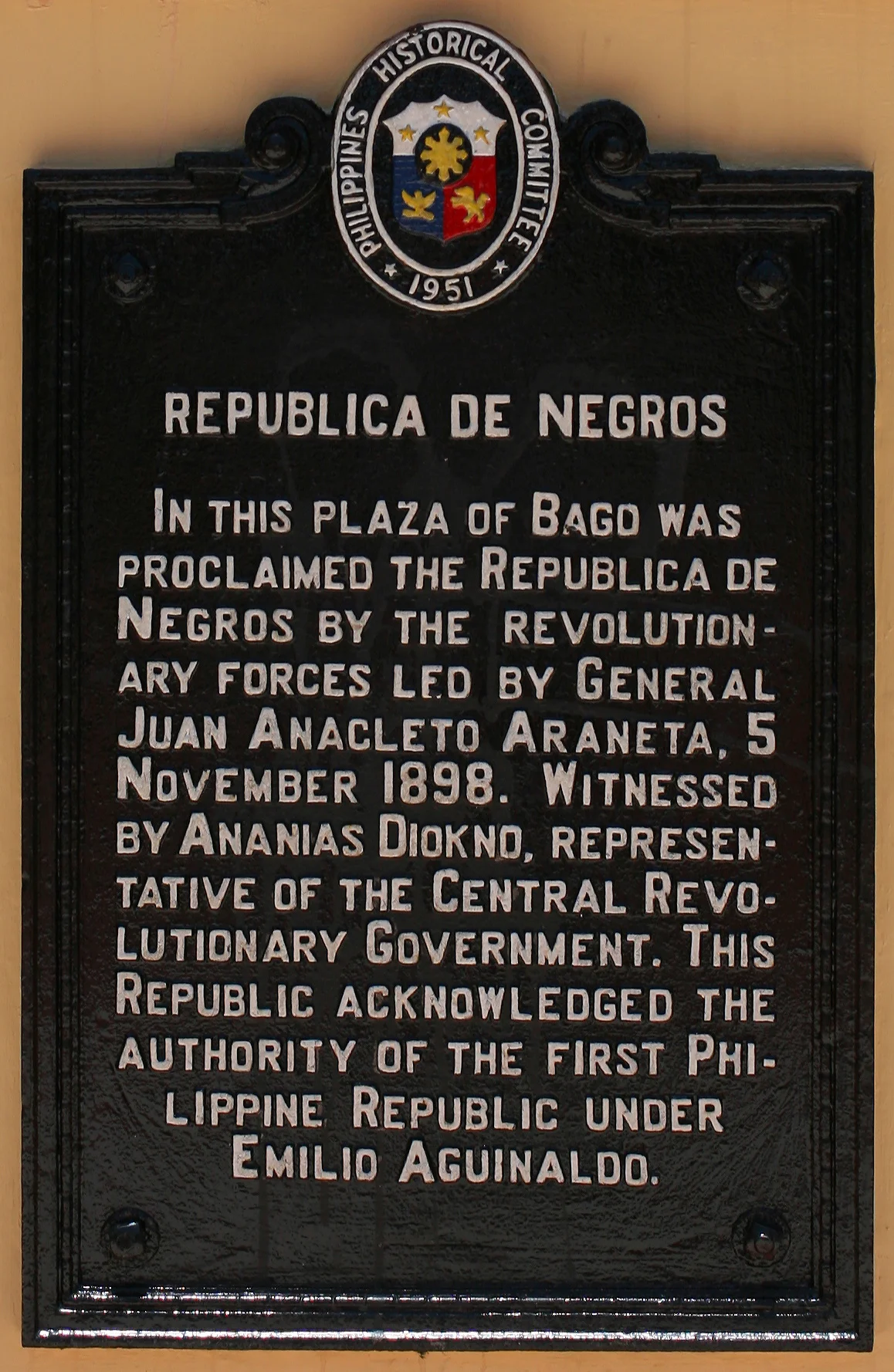

Republic of Negros
The rifles were carved from palm fronds. The cannons were rolled bamboo mats, painted black to look like iron barrels from a distance. On November 5, 1898, when Spanish officials on the island of Negros looked out at the armed columns marching in a pincer movement toward Bacolod, they saw what appeared to be an overwhelming force and surrendered. They had been defeated by a prop army. The revolutionaries who pulled off this audacious bluff -- led by Generals Juan Araneta from Bago and Aniceto Lacson from Talisay -- had just achieved one of the most theatrical victories of the Philippine Revolution, establishing a republic that would last barely four months before surrendering to American forces -- but would never be forgotten.
The Bluff That Built a Nation
The uprising began on November 3, 1898, as Negrenses across the island rose against the Spanish colonial government headed locally by politico-military governor Colonel Isidro de Castro. The Spanish position on Negros was already weakened -- Spain had lost the Battle of Manila Bay to the Americans in May, and revolutionary movements were spreading across the archipelago. But the local revolutionaries lacked real weapons. What they had was ingenuity and nerve. Araneta and Lacson organized their forces into columns that converged on Bacolod from multiple directions, creating the impression of a coordinated military operation with superior numbers and firepower. By November 5, the Spanish officials had seen enough and surrendered themselves to native troops. The bluff had worked perfectly.
A Republic in Three Acts
The political entity that emerged went through rapid transformations. A provisional government formed immediately with Aniceto Lacson as president, and Melecio Severino transmitted notice of the revolution's success to President Emilio Aguinaldo on Luzon. On November 27, 1898, a unicameral Congress of Deputies met in Bacolod and declared the establishment of the Republican Canton of Negros, formally linking the island to the First Philippine Republic. The Congress acted as a constituent assembly, drafting a constitution for what it envisioned as a permanent government. But permanence was not available. On March 4, 1899, the hacendero-led cantonal government surrendered to invading American forces. The entity was reorganized as the Federal Republic of Negros under U.S. protection, and eventually annexed to the Philippine Islands simply as the Republic of Negros. From revolution to republic to protectorate to annexation -- the entire arc took roughly two and a half years.
The Sugar Lords Who Shaped a Revolution
The revolution on Negros had a character distinct from uprisings elsewhere in the Philippines. The island's economy was dominated by sugar haciendas, and the revolutionary leadership came largely from the hacendero class -- the plantation owners who had the resources, organization, and social authority to mount a rebellion. Juan Araneta was based in Bago, a sugar-producing town; Lacson operated from Talisay. Their revolution was not a peasant uprising but a planters' revolt, driven by elite dissatisfaction with Spanish governance as much as by nationalist ideals. This class dimension shaped the republic's brief existence and its ultimate willingness to transfer allegiance to American authority when the strategic calculus shifted. The hacenderos had overthrown one colonial master; they calculated they could work with the next.
Cinco de Noviembre
The memory of the bamboo-cannon revolution lives on in Negros Occidental. November 5 -- Cinco de Noviembre -- has been officially observed as a special non-working holiday in the province since 1989, established by Republic Act No. 6709. In the main square of Bago, where Juan Araneta organized his forces, a historical marker commemorates the republic. The inscription records the key dates and figures, but the story it tells is really about the power of audacity. The Negrenses did not wait for real weapons to arrive from Luzon or for American forces to do the job for them. They carved their own rifles, painted their own cannons, and marched on the capital with the conviction that appearing dangerous was, in that particular moment, indistinguishable from being dangerous. The Spanish garrison agreed.
From the Air
Located on Negros Island at approximately 10.00N, 123.00E. Bacolod, the center of the revolutionary activity, is served by Bacolod-Silay Airport (RPVS). The sugar haciendas that formed the economic base of the revolution are visible as large agricultural plots across the western lowlands of Negros. Bago, where Juan Araneta was based, is approximately 25 km south of Bacolod. Best viewed at 5,000-10,000 feet AGL to appreciate the scale of the sugar landscape.
Nearby Stories
- Moalboal 2 km away
- Boljoon Church 9.8 km away
- Pamplona Massacre 34 km away
- Kanlaon Volcano 37 km away
- San Joaquin Church (Iloilo) 49 km away
- Cebu 56 km away
- Baroque Churches of the Philippines 80 km away
- Canatuan Mine 215 km away