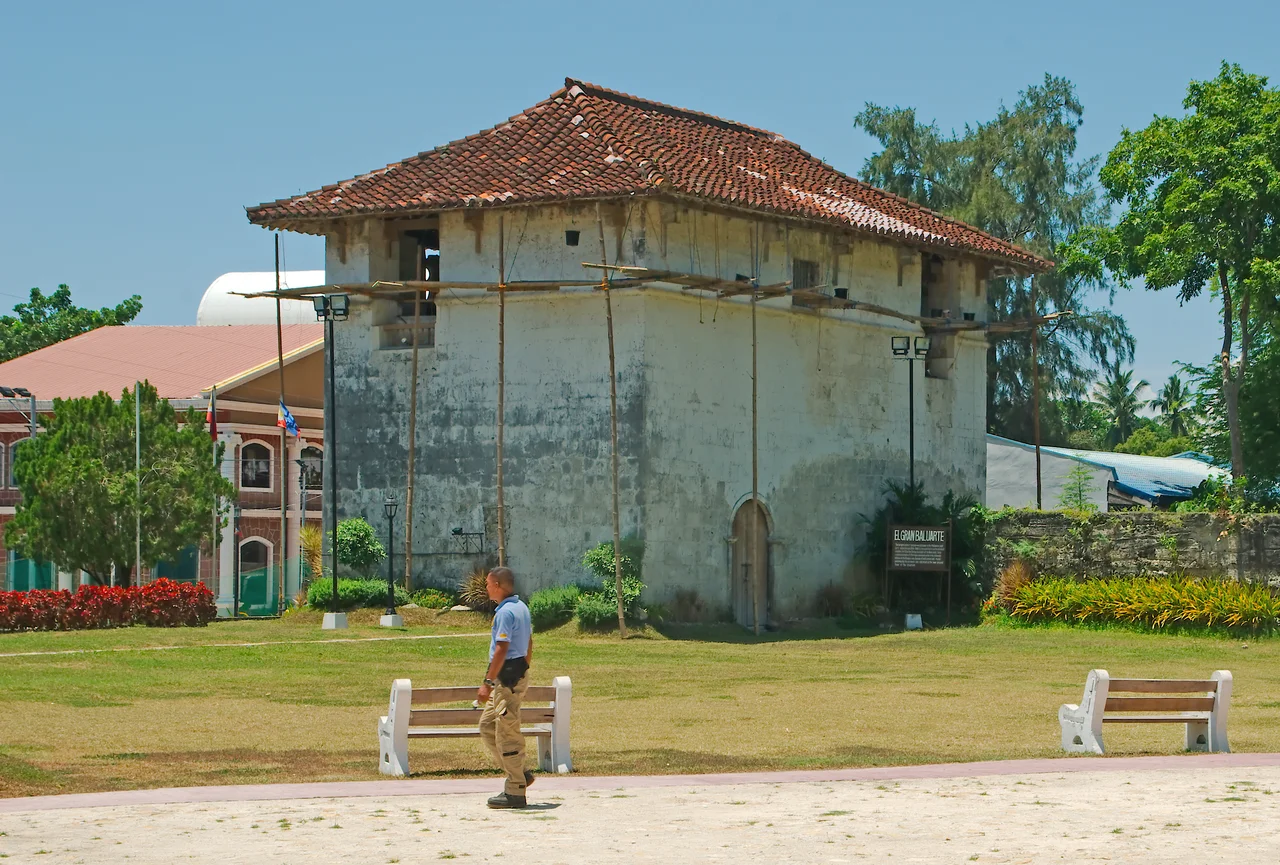

Boljoon Church
The walls are two meters thick. They are made of coral stone and mortar, supported by twenty-eight pillars, and they were built not just to hold a roof but to withstand attack. Boljoon Church -- formally the Archdiocesan Shrine of Patrocinio de Maria Santisima -- sits on a hill overlooking the sea on Cebu's southeastern coast. It is a fortress church in the most literal sense: constructed to defend its congregation against the Moro raiders who terrorized the Visayan coastline for centuries. Today it is the only church in Cebu designated as a National Cultural Treasure, and a candidate for UNESCO World Heritage status.
From Chapel to Fortress
Boljoon began as a small Christian settlement called Nabulho. In 1599, Augustinian missionaries established a chapel dedicated to the Patronage of the Virgin Mary, and the image of the Blessed Virgin was brought from Spain by Fray Bartolome de Garcia. The growing Christian population prompted elevation to a full parish on October 31, 1690, with Father Nicolas de la Cuadra as its first parish priest. The present stone church was constructed in 1783, and Father Julian Bermejo added the blockhouse -- a quadrangular fortification called Dakong Balay, or Big House -- when he arrived in 1808. The church complex was designed as a complete defensive system: walls, watchtowers, bell tower, and blockhouse, all built of coral stone quarried from the coast below.
Terracotta and Filipino Baroque
What makes Boljoon architecturally distinctive is not its fortifications but its art. The church retains its original terracotta roof tiles, a rarity among Philippine colonial churches. Inside, the choir screen and pulpit display a style scholars call Filipino Baroque -- folk art traditions woven into European architectural forms. The main retablo combines pseudo-baroque and rococo elements with gold leaf highlights and polychrome accents. The rectangular bell tower, which once held seven bells, served double duty: its ground floor was used as a prison cell, likely for captured pirates, as evidenced by drawings of ships scratched into the walls by former prisoners.
The Stolen Panels Come Home
In the 1980s, five early 19th-century panels depicting various saints disappeared from the church's pulpit. Whether they were stolen or illegally sold by a parish priest remains disputed. Four of the panels resurfaced decades later in the private collection of Union Bank of the Philippines CEO Edwin Bautista, who donated them to the National Museum in February 2024. The donation ignited a fierce public dispute. The Archdiocese of Cebu and provincial officials demanded the panels' return to Boljoon. The Cebu Provincial Board voted to file charges against the National Museum. After months of legal and public pressure, the Museum's board of trustees ruled in favor of returning the panels. On March 13, 2025, the panels were formally handed over at the Cathedral Museum of Cebu and brought to Boljoon the next day. The church continues to seek recovery of an 18th-century tabernacle auctioned in 2017.
Cemetery, Watchtower, and the Weight of Centuries
The church complex extends beyond the building itself. The cemetery, where burials likely began in the 1760s, features a symmetrical coral-stone gateway with a three-layered pediment and a relief of a human skeleton carved on top. The Ilihan watchtower ruins, built by Father Bermejo as part of the church's broader fortification network, stand on the coast nearby. The image of Nuestra Senora del Patrocinio de Boljoon -- a carved wooden Madonna and Child dressed in white and blue vestments with a gold veil -- received a pontifical decree of Canonical coronation in 2022, as part of ceremonies marking 500 years of Christianity in the Philippines. From chapel in the jungle to fortress against raiders to National Cultural Treasure, Boljoon Church has accumulated four centuries of meaning in its coral-stone walls.
From the Air
Boljoon Church sits on a hillside overlooking the sea on Cebu's southeastern coast at approximately 9.63N, 123.479E. From the air, the coral-stone church complex is visible as a compact cluster of structures on elevated ground near the coastline. The Tanon Strait lies to the west, with Negros Island visible beyond. The nearest major airport is Mactan-Cebu International Airport (RPVM), approximately 115 km to the north. The church, bell tower, and blockhouse form a recognizable grouping at lower altitudes.
Nearby Stories
- Argao Church 5.6 km away
- Republic of Negros 18 km away
- Pamplona Massacre 20 km away
- Lazi Church 22 km away
- 1995 Ipil Massacre 178 km away
- November 2023 Mindanao Earthquake 428 km away
- Balut Island 486 km away
- Sinking of MV Sewol 2719 km away