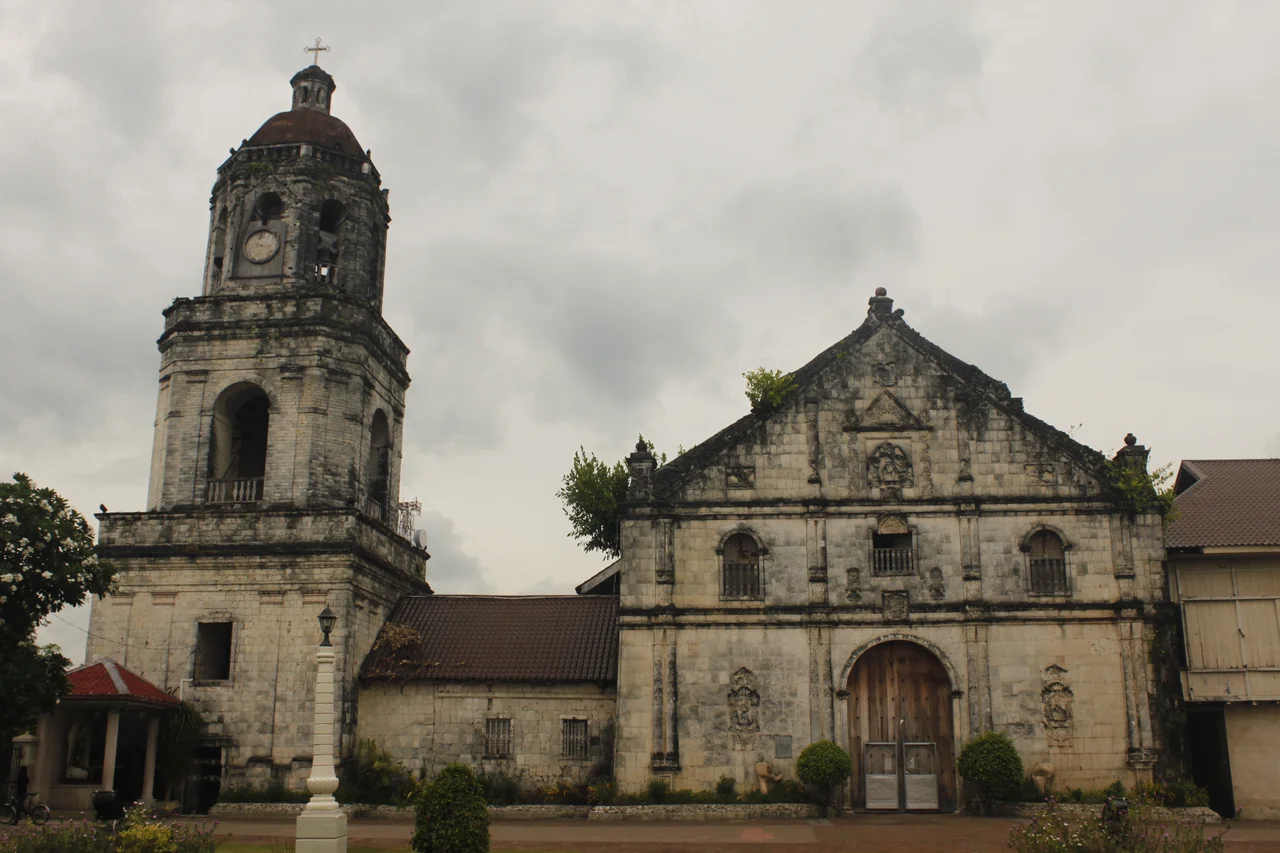

Argao Church
The skulls carved into the pediment give it away. Beside the front entrance of Argao Church stands a small coral stone building whose facade features ornate carvings of angels and human figures intertwined with skulls and bones. It was a mortuary chapel during the Spanish era, later repurposed as a leprosarium, then an autopsy room under the Americans. Most visitors walk right past it on their way to the church proper. But this single structure, with its unflinching decoration, captures something essential about Argao: a place where beauty and mortality have always occupied the same walls.
Coral and Conviction
The Augustinians established Argao as a parish in 1703. Construction of the stone church began in 1734 and took more than half a century to complete, finishing in 1788. The builders used coral stone, quarried from the reefs that line the Cebu coast, a material that gives the church its warm, porous texture and connects it physically to the sea. The facade is imposing: a highly ornate pediment crowned with oversized urn-like finials, double-pilaster columns framing the entrance, and a niche displaying the patron saint, San Miguel Arcangel. Inside, the cruciform plan opens into a single aisle with a double nave, where five gilded retablos anchor the sanctuary and transept. The main altarpiece holds three life-size statues of the archangels Michael, Raphael, and Gabriel, standing watch over a congregation that has gathered here for more than three centuries.
The Painted Ceiling
Look up inside Argao Church and you encounter one of the great puzzles of Cebuano art. The vaulted ceiling is composed of wooden panels arranged lengthwise, supported by corbels carved as protruding seraphs. Across this surface unfolds a series of paintings depicting the lives of angels and archangels, alongside scenes from Biblical scripture. Half were painted by Raymundo Francia, a renowned Cebuano master. The other half are the work of an unknown Boholano artist. Which panels belong to whom, and how two painters working in different styles managed to create something cohesive across such an expanse, remains a subject of quiet debate. The effect is seamless enough that most visitors never notice the seam.
A Fortress Against the Sea
Argao Church was not built merely as a house of worship. It was built to survive. During the 18th and 19th centuries, Moro raiders from the southern Philippines terrorized coastal communities across the Visayas, and the church complex was fortified accordingly. Thick coral stone walls, wide enough for sentries to walk atop, encircle the grounds. Four gateways pierce the perimeter, each with overhead beams spanning the passageway and stairways built into the columns for access to the wall's upper reaches. Two watchtowers, or baluartes, anchor the defenses: one at the front of the church, integrated into the fortified walls as a first line of warning, and one at the rear, now a ruin built from river stones in a riprap style. The convent beside the church served double duty as well, functioning as a seminary in the early 19th century. Today it houses the parish offices and the Museo de la Parroquia de San Miguel, an ecclesiastical museum whose collection of artifacts draws returning overseas Filipinos and tourists alike.
Stations in Stone
The church plaza is bounded by a low coral stone wall where processions have begun and ended for generations during religious feast days and civic celebrations. What makes this plaza extraordinary, even by Philippine standards, lies along those walls: fourteen high-relief carvings of the Via Crucis, the Stations of the Cross, depicted through symbolism rather than literal representation. This approach is unique and highly unusual in the Philippines, where the Stations are typically rendered as straightforward narrative scenes. At Argao, each station becomes an exercise in interpretation, the viewer drawn into an older, more allusive tradition of sacred art. Three statues on pedestals stand in the plaza, and light posts mark the paths where the faithful walk. The big wooden evangelization cross that once stood at the center is gone, but the clay tiles that used to pave the grounds have been replaced, and the processions continue.
Layers That Remain
The L-shaped Palacio, where Spanish dignitaries and visiting priests once stayed, was burned by the Japanese during World War II. Today the site serves as the Court of Justice, one more transformation in a place that has never stopped adapting. In 2016, the National Historical Commission installed a historical marker on the church, formalizing what generations of Argao residents already knew: this complex is irreplaceable. The bell tower rises three levels above the plaza, its square base giving way to octagonal belfries capped with a dome. A single large bell hangs on the second level, eight smaller ones on the third, connected to the church by a baptistry where the newest members of the parish have been welcomed for as long as anyone can remember. Argao Church endures not because it was preserved in amber, but because it kept being used.
From the Air
Coordinates: 9.882N, 123.608E, on the southeastern coast of Cebu Island. The church complex is visible in the town center of Argao, a coastal municipality approximately 68 km south of Cebu City. Nearest major airport: RPVM (Mactan-Cebu International Airport) approximately 75 km north. From altitude, Argao sits along the coast facing the Bohol Sea, with the mountainous spine of Cebu running behind it. The town's layout with church plaza at center is visible at lower zoom levels.
Nearby Stories
- Republic of Negros 9.2 km away
- Boljoon Church 11 km away
- Pamplona Massacre 29 km away
- Cebu 37 km away
- Daku Balay 54 km away
- November 2023 Mindanao Earthquake 466 km away
- Sinkyo Maru 522 km away
- Sinking of MV Sewol 2680 km away