.jpg)
Daku Balay
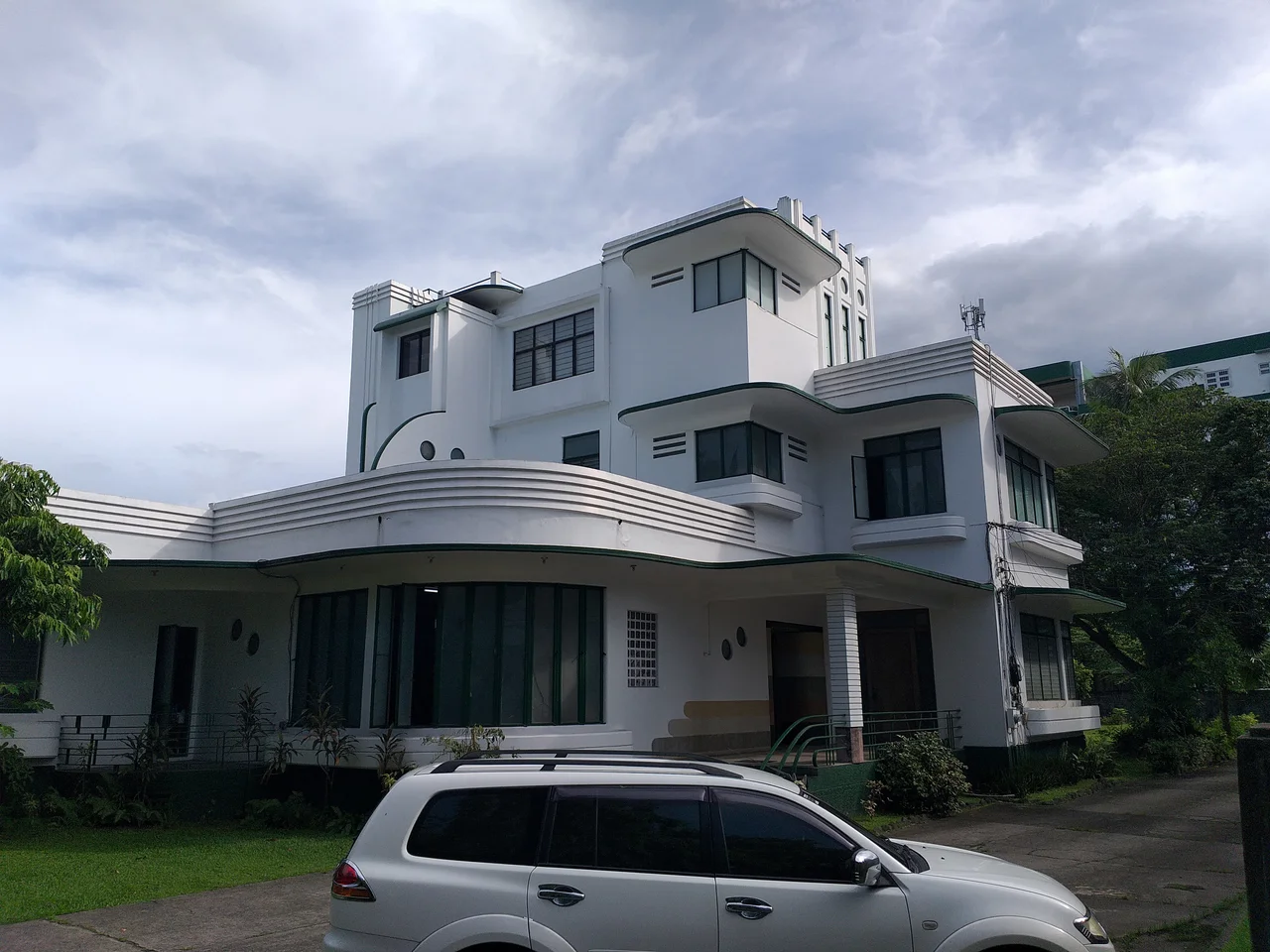
The neighbors called it the Boat House. With its curved concrete balconies, steel-cased porthole windows, and graceful parapets, the three-story mansion on Burgos Street in Bacolod looked like a landlocked ocean liner. The family had a simpler name: Daku Balay, Hiligaynon for big house. Its builder, sugar planter Generoso M. Villanueva, designed the entire structure himself, and according to family legend, he did it to settle a score -- fulfilling a vow to someday build the tallest house in the city so he could literally look down on the home of a business and political rival.
Art Deco from Local Hands
Villanueva took three years, from 1933 to 1936, to realize his vision. He hired Cebu engineer Salvador Cinco to execute the construction, but the design was entirely his own. The result was the first art deco structure in Bacolod, and it was built entirely from local materials. Despite the building's international sophistication -- its venetian-finish concrete walls separated by copper sidings, its handpainted glass featuring both native Philippine scenes and modernist European figures -- there is no record of Villanueva ever traveling abroad. He made frequent trips to Manila, where art deco architecture was flourishing in the 1930s, and brought that vision back to Negros Island. The 5,000-square-meter mansion, with its five-level roof deck exceeding 600 square meters, was the tallest building in Bacolod until the Philippine National Bank building surpassed it in 1959. It also housed the first elevator on Negros Island, manufactured by Inclinator of Philadelphia.
Hardwood, Snakes, and Spiders
Every detail in the Daku Balay carries Villanueva's personal stamp. The living room floors combine at least seven different Philippine hardwoods, selected by color and natural grain and laid in classical art deco patterns. Each of the solid molave doors is carved with delicate art deco designs and quilted carvings. The sweeping staircase to the third floor is measured so that the final step on each landing falls on oro in the traditional Filipino oro, plata, mata counting system, a Hispanic feng shui practice meant to ensure good fortune. Visitors entering from the back during rain are greeted by two carved stone snake heads whose bodies curve upward to form the sides of the foyer. But the crown jewel is the top-floor recreation room, originally the billiard room, where Villanueva cast animals permanently into the floor and walls of a six-meter-ceilinged chamber. An articulated metal sculpture of a spider and a fly perches at the ceiling's peak, giving the room its nickname and showcasing the patriarch's whimsical love of folk tales.
Seat of Power
When the Japanese occupied Bacolod on May 21, 1942, Lieutenant General Takeshi Kawano Kono seized the Daku Balay for his headquarters. The tallest building in the city became its watchtower. For the entirety of the war, the mansion served as the seat of power for the Japanese forces in Negros and the Central Visayas, with Kono both living and working within its art deco walls. When liberation came on May 29, 1945, through joint Filipino and American forces, the retreating Japanese could have destroyed the building. They did not. On Kono's orders, the Daku Balay was spared. The American 40th Infantry Division, the Sun Burst Division, moved in next, with Major General Rapp Brush occupying the house for approximately five months before the Villanueva family could finally come home.
The Patriarch's Legacy
What makes the Daku Balay remarkable is not just its architecture but the ambition that produced it. Generoso Villanueva was a sugar planter, not a trained architect or designer. He never saw the art deco landmarks of New York or Paris firsthand. Yet the building he imagined and brought to life on Burgos Street, once known as Millionaires' Row, remains one of the most distinctive heritage houses in the Philippines. The bas-relief on the second floor wall tells his story as he wished it to be remembered: a vision of bountiful land rewarding the hardworking farmer on his carabao, surrounded by women carrying the harvest toward a cornucopia, while a man plays a harana on the guitar. It is an idealized world rendered in plaster and stone by a man who built the tallest house in Bacolod to prove a point, and who embedded his dreams into every floor, wall, and whimsical metal spider along the way.
From the Air
Located at 10.670°N, 122.953°E on Burgos Street in central Bacolod, Negros Island. The mansion is part of the historic Millionaires' Row area, identifiable as a prominent three-story art deco structure among the heritage houses lining the street. Nearest airport is Bacolod-Silay International Airport (RPVB), approximately 15 km northeast. Best viewed at 1,500-2,500 ft AGL. The Negros Occidental Provincial Capitol complex is nearby to the north, and the Guimaras Strait is visible to the west.
Nearby Stories
- Sagay Massacre 9.9 km away
- Baroque Churches of the Philippines 12 km away
- Escalante, Negros Occidental 25 km away
- Hacienda Rosalia 30 km away
- Republic of Negros 44 km away
- Moalboal 47 km away
- Maniguin Island Lighthouse 105 km away
- Canatuan Mine 293 km away