
Hacienda Rosalia
The swimming pool at Hacienda Rosalia was not always for leisure. During World War II, the Gaston family used it as a hiding place, one of several wartime improvisations on a property that has been reinventing itself since the 1930s. The hacienda in Manapla, Negros Occidental, is the ancestral compound of a family whose French patriarch arrived in the Philippines and started an industry. Today the mansion, the gardens, and the curious Chapel of the Cartwheels remain, along with the memory of a film that used this setting to tell the story of the entire sugar aristocracy's collapse.
The Frenchman's Legacy
The Gaston family traces its Philippine origins to Yves Leopold Germain Gaston, a Frenchman credited as the first person to commercially produce cane sugar in Negros. That single innovation transformed the province. Sugar became the primary product of Negros Occidental, and the families who controlled the haciendas became the island's de facto aristocracy. Jose Gaston, one of Victor Gaston's sons, owned Hacienda Santa Rosalia. He married Consuelo Azcona and raised eight children on the property. The mansion he built in the 1930s is set within gardens of flowers, shrubs, potted palms, and herbs, a domestic landscape that softens the scale of the surrounding plantation.
Cartwheels and Holy Ground
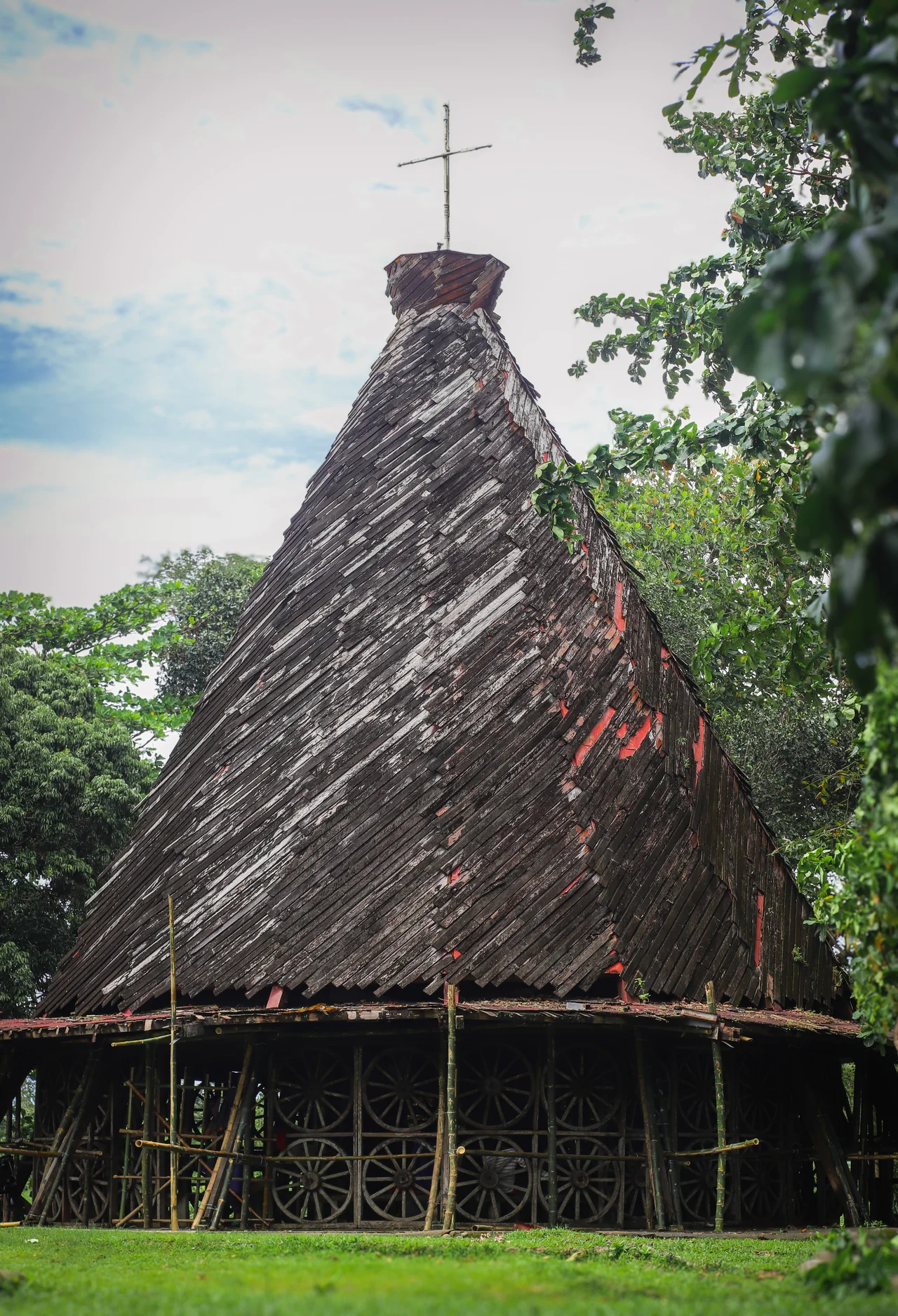
A few meters from the mansion stands the Chapel of the Cartwheels, one of the more unusual sacred structures in the Visayas. The chapel takes its name from its distinctive architectural elements, cartwheel motifs incorporated into the design. Within the broader compound, the chapel anchors the spiritual life of the hacienda just as the mansion anchors its domestic life. Together, house and church illustrate how the sugar haciendas of Negros functioned as self-contained worlds: the owner's family, their workers, their worship, and their recreation all coexisting within the same fenced boundaries. The Victorian fountain, the basketball court, the windmill, and the time-worn shoe house that once served as a children's playground complete the picture of a compound designed to provide everything its residents might need.
Oro, Plata, Mata
In 1982, director Peque Gallaga used Hacienda Rosalia as a location for Oro, Plata, Mata, an epic film widely regarded as one of the finest in Philippine cinema. The title, translated as Gold, Silver, Death, refers to a Filipino superstition about staircases, and the film chronicles the collapse of the sugar aristocracy during the Japanese occupation. Gallaga chose the hacienda because it embodied exactly the world his characters were losing: the ordered gardens, the grand rooms, the chapel, the sense of a universe complete within its gates. The film transformed the hacienda from a family estate into a cultural landmark, its rooms and grounds now carrying a double identity as both historical site and cinematic setting.
Roots in Silay
The story of Hacienda Rosalia cannot be told without Silay City, twenty kilometers down the coast. Victor Gaston's house in Silay, Jose's father's home, is now the Balay Negrense museum, the first museum established in Negros Occidental. The connection between the two properties traces the arc of the Gaston family's expansion: from the Frenchman's arrival, to commercial sugar production, to the grand urban house in Silay, to the working plantation in Manapla. Hacienda Rosalia is the rural counterpart to Balay Negrense's urban elegance. Where the Silay house preserves the social world of the sugar baron, the hacienda preserves the productive world, the land and labor that made the social world possible.
From the Air
Located at 10.91N, 123.15E in Manapla, Negros Occidental. The nearest major airport is Bacolod-Silay International Airport (RPVB), approximately 25 km to the southwest. From the air, the hacienda compound is identifiable within the sugarcane flatlands of northern Negros. The Chapel of the Cartwheels and the mansion are clustered together amid gardens, distinguishable from the surrounding agricultural landscape. Manapla sits on the northern coast, with views toward the Visayan Sea.
Nearby Stories
- Northern Negros Natural Park 10 km away
- Fort San Pedro (Iloilo) 13 km away
- Santa Barbara Church (Iloilo) 25 km away
- Gigantes Islands 41 km away
- Cebu 48 km away
- Maniguin Island Lighthouse 116 km away
- November 2023 Mindanao Earthquake 617 km away
- Sinking of MV Sewol 2565 km away