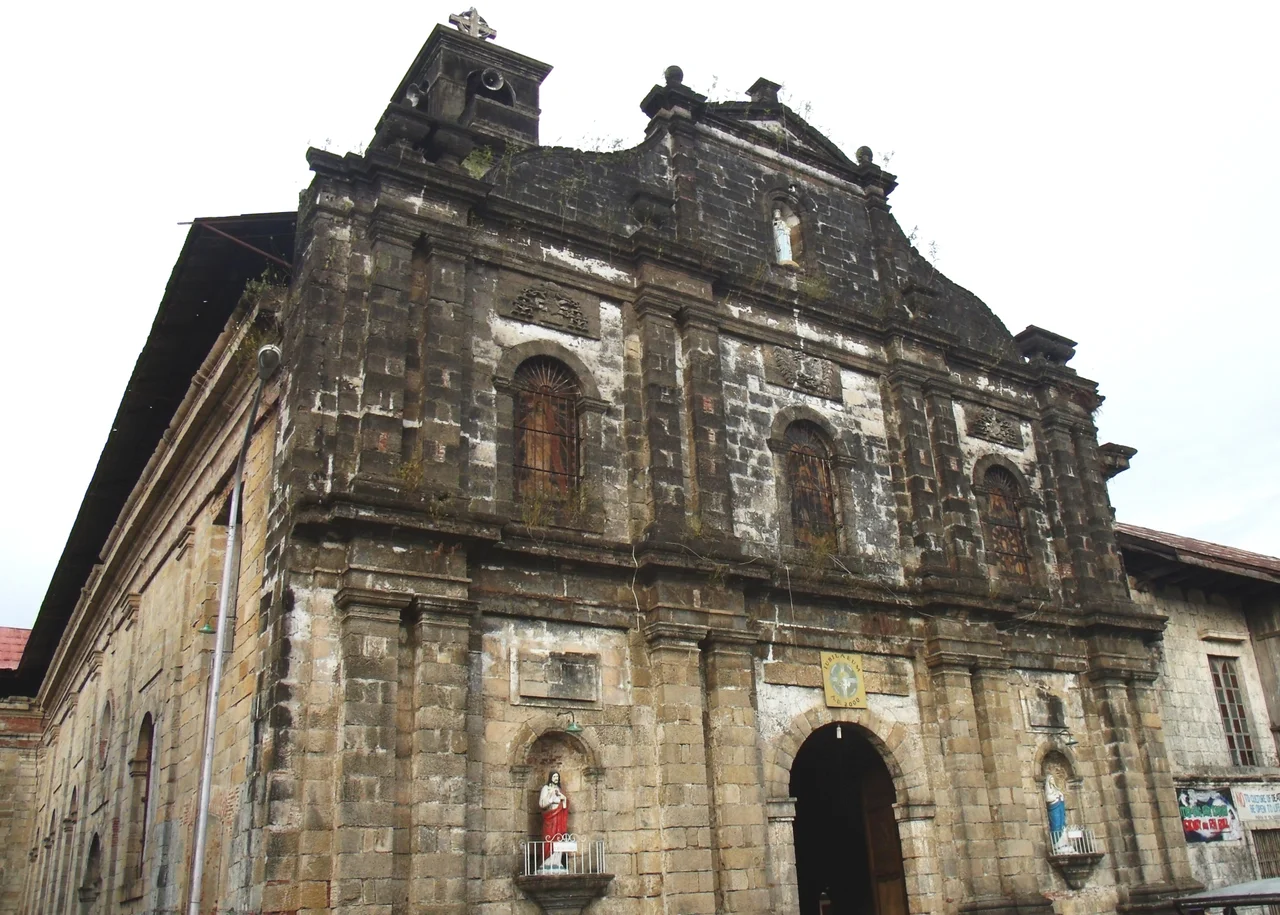

Santa Barbara Church (Iloilo)
General Martin Delgado chose this church. Not any church on Panay, not a fortified position or a mountain redoubt, but the Santa Barbara Parish Church in Iloilo province -- an Augustinian structure built from quarried stone and hardwood, paid for by parishioner taxes and constructed through forced labor under Spanish colonial law. It was here that Delgado convened the junta that ignited the first Cry of Revolution against Spain outside Luzon, turning a house of worship into the birthplace of Visayan independence. The building that colonial power had compelled its subjects to erect became the building where those subjects declared they had had enough.
Stone by Forced Hand
The parish became independent in 1760 when the settlement near the Tigum and Aganan rivers was elevated to the status of a pueblo. Father Juan Ferrer led the new parish under the patronage of Saint Barbara. But the church that stands today dates to 1845, when Father Francisco Aguerria arrived and began construction of the permanent Augustinian structure. The project was funded through parishioner taxes of eight to twelve reales, while the labor itself was extracted through the repartimiento system, which required men over sixteen to provide forty days of forced labor for Spanish public works and private farms. Wealthier residents could pay their way out. Workers quarried stone and harvested mulawon and mangle wood from the municipalities of Leon, Alimodian, and Tubungan. The builders sketched their plans directly onto the walls and columns of the rising church, as no formal architectural drawings existed.
The Cradle of Independence
The revolution that swept through Luzon in 1896 took two more years to reach the Visayas, but when it arrived, Santa Barbara Church was its staging ground. General Martin Delgado of the Visayan Revolutionary Government convened a junta within the church's walls that launched the first armed uprising against Spanish authority outside the main island of Luzon. The church subsequently served as the general headquarters and military hospital of the revolutionary forces, its neoclassical nave repurposed for triage and strategy sessions. In 1991, the National Historical Commission of the Philippines recognized the building's role by declaring Santa Barbara Church and its adjacent convent a National Landmark. The designation acknowledges that independence in the Philippines was not born in a single place but ignited across an archipelago, and that this stone church beside two rivers was one of the sparks.
Austere Facade, Moorish Convent
The church's neoclassical facade is deliberately unembellished, a contrast to the Churrigueresque extravagance found at other Iloilo churches. Four sets of Tuscan pilasters divide the front plane into sections. The central division frames the main entrance, while niches at either end hold icons of the Blessed Virgin and the Sacred Heart of Jesus. Three stained glass windows on the upper level indicate the choir loft within, and the side windows are capped with crests: the Pope's on the left, the Augustinians' on the right. At the very top, a niche shelters a statue of St. Barbara herself. The adjacent convent is a different architectural conversation altogether, its design drawing on Moorish motifs that feel transplanted from Andalusia to the Philippine tropics.
A Presidential Restoration
Santa Barbara Church and its convent underwent a significant restoration ahead of Philippine Independence Day in 2015. President Benigno Aquino III chose to celebrate the national holiday in Santa Barbara, Iloilo, a decision that underscored the site's symbolic importance to the broader narrative of Philippine independence. The National Historical Commission of the Philippines supervised the restoration, which preserved the church's neoclassical character while reinforcing the aging stone and woodwork. The choice of Santa Barbara for the national celebration was itself a statement: independence was not only a Manila story, not only a Luzon story, but a Visayan story too, and this church, built by conscripted hands and liberated by revolutionary ones, stood as proof.
From the Air
Located at 10.828°N, 122.532°E in the municipality of Santa Barbara, Iloilo province, on the eastern coast of Panay Island. The church and convent complex sit in the town center, identifiable from the air by the church's neoclassical facade and adjacent convent. Nearest airport is Iloilo International Airport (RPVI), approximately 20 km to the south. Best viewed at 2,000-3,000 ft AGL. The Tigum and Aganan rivers flow near the town.
Nearby Stories
- St. Joseph the Worker Chapel, Victorias 7.9 km away
- San Jose de Buenavista 9.3 km away
- Jalaur Dam 13 km away
- Kanlaon Volcano 18 km away
- Guimaras Oil Spill 37 km away
- Maniguin Island Lighthouse 67 km away
- Gigantes Islands 67 km away
- Tubbataha Reef 293 km away