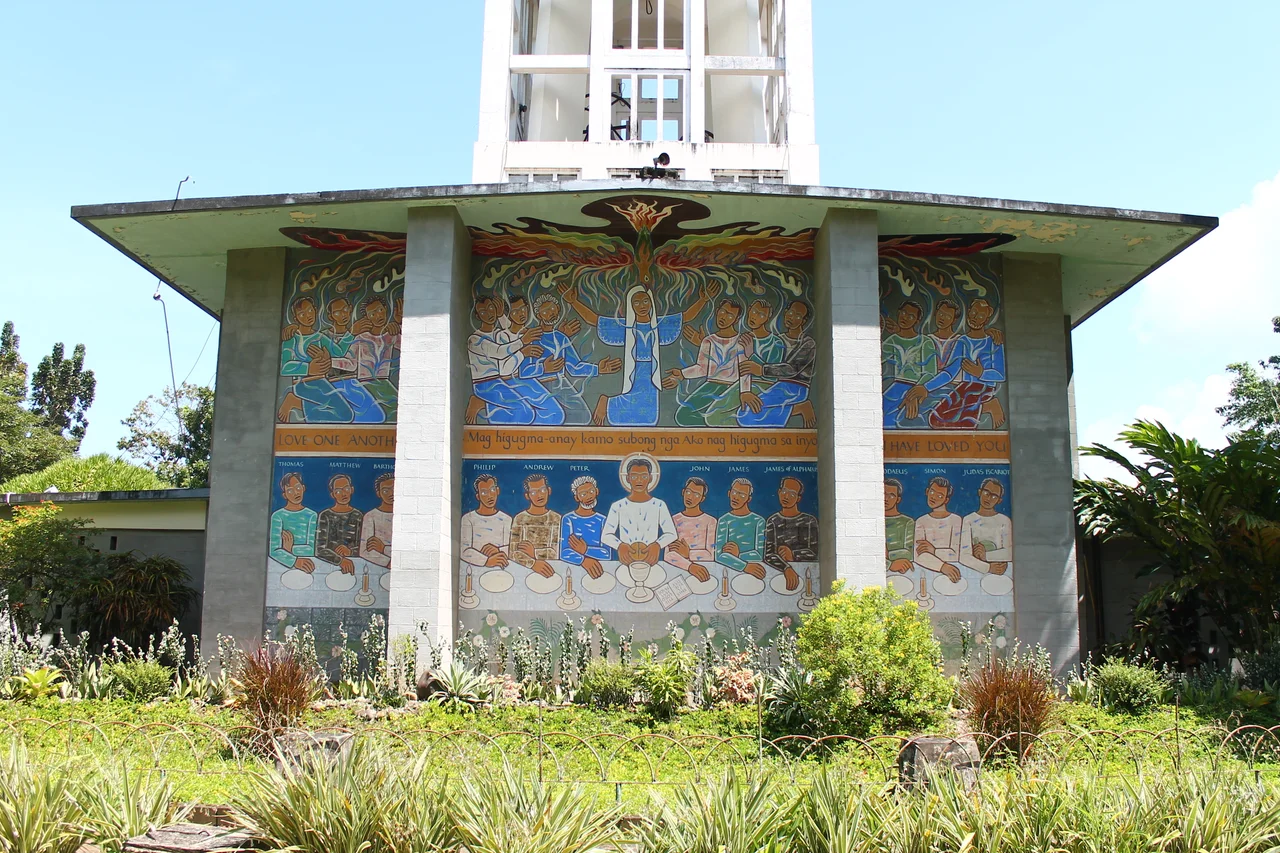

St. Joseph the Worker Chapel, Victorias
The Christ on the wall does not look merciful. His eyes blaze from a riot of color, his expression fierce, almost accusatory. Visitors to the St. Joseph the Worker Chapel in Victorias City have called the mural many things since Alfonso Ossorio painted it in 1950, but the name that stuck is the simplest: the Angry Christ. That a small chapel inside a sugar milling company's residential compound would house one of the most provocative works of religious art in the Philippines is the kind of story that only Negros Occidental can produce, where sugar money, global art connections, and Catholic devotion have always intertwined.
A Chapel Built for Earthquakes
The Ossorio family, who owned interests in the Victorias Milling Company, commissioned the chapel between 1948 and 1950. They initially considered offering the project to Leandro Locsin, then a young and unproven Filipino architect. They changed their mind and selected Antonin Raymond, a Czech-American architect already recognized as one of the founders of modern architecture in Japan. Raymond had designed buildings across the United States, Japan, India, and Indonesia. His design for the Victorias chapel addressed the Philippines' seismic reality head-on: the structure consists of two sections, the nave and the tower, connected by movable beams that allow the building to flex during earthquakes rather than crack. He also designed for the tropical climate, maximizing air circulation through the hot, humid interior. The result is considered the first example of modern sacred architecture in the Philippines, and in December 2015, it was declared an Important Cultural Property of the nation.
Pollock's Friend at the Altar
Alfonso Ossorio was born in the Philippines but made his career in the New York art world, where he moved in the circle of Jackson Pollock and Clyfford Still. His mural for the family chapel dominates the sanctuary wall: a vibrant, confrontational image centered on a large eye and the angry-looking figure of Christ. The painting owes nothing to the sentimental religious art that filled Philippine churches for centuries. It is abstract expressionism applied to devotion, and its emotional register is closer to judgment than to comfort. Ossorio's intent was not to soothe worshippers but to challenge them, creating a Christ who demands rather than invites. The sanctuary itself has no reredos, no ornamental screen behind the altar. There is only the mural, filling the wall with a force that makes decoration redundant.
Brown Skin in the Stations of the Cross
While Ossorio's mural draws the headlines, the chapel's most quietly radical art may be the work of two local artists. Arcadio Anore executed the designs of Belgian artist Adelaide de Bethune for the brass plates in the pulpit and baptistery. Benjamin Valenciano carved the wooden sculptures inside the church, including all fourteen Stations of the Cross. Their contribution was recognized for introducing a distinctly Filipino vision of sacred art: Mary, Joseph, and the figures in the Stations have brown skin and wear traditional Filipino attire. In a country where colonial-era religious imagery had overwhelmingly depicted its subjects as European, this choice was both a theological statement and a cultural reclamation. The sacred story belongs to the people who pray in this chapel, and their art insisted that the figures in that story look like them.
The Architect Who Changed Course
The chapel's construction had an unexpected consequence for Philippine architecture. When the Ossorio family passed over Leandro Locsin in favor of the internationally acclaimed Raymond, the rejection pushed Locsin to rethink his approach. He shifted toward the modern architectural language that would eventually make him famous and earn him the title of National Artist of the Philippines. In this way, the chapel shaped Philippine architecture twice: once through what Raymond built inside the Victorias compound, and once through what Locsin built everywhere else in response. The chapel sits today within the sugar mill's residential complex, a setting that reinforces its origin as an expression of industrial patronage. Sugar wealth built the building. Global art connections filled it. Filipino artisans made it their own.
From the Air
Located at 10.88N, 123.07E inside the Victorias Milling Company compound in Victorias City, Negros Occidental. The nearest major airport is Bacolod-Silay International Airport (RPVB), approximately 35 km to the southwest. From the air, the Victorias Milling Company complex is identifiable as a large industrial and residential area in the sugarcane flats. The chapel is a small structure within the compound, not individually visible from cruising altitude but the milling complex itself is a prominent landmark.
Nearby Stories
- Lizares Mansion 17 km away
- Kanlaon Volcano 18 km away
- Jalaur Dam 28 km away
- Cebu 30 km away
- Guimaras Oil Spill 43 km away
- Gigantes Islands 60 km away
- November 2023 Mindanao Earthquake 598 km away
- Sinking of MV Sewol 2585 km away