
Baroque Churches of the Philippines
On the pediment of Miagao Church in Iloilo, Saint Christopher carries the Christ Child on his back while gripping a coconut palm for support. Not a Roman column. Not an Italian cypress. A coconut palm. This single carved detail captures what makes the Baroque Churches of the Philippines unlike any other churches in the world: they are European cathedrals filtered through the hands and eyes of Filipino and Chinese craftsmen who filled every surface with the images they knew. UNESCO recognized four of these churches as World Heritage Sites in 1993, but the designation only formalized what the buildings had been demonstrating for centuries -- that colonial architecture, when genuinely shaped by local hands, becomes something entirely new.
When Earthquakes Become Architecture
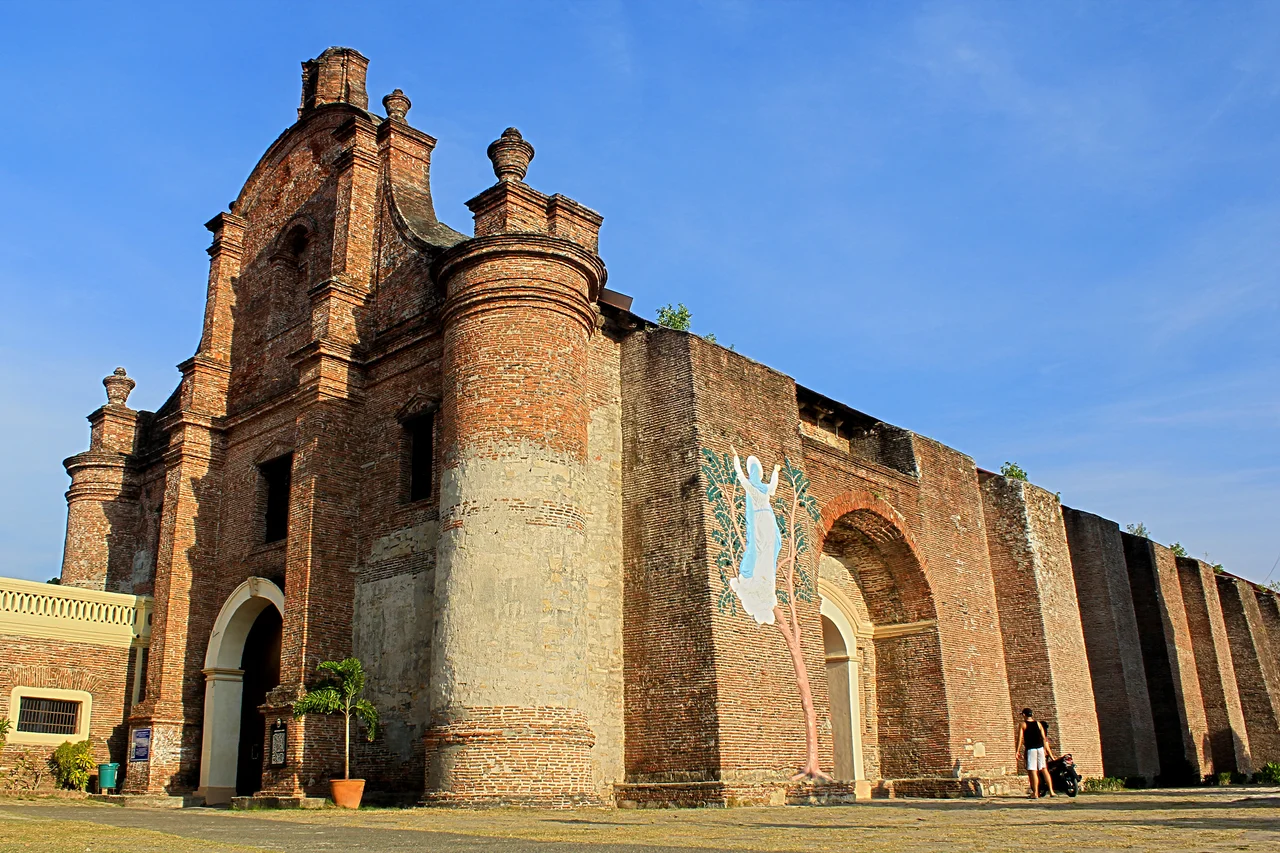
The Philippines sits on the Pacific Ring of Fire, and the Spanish missionaries who arrived during the colonial period (1565-1898) learned this the hard way. Earthquakes leveled churches. Typhoons tore off roofs. Fires consumed wooden structures. The response was not European Baroque transplanted whole but something adapted to destruction: Earthquake Baroque. This style features walls thick enough to withstand seismic shocks, massive buttresses that brace naves against lateral forces, and detached bell towers positioned away from the main structure so their collapse during tremors would not bring down the church. At Paoay Church in Ilocos Norte, fourteen buttresses range along the nave like the ribs of a stone ship. The walls are 1.67 meters thick, held together by mortar made from sugarcane juice, mango leaves, and rice straw. Beauty here serves durability, and durability shapes beauty.
Horror Vacui and the Filipino Hand
The Spanish friars who commissioned these churches were not trained architects. Construction fell to local communities -- Filipino and Chinese craftsmen who brought their own aesthetic sensibilities to the work. The result was a decorative tradition the Spanish called horror vacui, the fear of empty spaces. Every surface becomes a canvas. Facades erupt with carvings of patron saints dressed in native clothing, flanked by tropical flora and fauna. Chinese fu dogs guard the entrance of San Agustin Church in Manila. Paoay Church's exterior features rosettes reminiscent of Javanese temples. The fusion is so thorough that art historians cannot cleanly separate the European from the Asian elements -- which is precisely the point. These are not copies of Spanish churches. They are Filipino churches that happen to use Baroque vocabulary.
Four Churches, Three Centuries
San Agustin Church in Manila, the oldest of the four, was first built in 1571 and reconstructed in stone by 1587. It is the only structure in the walled city of Intramuros to survive the devastating Battle of Manila in 1945. Inside, trompe-l'oeil ceiling paintings by Italian artists Alberoni and Dibella overlay earlier tempera murals, and the remains of Miguel Lopez de Legazpi, founder of Manila, rest in a side chapel. Santa Maria Church in Ilocos Sur breaks convention by sitting on a hilltop rather than a central plaza, surrounded by defensive walls. Paoay Church, also in the north, represents the most dramatic expression of Earthquake Baroque, its coral stone and brick exterior bound by organic mortar. Miagao Church in Iloilo, the southernmost, crowns the highest point in town, its asymmetrical bell towers -- designed by two different priests on two different occasions -- flanking the most elaborately carved facade of any church in the country.
The Threat of Modernity
UNESCO World Heritage status cuts both ways. It brings international recognition and conservation resources, but it also creates buffer zones that can conflict with urban development. When the Binondo-Intramuros Bridge was completed in 2022, approximately 550 meters from San Agustin Church, concerns arose that the project had encroached on the church's prescribed buffer zone. Because the four churches are inscribed as a single serial World Heritage Site, the delisting of one would mean the delisting of all. The stakes are not abstract: Paoay in Ilocos Norte, Santa Maria in Ilocos Sur, and Miagao in Iloilo would lose their UNESCO designation if San Agustin in Manila lost its own. Five additional churches have been nominated for a proposed extension of the World Heritage Site, including Loboc Church in Bohol and Lazi Church in Siquijor, but that expansion depends on the original four maintaining their status.
From the Air
The four churches are spread across the Philippine archipelago. Miagao Church (10.642N, 122.235E) is in Iloilo, Panay Island, near Iloilo International Airport (RPVI). San Agustin Church is in Intramuros, Manila (RPLL). Santa Maria Church and Paoay Church are in Ilocos Sur and Ilocos Norte respectively, accessible via Laoag International Airport (RPLI). Best viewed individually at 2,000-5,000 feet AGL.
Nearby Stories
- San Sebastian Cathedral (Bacolod) 28 km away
- Guimaras Oil Spill 40 km away
- Jalaur Dam 44 km away
- Hacienda Rosalia 49 km away
- Republic of Negros 53 km away
- Cuyo, Palawan 72 km away
- Coron, Palawan 199 km away
- Tubbataha Reef 250 km away