.jpg)
San Sebastian Cathedral (Bacolod)
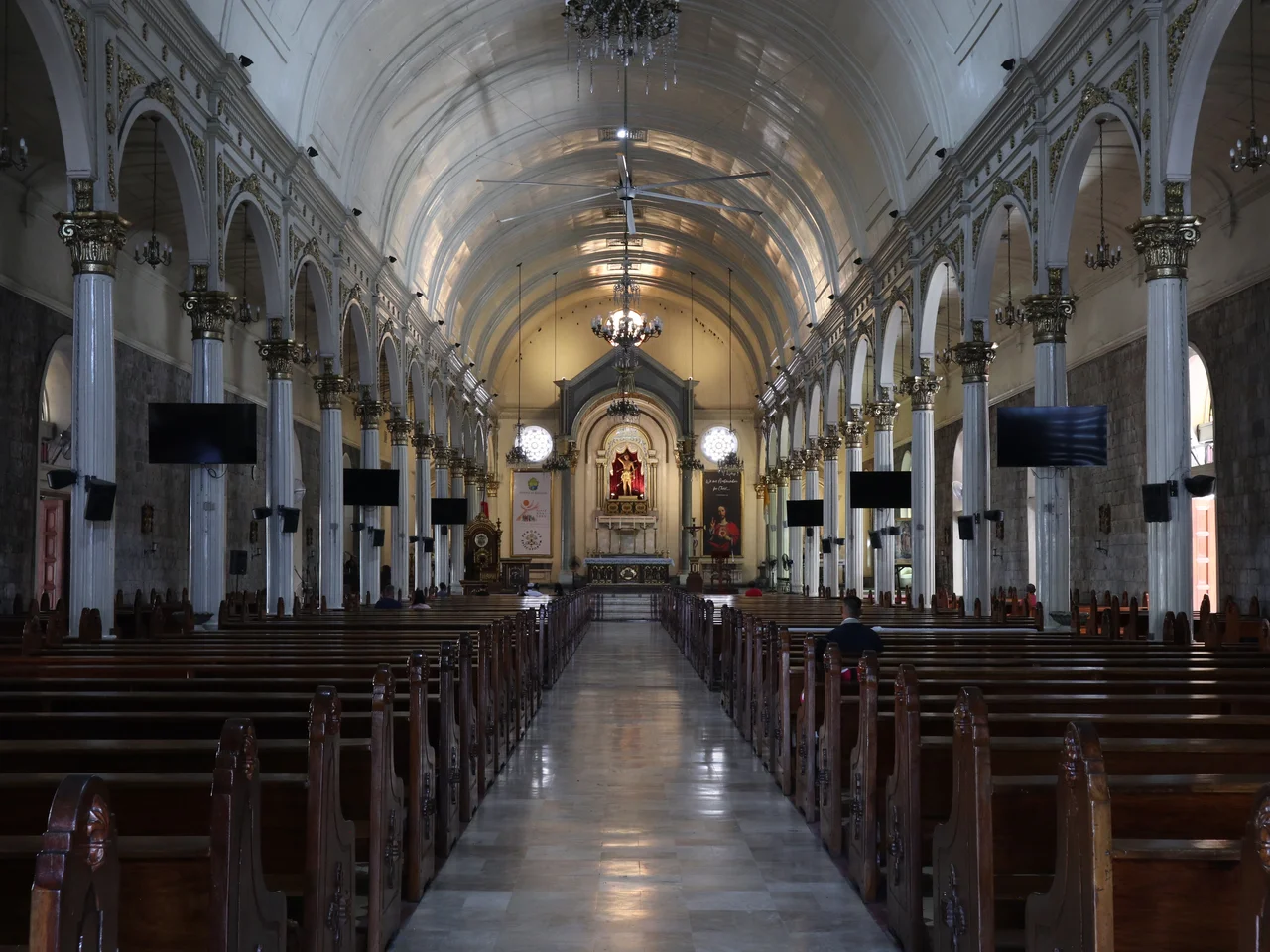
The word bakolod means hill in Old Hiligaynon, and the city that took this name exists because of a raid. In the 1700s, the coastal village of Magsungay came under repeated attack by Moro pirates. Its inhabitants abandoned the shore and fled to higher ground, carrying with them a relic of Saint Sebastian donated by a local corregidor. The village became San Sebastian de Magsungay, and eventually just Bacolod. The cathedral that bears the saint's name has stood at the center of the city's spiritual life since 1825, rebuilt in coral stone in 1876, and patched, renovated, and partially demolished more than once since then -- always returning, like the city itself, to the same stubborn spot on the hill.
Wood, Iron, and a Priest from Barcelona
The original San Sebastian Church was a humble affair: wood walls under a galvanized iron roof, built in 1825 by Fr. Julian Gonzaga, a young priest from Barcelona who served the parish from 1818 to 1836. Gonzaga had arrived in Bacolod during its formative years as a town, just over a decade after Fr. Leon Pedro had been appointed the first parish priest in 1806. The church started with a medium-sized bell, but parishioners and clergy gradually expanded its voice. Fr. Roman Manuel Locsin donated a large bell, and Fr. Mariano de Avila added another when he became parish priest in 1863 after Locsin's death. These bells would become characters in their own right, their fate intertwined with the cathedral's physical story for the next century and a half.
Coral from Guimaras, Hardwood from Palawan
The wooden church gave way to stone on April 27, 1876, when Fr. Mauricio Ferrero of the Order of Augustinian Recollects began construction of the structure that stands today. The materials came from across the archipelago: coral stone quarried on the island of Guimaras, hardwood from the forests of Palawan. The labor came from an unexpected source. The politico-military governor, Roman Pastor, provided prison labor for the project and persuaded Fr. Ferrero to design and supervise a stone prison as well -- the old Provincial Jail. Fr. de Avila's bell was installed in the new bell tower during construction, linking the old wooden church to the rising stone one through the continuity of its voice. Fr. Ferrero also built the parish rectory, now the bishop's house, starting construction on May 21, 1891, and finishing in 1894, using the same Guimaras coral and Palawan hardwood, with locally made bricks laid by Chinese masons.
The Bells' Troubled Journey
In 1956, Bishop Manuel Yap consecrated the renovated cathedral in ceremonies presided over by the Apostolic Nuncio. The main altar was simplified, and a life-size statue of Saint Sebastian was enshrined. Further renovation came under Antonio Fortich, who became the third Bishop of the Diocese of Bacolod in 1967. Then, in 1969, the Bacolod City Engineer's office declared the bell towers a public hazard. Fr. de Avila's bell was removed from the belfry, and the towers were demolished. The church organ was disassembled and never reassembled. The cathedral's rector, Fr. Antonio Santes, raised funds to rebuild the towers in their present form, but the original bells needed a new home. In 1976, the Lions Club of Bacolod built a special belfry where Fr. de Avila's bell and Fr. Ferrero's smaller bell hang today -- survivors of wooden churches, stone reconstructions, and demolition orders, still sounding over the city.
The Saint on the Hill
Saint Sebastian, an early Christian martyr, was the protector chosen by Spanish missionaries for the coastal village that would become Bacolod. The association dates to the mid-1700s, before the village even bore the name Bacolod. When corregidor Luis Fernando de Luna donated a relic of the saint between 1777 and 1779, the village's identity became fixed: San Sebastian de Magsungay. Today, the cathedral serves as the seat of the Diocese of Bacolod and remains the city's most prominent religious landmark. On December 25, 1994, Bishop Camilo Gregorio declared the nearby San Diego Parish Church a pro-cathedral, extending the cathedral's spiritual reach. The remains of the diocese's first two bishops, Casimiro Lladoc and Manuel Yap, rest in the cathedral's columbarium alongside church benefactors, tying the building to the institutional memory of the diocese itself. The hill that refugees from pirate raids once climbed for safety now anchors a city of over 600,000 people, and the saint they brought with them still watches over it.
From the Air
Located at 10.670°N, 122.947°E in central Bacolod, Negros Island. The cathedral sits near the Bacolod Public Plaza, the city's main civic square and the endpoint of the annual MassKara Festival parade. The San Sebastian Cathedral and plaza are identifiable from the air as the heart of the downtown area. Nearest airport is Bacolod-Silay International Airport (RPVB), approximately 15 km northeast. Best viewed at 1,500-2,500 ft AGL. The Guimaras Strait is visible to the west.
Nearby Stories
- Sagay Massacre 9.9 km away
- Baroque Churches of the Philippines 12 km away
- Escalante, Negros Occidental 25 km away
- Hacienda Rosalia 30 km away
- Republic of Negros 44 km away
- Moalboal 47 km away
- Maniguin Island Lighthouse 105 km away
- Canatuan Mine 293 km away