.jpg)
San Joaquin Church (Iloilo)
Of all the strange things to find carved into the facade of a village church on a Philippine island, a battle scene from Morocco ranks among the strangest. Yet there it is, above the entrance of San Joaquin Church in Iloilo: a limestone relief depicting the Spanish victory over the Moors at the Battle of Tetouan in 1860. The battle took place in North Africa. The church was completed in 1869 in the Visayas. The Augustinian friars who commissioned the carving wanted to celebrate Spanish military glory, but the Filipino artisans who executed it had never seen Morocco, never seen Moors, never seen the terrain where the battle occurred. What they produced is not a documentary record but a folk interpretation -- the Battle of Tetouan as imagined by craftsmen on the far side of the world.
A Battle Carved in Coral
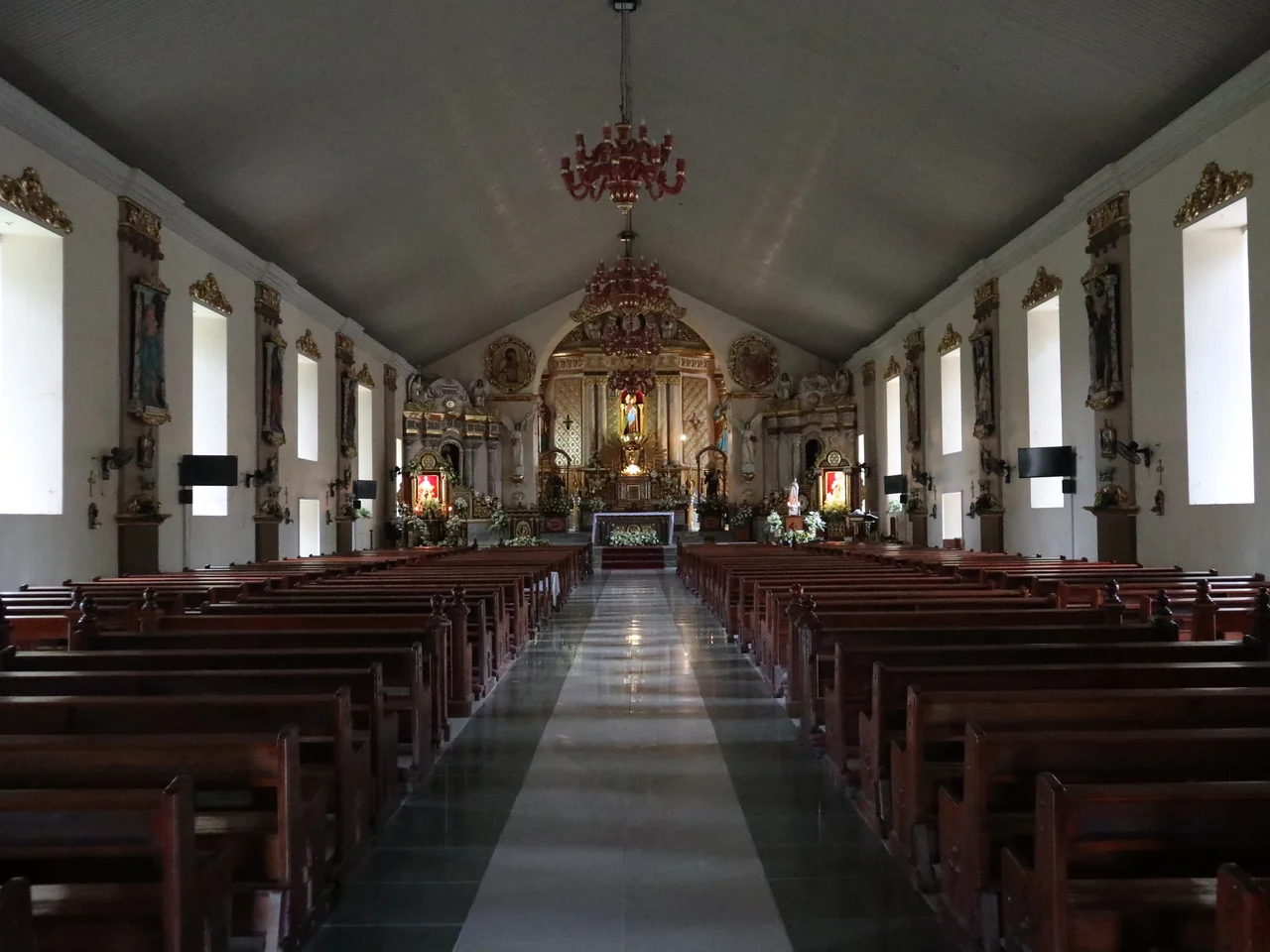
The pediment relief is San Joaquin Church's most distinctive feature, and the reason it draws visitors and scholars from across the Philippines. The carved scene shows Spanish soldiers in formation, their Filipino interpretation giving the figures a slightly flattened, narrative quality that art historians classify as folk art rather than academic sculpture. The composition fills the triangular space of the pediment completely, framing the church entrance with military drama. Below and around this scene, three retablos of carved limestone -- formerly painted in polychrome but now bare -- line the interior. The retablos and pediment together represent one of the most cohesive programs of stone carving in any Philippine church, all executed in the local limestone that gives the carvings their warm, porous texture.
Augustinian Ambitions
Construction of San Joaquin Church was completed in 1869 under the direction of Augustinian friars during the late Spanish colonial era. The choice to depict the Battle of Tetouan -- fought only nine years before the church's completion -- suggests the friars were eager to celebrate contemporary Spanish victories, not just biblical narratives. Spain's campaign in Morocco in 1859-1860 had been a source of national pride, and the Augustinians in distant Iloilo wanted their church to participate in that celebration. The decision reveals the colonial church as a vehicle for imperial messaging as much as spiritual guidance. That the message was rendered by Filipino hands in Filipino stone, creating something neither fully Spanish nor fully local, captures the layered identity of colonial Philippine art.
What the War Left Behind
The convent adjacent to San Joaquin Church was reduced to ruins during World War II. What remains includes a well and a kiln that were once used for baking -- humble artifacts that outlasted the grand structure surrounding them. The ruins have become part of the church's identity, their crumbling walls offering a counterpoint to the intact facade. The National Historical Institute designated the church a National Historical Site in 1980, and on January 19, 2019, the parish celebrated the 150th anniversary of the church's completion. For that occasion, parishioners and priests collaborated on a careful restoration of the interior, working to recover the original designs of the tabernacle, high altar, and side altar retablos. Archbishop Jose Romeo O. Lazo formally dedicated the restored church on January 18, 2019.
Stone Memory on an Island Edge
San Joaquin sits on the southern coast of Panay Island, facing the open waters that separate the Visayas from Mindanao. The church's position at the edge of this coastline gives it a quality of outpost -- a permanent stone statement in a landscape shaped by water and wind. The National Museum of the Philippines has declared it a National Cultural Treasure, recognizing both the quality of its stone carving and its rarity as a surviving example of narrative relief sculpture in Philippine ecclesiastical architecture. The Battle of Tetouan pediment remains the only known depiction of a specific military engagement on any church facade in the Philippines. It is a monument to the strange trajectories of colonial culture: a North African battle, filtered through Spanish pride and Filipino artistry, preserved in the limestone of a Visayan island.
From the Air
Located at 10.586N, 122.141E in San Joaquin, Iloilo, on the southern coast of Panay Island. The church is a stone structure visible near the coast. Nearest major airport is Iloilo International Airport (RPVI), approximately 50 km northeast. Best viewed at 2,000-5,000 feet AGL. The southern Panay coastline provides scenic approaches with views across to Guimaras Island.
Nearby Stories
- San Sebastian Cathedral (Bacolod) 28 km away
- Guimaras Oil Spill 40 km away
- Jalaur Dam 44 km away
- Hacienda Rosalia 49 km away
- Republic of Negros 53 km away
- Cuyo, Palawan 72 km away
- Coron, Palawan 199 km away
- Tubbataha Reef 250 km away