
Béthanie (Hong Kong)
Between 1875 and 1974, exactly one hundred missionaries died at Béthanie — one per year, on average. The coincidence struck the Missions Étrangères de Paris as remarkable, even providential. It is one of those details that lodges in the mind when you stand in the cool shadow of the neo-Gothic chapel at No. 139 Pok Fu Lam Road, listening to the wind in the pines, and try to understand what this place has been across its many lives.
Built to Heal the Healers
Hong Kong in the 1870s was a dangerous posting for French missionaries. Tuberculosis moved through Asia with terrible efficiency, and tropical fevers ended careers — and lives — long before priests could return from the field. Pierre-Marie Osouf, leading the Paris Foreign Missions Society in the region, oversaw the construction of Béthanie on land originally purchased from a J.J. dos Remedios in June 1873. When the building opened in 1875, it was the first sanatorium in Hong Kong.
Fr. Charles Edmond Patriat supervised the construction and became its first Superior. His assistant Fr. Holhaan succeeded him in 1887 and within a few years was managing a building stretched well beyond its fourteen rooms — annual visitors rising from fifteen or twenty in the early years to more than fifty by the 1890s. In 1896, expansion began. The cost came to $15,820, roughly equivalent to a full year's operating budget. Alongside medicine, the missionaries ran a printing press at Béthanie that published religious materials in twenty-eight languages.
War, Neglect, and the Students Who Saved It
The Japanese occupation of Hong Kong devastated the grounds. Desperate for fuel, occupying forces felled the fifty-year-old conifer trees that had shaded the complex for generations, leaving the site bare. After the 1945 surrender, the missionaries returned and began rebuilding; by February 1949, the refurbished building had reopened under Fr. Vignal. The Communist Revolution that same year created a new surge of need — within two years, Béthanie was again overfull, recording 70 missionaries and 4,950 days of stay.
The end came not from war but from commerce. In 1974, the Fathers sold the complex to Hongkong Land for redevelopment. The developer decided the site was too difficult to build on and returned it to the government — which promptly issued a demolition order. For five years, the sanatorium sat under threat. Then, in 1978, University of Hong Kong students moved in, needing temporary accommodation while waiting for campus housing. Their presence sparked a preservation movement. By 1981, Béthanie was saved and listed as a Grade II historic building. From 1978 to 1997 it served as a university warehouse, slowly deteriorating — but standing.
Neo-Gothic on the South China Sea
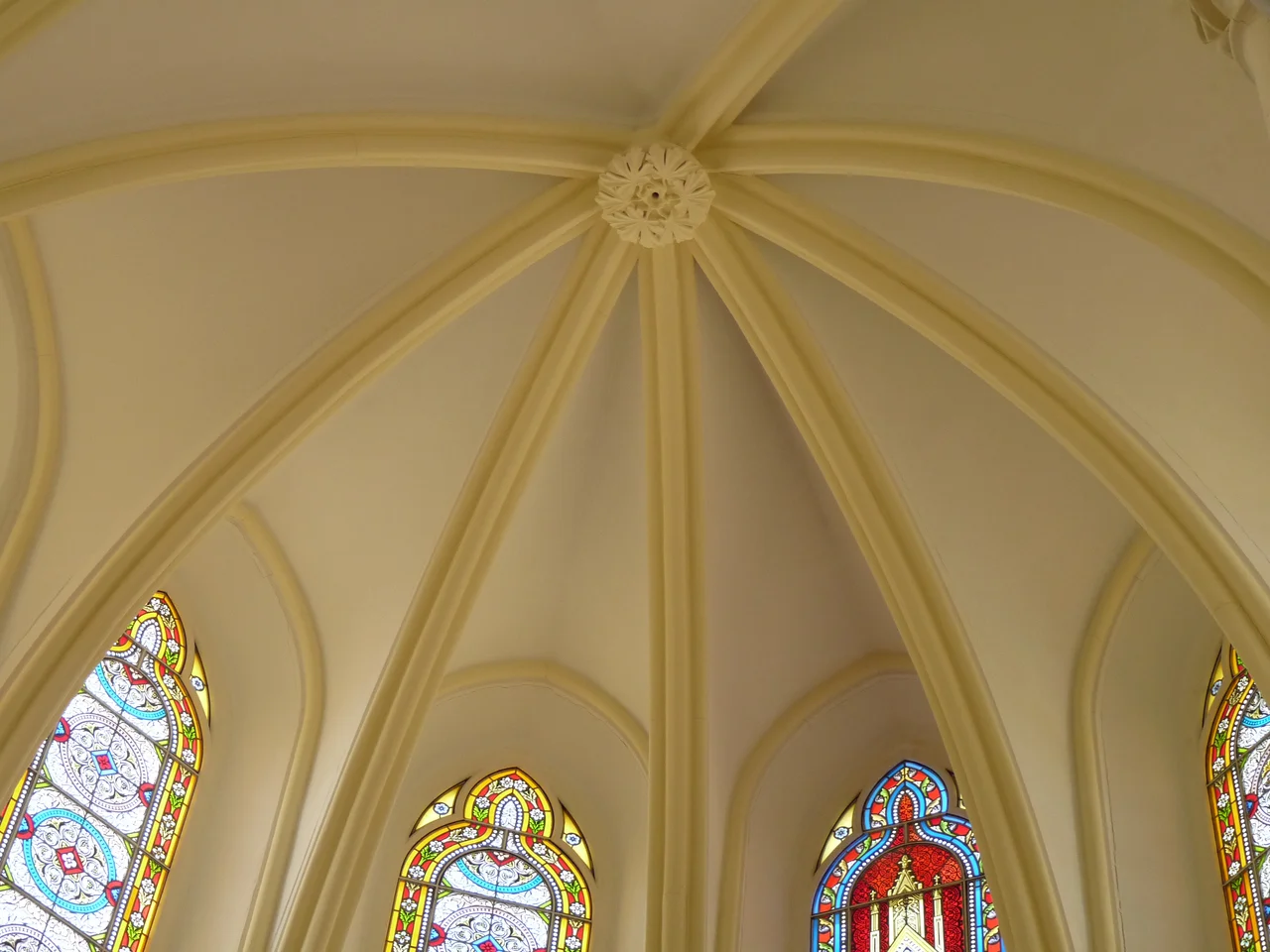
The architectural language of Béthanie is unexpected in Hong Kong: ogive arches, tracery windows, rib vaults, flying buttresses. The George C. Tso Memorial Chapel has a high ceiling and pitched roof, its nineteen stained glass windows mixing nine surviving originals with reproductions handmade in the Philippines. Of the twelve statues of the apostles that once stood on corbels above the altar, only four have been found; the Academy replicated the rest using silicone moulding.
Béthanie is one of very few surviving examples of French colonial architecture in Hong Kong. Buildings erected by the French community since 1848 represent the most significant non-British architectural contribution in the territory's history — a legacy that also includes the former French Mission Building in Central, with its red brick walls and Doric and Ionic columns. The restoration of Béthanie earned a UNESCO Asia-Pacific Heritage Award in 2008, credited to architect Philip Liao and HKAPA associate director Philip Soden, who described the hardest challenge as installing air conditioning, fire services, and lighting without altering the building's appearance.
From Sanatorium to Screening Room
In March 2003, the Legislative Council approved HK $80 million to fund the Hong Kong Academy for Performing Arts to restore Béthanie and its two adjacent Dairy Farm cowsheds. The project took three years. The cowsheds became the Béthanie Theatre — a 150-seat performance space with advanced acoustics, the original octagonal roof and milking stalls retained for visitors to see. The basement wine cellar became a museum of French missionary history across 300 years of activity in Asia.
The main building now houses the HKAPA's School of Film and Television, which opened in September 2006. On the second floor, the Jackie Chan Charitable Fund donated a 70-seat screening room. The Sir Y.K. Pao Studio — its distinctive pitched roof restored with double-glazed glass panels — serves as a multi-function rehearsal space. In December 2006, Sunday services resumed in the chapel, carried on by the Emmanuel Church Pokfulam, a daughter church of St. John's Cathedral. Béthanie was upgraded to a Grade I historic building in 2009 and declared a monument in 2013.
A French Footprint in Pok Fu Lam
The French presence at Béthanie extended beyond religion and architecture. In 1964, the first French-language school in Hong Kong was founded on the Béthanie grounds, initially accommodating just 35 students. It relocated several times over the following decades, eventually becoming the Lycée Français International Victor Segalen, which today operates as the largest French International School in Asia, with more than 2,700 students across four campuses.
The complex sits in the pine-covered hills above the Pok Fu Lam coastline, with views toward the sea. Adjacent to the Chinese Cuisine Training Institute, it is visible from the road only by following signs. For those who make the detour, it remains one of the quieter, stranger corners of Hong Kong: a place where French priests once recovered from fever, where students once staged an occupation, and where film students now edit in rooms that smell of old timber.
From the Air
Béthanie sits at approximately 22.26°N, 114.14°E on the western side of Hong Kong Island, in the Pok Fu Lam hills above the South China Sea coast. Approaching from the southwest at 2,500–3,500 feet, the complex is visible among the forested hillside below Victoria Peak. Hong Kong International Airport (VHHH) lies approximately 25 km to the northwest on Lantau Island. The southern coastline of Hong Kong Island and the Aberdeen Channel are visible nearby.
Nearby Stories
- Lok Ma Chau Loop 2.3 km away
- Portas do Cerco 2.3 km away
- Kweilin Incident 17 km away
- Wanshan Archipelago Campaign 34 km away
- Nanxiong Formation 115 km away
- Battle of Nanpeng Island 148 km away
- Heyuan 169 km away
- Cape Maobitou 632 km away