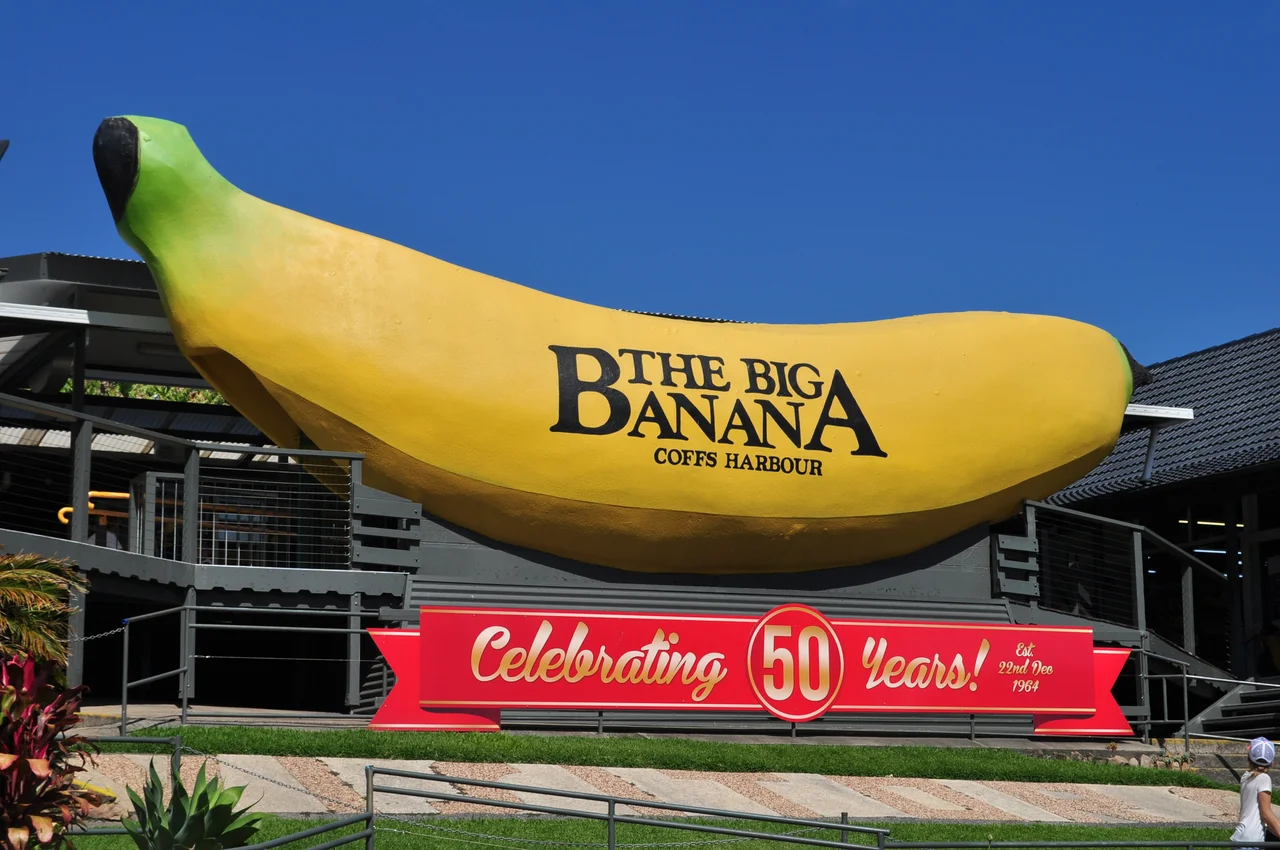

Big Banana
A banana grower wanted people to stop at his fruit stall, so he built a banana you could walk through. In 1964, on the highway just north of Coffs Harbour, John Landi looked at his roadside stand among the plantations and decided it needed something no driver could ignore. Inspired by a giant pineapple he had heard of in Hawaii, he had a local engineer, Alan Chapman, slice up the best-looking banana he could find into forty pieces and work out the curves from there. The result, a 13-metre fibreglass-and-steel banana, opened on 22 December 1964. It was Australia's first Big Thing, and it started something that never stopped.
The Birth of the Big Thing
Nobody knew it at the time, but the Big Banana invented a genre. Before it, Australian roadsides had signs and stalls; after it, they sprouted giants. The idea was irresistibly simple, a landmark so absurdly large and so specific to its town that travellers had to pull over, take a photo, and buy something. From that one yellow banana grew the Big Pineapple, the Big Merino, the Big Lobster, the Golden Guitar and, eventually, more than a thousand Big Things scattered across the continent. In 2007, Australia Post put a row of them on postage stamps, the Big Banana among them, official recognition of a craze that began as one grower's marketing hunch.
Folly, and Proud of It
There is no pretending the Big Banana is high art, and that is precisely the point. In 2011 the Huffington Post listed it among the world's top ten pieces of folly architecture, the sort of building made for delight rather than function. Australians have always understood the joke and embraced it anyway. The Big Banana is unapologetically daft, gloriously oversized, and completely sincere about both, a monument to the idea that a roadside attraction can be worth the trip simply for being magnificently, memorably silly. Imitation followed, naturally, with a copy raised at Carnarvon in Western Australia.
Around the Banana
What began as a single walk-through fruit grew, over six decades, into a full fun park wrapped around a working banana plantation. Today an 82-metre slide runs down the hillside, alongside a water park, a toboggan and a 4D cinema, an ice rink, mini golf, laser tag, a reptile house and escape rooms. The newest arrival is the Plantation Coaster, an alpine coaster that opened in December 2025 after years of planning. Plantation tours still explain how bananas actually grow, and the gift shop remains gloriously committed to the theme, selling banana everything to visitors who arrived, as Landi hoped all those years ago, because they simply could not drive past.
A Coffs Harbour Institution
For all its kitsch, the Big Banana is a genuine landmark and a serious draw. In a single peak month, January 2014, it welcomed close to 150,000 visitors, and it has remained family-owned since Betty and John Landi and Stella and John Enveoldson opened it in 1964. It has shrugged off setbacks, a fire that destroyed an old lookout on Australia Day in 2014, a runaway monorail that ploughed into a lagoon, and kept on going. To pass through Coffs Harbour without stopping at the Big Banana feels almost like missing the town itself. Sixty years on, the gimmick has become the icon.
From the Air
The Big Banana stands at 30.27 degrees south, 153.13 degrees east, on the Pacific Highway just north of the Coffs Harbour town centre, set on a banana-plantation hillside overlooking the coast. From the air it is hard to miss: a bright yellow landmark on terraced green plantation slopes a short distance inland from the Pacific shoreline and the Coffs Harbour marina. Recommended viewing altitude is 1,500 to 3,000 feet AGL. Coastal weather is generally clear but afternoon sea-breeze cloud and summer storms are common along this stretch of the Mid North Coast. Coffs Harbour Airport (YSCH) lies just a few kilometres south, so the area falls within its circuit, observe local airspace and traffic.
Nearby Stories
- New England National Park 21 km away
- Guy Fawkes River National Park 27 km away
- Yuraygir National Park 31 km away
- Trial Bay Gaol 33 km away
- Apsley Falls 93 km away
- Cape Byron Marine Park 153 km away
- Cape Byron Light 187 km away
- SS Elingamite: Gold, Fog, and a Captain Wrongly Blamed 1771 km away