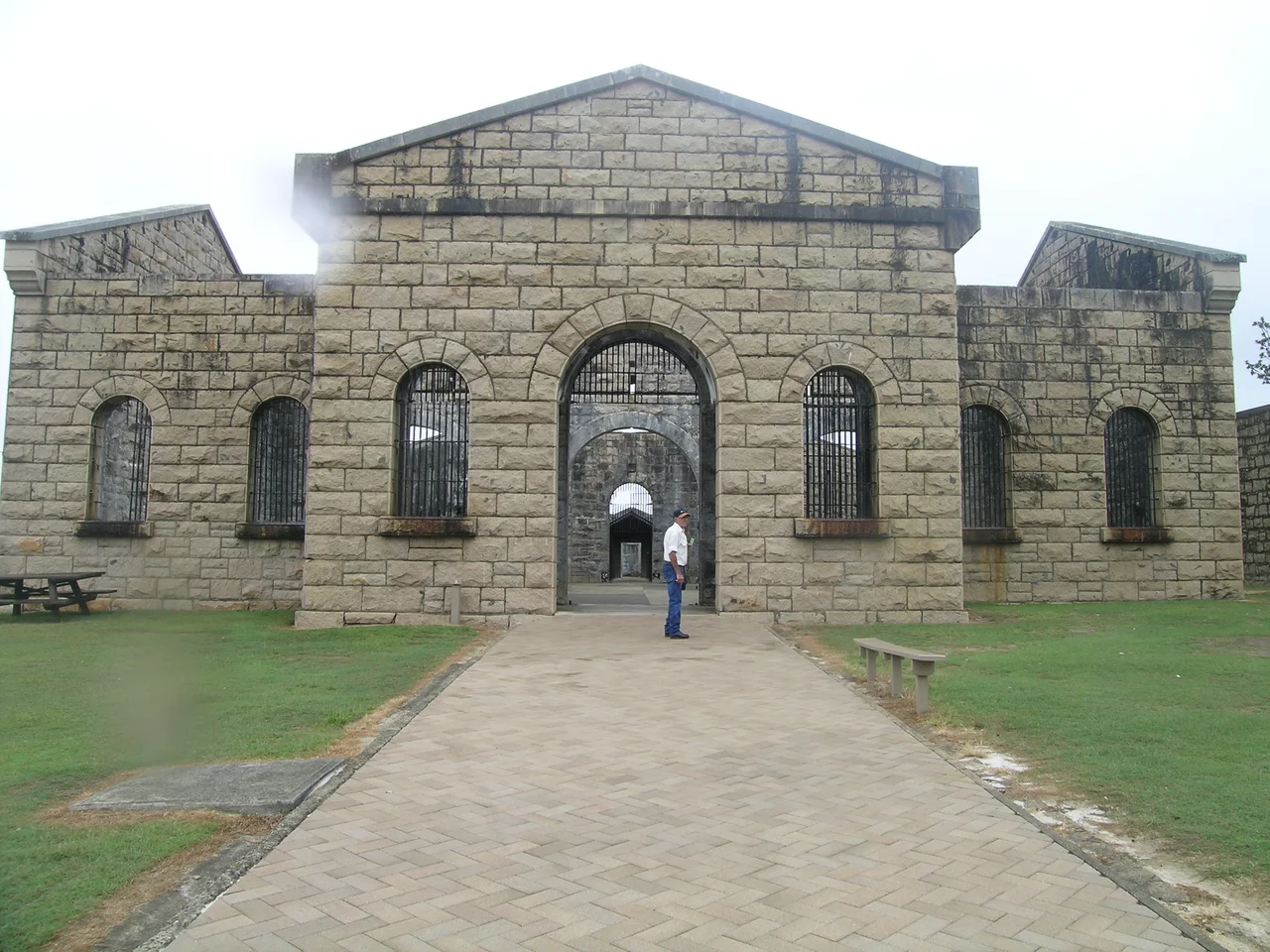

Trial Bay Gaol
The walls still stand, but the roof is gone. On Laggers Point, high above the blue curve of Trial Bay, the granite shell of a Victorian prison sits open to the sky, its empty cell blocks framing rectangles of cloud. This is Dunghutti country, where the Macleay River, the creeks and the sea once provided everything, and where people moved with the seasons long before any stone was laid. The gaol that came later was built for a strange and stubborn dream: that prisoners, working with hammer and barrow, could throw a wall of rock across open water and tame a wild bay.
The Brig That Named the Bay
The bay carries the name of a ship. In 1816 the brig Trial, owned by the Sydney merchant Simeon Lord, was seized by a party of convicts who forced its crew to sail north in a desperate bid for freedom. Their escape ended here, wrecked on this coast, and the name stuck to the water that swallowed the vessel. It was one of the earliest moments of contact between Europeans and the Dunghutti people of the Macleay. A convict ship, fleeing the colony and dashed on the rocks, gave the bay its name decades before anyone thought to build a prison on the point above it.
A Wall Against the Sea
From 1877, prisoners began raising the gaol under the eye of Sheriff Harold Maclean, a penal reformer who believed in single cells, separation, and useful labour over idle punishment. His prison was an experiment: a public-works gaol whose inmates would build a breakwater to shelter passing ships on the long, exposed run between Sydney and Brisbane. Work on the great stone arm began in 1889. The sea fought back. Storms washed away what crews built, the stone proved brutally hard, and by 1903, after swallowing some 67,000 pounds, the breakwater had reached less than a fifth of its planned length. The project was abandoned. Today barely 100 metres of the original 300 survive beneath the waves.
Enemies at Home
The gaol fell silent until the First World War gave it a new and troubling use. In August 1915 it became one of only five internment camps in New South Wales, and the only one reserved for Germans and Austrians of high standing, businessmen, professionals, ships' engineers from the civilian steamship SS Emden, men swept up not for anything they had done but for where they were born. At its peak around 580 internees lived behind the walls. They were not idle. They laid out tennis courts, staged theatre and music, painted delicate friezes and borders inside their cells that survive to this day, and built a monument on the hill to five of their number who died here, two of illness, one drowned off the point, two in Sydney.
A Ruin That Endures
When the internees left, the gaol was stripped. Its timber roof was sold off in the 1920s, which is why the cell blocks now stand open, their top storeys weathering under the elements, more theatre than prison. The German monument was destroyed in 1919 in the bitter aftermath of war, then rebuilt in 1959 and 1960 with help from the German consulate and the local community, though one tier of its obelisk is still missing, the original blocks too damaged to reuse. For the Dunghutti people the headland remains living country, where ceremony continues. Visitors have camped here for generations, some returning every summer for thirty years, drawn to a place where dignity and cruelty, ambition and failure, are all written into the same silent stone.
From the Air
Trial Bay Gaol crowns Laggers Point at 30.88 degrees south, 153.07 degrees east, within Arakoon National Park on the southern edge of Trial Bay, just east of South West Rocks. The roofless granite walls on the green headland, with the stub of the failed breakwater reaching north-east into the bay, make a striking and unmistakable landmark from the air. Smoky Cape Lighthouse stands on the higher headland to the south-east. Nearest airports are Kempsey (YKMP) about 35 km south-west and Port Macquarie (YPMQ / PQQ) roughly 55 km south. The point is exposed to south-easterly weather; sea breezes and coastal haze build through the afternoon, and the open cell blocks read most dramatically in low morning or late-afternoon light.
Nearby Stories
- New England National Park 12 km away
- Bellingen, New South Wales 25 km away
- Ebor Falls 55 km away
- Cape Byron Marine Park 212 km away
- Cape Byron Light 246 km away
- Manly, New South Wales 322 km away
- North Head Quarantine Station 345 km away
- SS Elingamite: Gold, Fog, and a Captain Wrongly Blamed 1754 km away