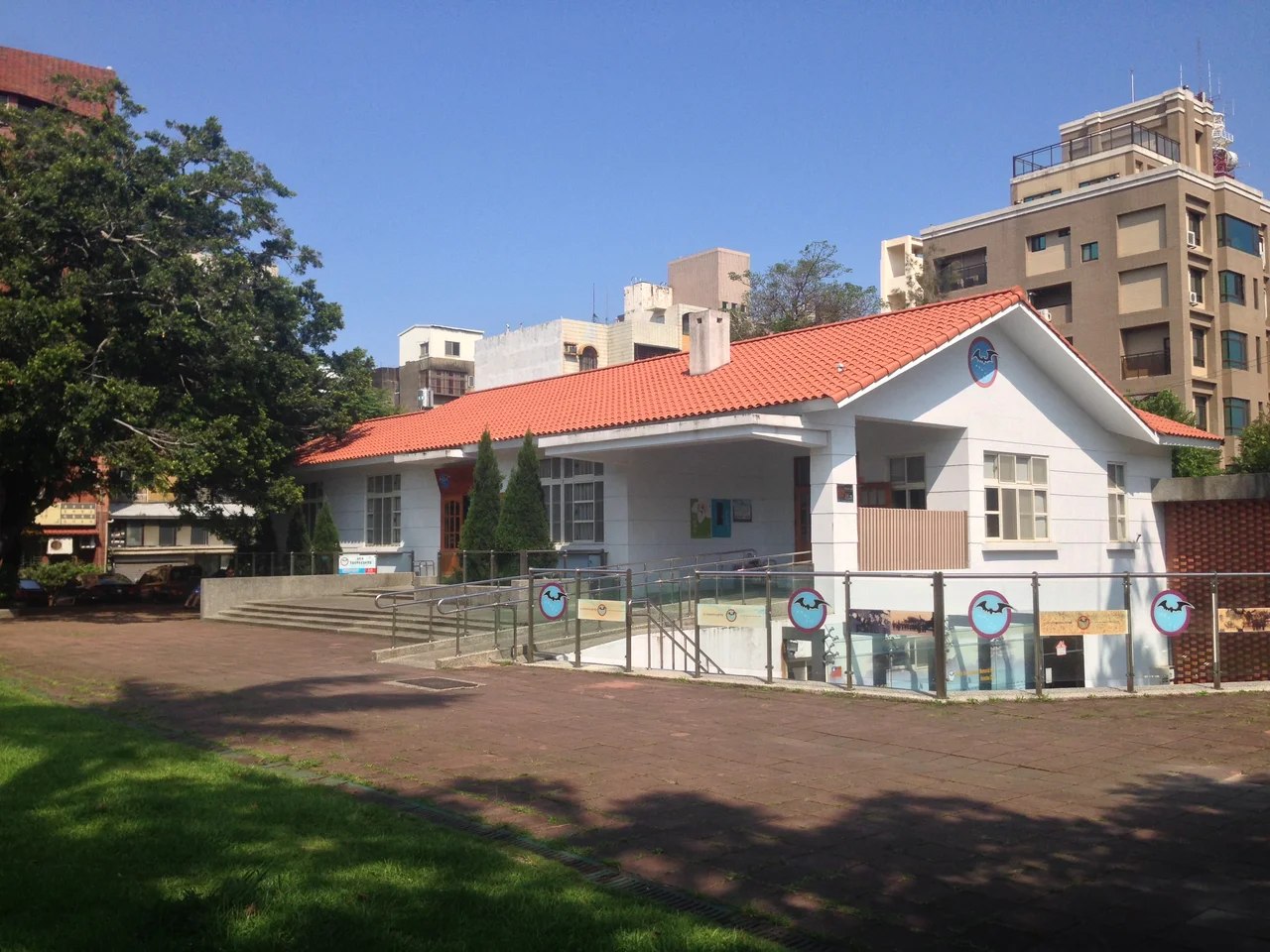

Black Bat Squadron Memorial Hall
The building on Dongda Road in Hsinchu's East District does not look like a place that holds grief. It is compact and low, designed in the American military dormitory style of the 1950s, with clean lines and a small open square on its left wing. But it was built on ground where men once lived between missions — men who flew low and at night over mainland China during the Cold War, who did not tell their families where they were going, and 148 of whom never returned. The Black Bat Squadron Memorial Hall opened in 2009 to remember them. It stands on the original site of the squadron's dormitory, which makes the building itself an act of witness.
What the 34th Squadron Did
The Black Bat Squadron — formally the 34th Squadron of the Republic of China Air Force — was established in 1953 and operated until 1973, with its last mission flown in 1967. It flew 838 missions in total, most of them at night, most of them low, and most of them deep into mainland Chinese airspace. The crews gathered signals intelligence, mapped radar networks, dropped agents, and resupplied operatives on the ground. The CIA established and supported the squadron in its early years through a front organisation called Western Enterprises, Inc., based in Taipei. The aircraft ranged widely — across China's northeast, as far west as Gansu, Yunnan, and Qinghai. The squadron flew 13 different aircraft types over its operational life, including the B-17G, Douglas A-26 Invader, RB-69A, C-123 Provider, C-130 Hercules, and P-3A Orion. They flew at altitudes and in conditions that gave radar systems little warning and gave the crews little margin.
Fifteen Aircraft, 148 Men
Fifteen of those 838 missions did not come back. Fifteen aircraft were lost, and with them 148 airmen. The missions were classified, the losses were not acknowledged, and the families of the dead were left with grief and very few answers. Cold War secrecy compounded the silence: what the squadron did was not something Taiwan or the United States could explain publicly during those decades. Some families waited years, even decades, to learn what had happened to their husbands and fathers. A Taipei Times report from 2021 described the ongoing effort to bring closure to families still seeking information about remains and records. The number — 148 men across 15 aircraft — is not an abstraction. It represents crews of roughly fourteen, nearly all of them lost on the flights that did not return.
The Memorial and What It Holds
The Hsinchu City government broke ground on the memorial hall on 2 April 2009, and it opened on 22 November 2009 after 110 days of construction at a cost of NT$15 million. The building — 460 square metres across ground floor and basement — is the original dormitory structure, preserved rather than rebuilt. Inside, five exhibition areas organise the squadron's history: a chronological overview of the unit's Cold War context; a display of miniature models of the 13 aircraft types the squadron flew; a section on major missions and their courses; a dedicated area introducing the squadron's previous commanders and listing the 148 casualties; and a collection of photographs showing squadron members during off-duty hours — ordinary men, captured in ordinary moments. That last room asks visitors to see them not as casualties but as people: men who played cards, posed for photographs, and ate meals in the same building where their names are now inscribed.
Architecture and Memory
The building itself carries meaning. The MAAG-style American military dormitory architecture — the same design used across US-aligned military facilities in Asia during the 1950s — reflects the transpacific relationship that made the squadron possible. American support, American aircraft types, American intelligence requirements, served by Taiwanese airmen who bore the cost. The open-air square on the building's left wing features a memorial wall of tempered glass etched with the squadron's history. It is designed for contemplation rather than ceremony — a place to stand and read, to look at names, to absorb what the glass lets through. The surrounding Hsinchu Park, where the memorial hall sits, provides a quiet setting. The hall is within walking distance north of Hsinchu Railway Station.
A History Gradually Surfacing
For decades, the Black Bat Squadron's story was known only in fragments — official secrecy on both sides of the Taiwan Strait ensured that. Since the 1990s, declassification and the passage of time have allowed more of the record to surface. Former squadron members have contributed photographs and memorabilia to the memorial hall's collection. Families have learned more about what happened on specific flights. The memorial hall exists partly to consolidate this emerging history, to give it a physical location and a public acknowledgement that the secrecy long denied. Visiting it is an encounter not with triumphalism but with the particular weight of Cold War sacrifice: missions that mattered enormously to the governments that ordered them, carried out by men who were asked to accept anonymity in life and, for too many of them, obscurity in death.
From the Air
The Black Bat Squadron Memorial Hall is located at 24.812°N, 120.970°E in the East District of Hsinchu City, adjacent to Hsinchu Park. Hsinchu is situated on Taiwan's northwestern coast, approximately 70 kilometres southwest of Taipei. The nearest international airport is Taoyuan International (RCTP), approximately 30 kilometres to the north. From the air at 2,000–4,000 feet, Hsinchu City is visible as a dense urban grid on the coastal plain; the large Hsinchu Science Park to the south is a distinctive landmark. Hsinchu Air Base (RCWP), where the 34th Squadron once operated, lies on the city's northern edge and remains an active military facility.
Nearby Stories
- Former Residence of Chang Hsueh-liang (Hsinchu County) 3.8 km away
- Dawulun Fort 7.3 km away
- Cherry Orchard Cemetery 8.4 km away
- 2022 Chinese Military Exercises Around Taiwan 17 km away
- Suao 21 km away
- 2015 New Taipei Water Park Fire 28 km away
- Gaomei Lighthouse 33 km away
- Gaomei Wetlands 63 km away