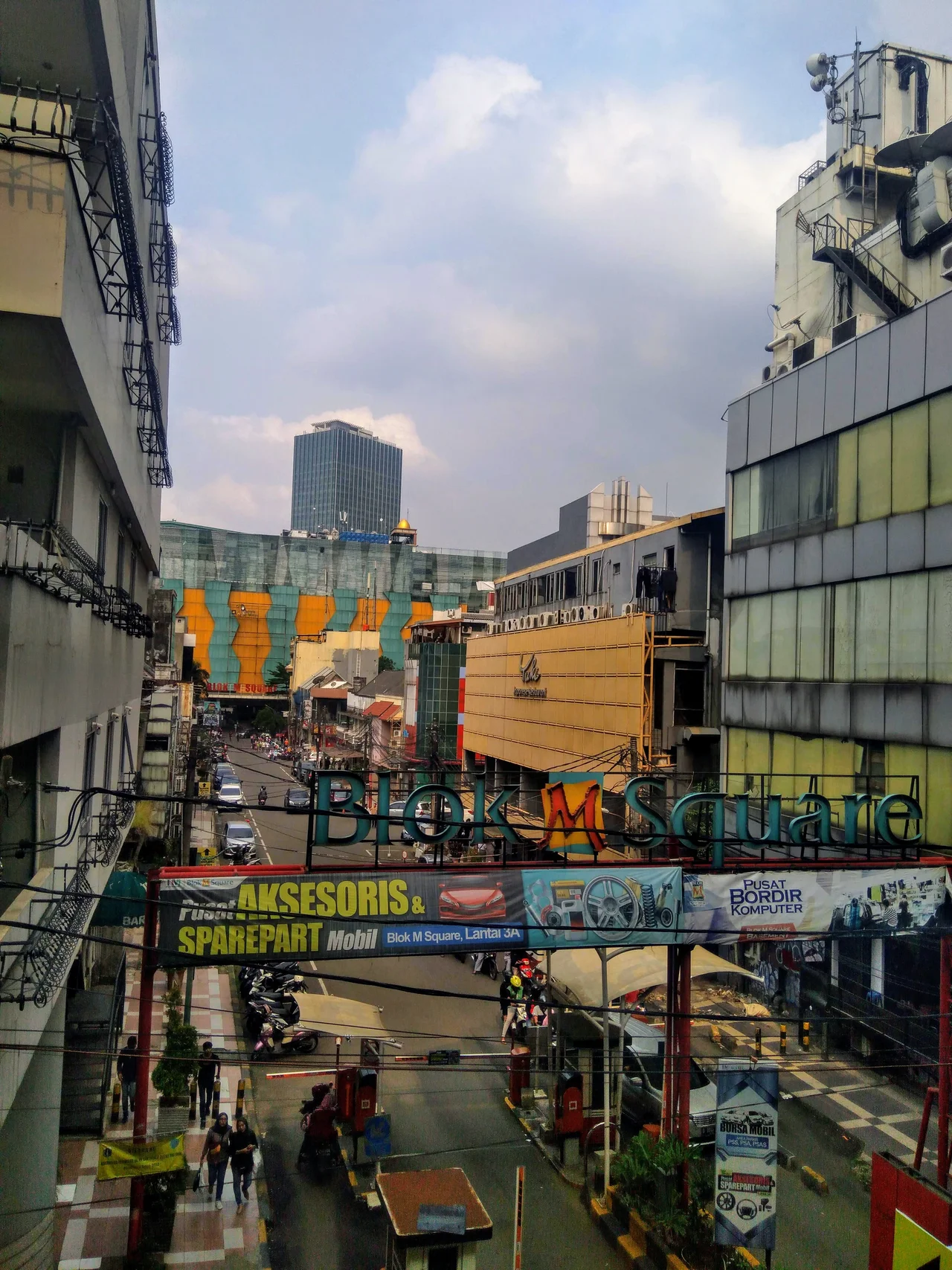

Blok M: Jakarta's Quarter That Refused to Die
The letter M seems unremarkable -- just one in an alphabetical grid of city blocks that a Dutch-trained Indonesian architect drew up in 1948. Blok A through Blok S, each a tidy rectangle in the master plan for Kebayoran Baru, a satellite city south of the colonial capital. But while the other letters faded into residential anonymity, Blok M became a noun, a destination, a shorthand for a certain kind of Jakarta energy -- crowded, cheap, loud, alive after midnight. Ask a Jakartan where to find bargain electronics in 1990, and the answer was Blok M. Ask where the nightlife was, and the answer was Blok M. Ask where the Japanese expats gathered for ramen and karaoke, and it was Blok M again. The quarter has died at least twice since then, and come back each time wearing a different face.
A Garden City's Commercial Heart
Kebayoran Baru was supposed to be an orderly garden city for 100,000 residents -- green spaces, organized roads, schools, markets. The Dutch colonial government conceived it in 1938 as a satellite of Batavia, but war and revolution delayed the project by a decade. When architect Mohammad Soesilo finally laid out the master plan in 1948, he drew on the principles of his teacher Thomas Karsten, who had designed urban plans for Malang, Bandung, and Bogor. The development displaced villages, farmland, and livestock areas across seven square kilometers. By 1953 it was functioning, and at its geographic center sat Blok M, designated as the hub for economic activity and urban transit. The Dutch construction consortium CSW -- Centrale Stichting Wederopbouw -- established its headquarters in the district, a detail that survives today only in the name of a traffic intersection.
Little Tokyo and the Golden Years
In the 1970s, the opening of Pasar Raya Blok M brought modern retail to the district, followed by Aldiron Plaza. Then came the boom years. Blok M Plaza opened in 1992 as Jakarta's second luxury mall, after Plaza Indonesia. An underground shopping center called Mal Blok M was built inside the bus terminal basement in 1993, its warrens of stalls offering prices so low that bargaining was not just expected but required. A growing community of Japanese expatriates settled nearby, and Jalan Melawai became "Little Tokyo" -- a strip of ramen shops, izakayas, karaoke bars, and Japanese supermarkets. The quarter's pop-culture magnetism was strong enough to inspire a film, Blok M (Bakal Lokasi Mejeng), starring Paramitha Rusady and Desy Ratnasari, and songs like Denny Malik's "Jalan-jalan Sore" and Hari Moekti's "JJS Lintas Melawai." On weekend nights, the sidewalks along Melawai were almost impassable.
Crash and Hollow Years
The 1997 Asian financial crisis hit Jakarta like a wrecking ball, and Blok M took some of the worst damage. Consumer spending collapsed. The gleaming new malls emptied as Jakartans tightened their belts and glitzy competitors opened in other parts of the sprawling city. Throughout the 2000s and 2010s, Blok M's identity shrank to something humbler: a bus terminal. Transjakarta routes departed from its station, minivans idled along its curbs, but the shopping quarter itself grew ghostly. Pasaraya Blok M, once a department store with international-standard prices, drifted into near-total vacancy after the pandemic. Even the opening of an MRT station nearby in 2019 -- Blok M BCA, connecting the district to a shiny new rail network -- failed to reignite commercial life. The underground Mal Blok M decayed. The quarter seemed to be joining the long list of Jakarta landmarks that modernity had simply passed by.
The Comeback, Viral and Unpredictable
What brought Blok M back was not urban planning so much as Instagram. In the 2020s, the government renovated Martha Christina Tiahahu Park, refurbished the underground mall into a rebranded Blok M Hub, and extended Transjakarta feeder routes from Jakarta's outskirts. Meanwhile, M Bloc Space -- a creative complex built in an abandoned government housing compound owned by Perum Peruri -- became a magnet for young Jakartans with its music venues, trendy coffee shops, record stores, galleries, and eco-friendly markets. Restaurants began competing to offer what Indonesians call "viral culinaries" -- dishes engineered for social media shareability -- and weekend crowds returned. People traveled from as far as Bogor on new bus routes just to sample the food. By 2025, when Governor Pramono Anung reinaugurated Blok M Hub, he declared the quarter would become "the ASEAN economic and creative hub that never sleeps." Whether that vision materializes remains to be seen, but the sidewalks along Melawai are filling up again.
A Letter on the Map
Blok M today is layered in a way that no master plan could have anticipated. Little Tokyo still occupies its corner of Blok M Square, though the karaoke bars now compete with craft cocktail lounges. The Gojek ride-hailing giant has its headquarters here, a fitting tenant for a district built around transit. The underground Blok M Hub echoes with bargain hunters again, while M Bloc Space draws a crowd that would not have recognized the quarter ten years ago -- art students, musicians, eco-market vendors selling organic coffee. Aboveground, Blok M remains Jakarta's largest bus hub, Transjakarta vehicles cycling through the terminal that has anchored the district since the beginning. The letter M was never meant to stand for anything. It was just the thirteenth block in an alphabet. But in Jakarta's geography, it has come to mean persistence -- the commercial quarter that crashed, hollowed out, and filled back up, twice, on the same seven square kilometers that a Dutch-trained architect sketched almost eighty years ago.
From the Air
Located at 6.25S, 106.80E in South Jakarta's Kebayoran Baru district. From the air, Blok M is identifiable by the large bus terminal complex surrounded by dense commercial buildings, with the green space of Martha Christina Tiahahu Park adjacent to Blok M Plaza. The area lies roughly 10 km south of the National Monument (Monas). Nearest major airport is Soekarno-Hatta International (WIII), approximately 30 km to the northwest. Halim Perdanakusuma Airport (WIHH) is about 15 km to the east. Pondok Cabe Air Base (WIIC) is roughly 12 km to the south.
Nearby Stories
- The King's Footprints in the River 2.8 km away
- Rawagede Massacre 6.4 km away
- The Cruiser That Wouldn't Stop Fighting 14 km away
- Four Minutes Over the Java Sea 14 km away
- The Scholar's Mosque 21 km away
- Through the Cidepong Hills 37 km away
- Ujung Kulon National Park 97 km away
- The Islands That Vanished from Sight 352 km away