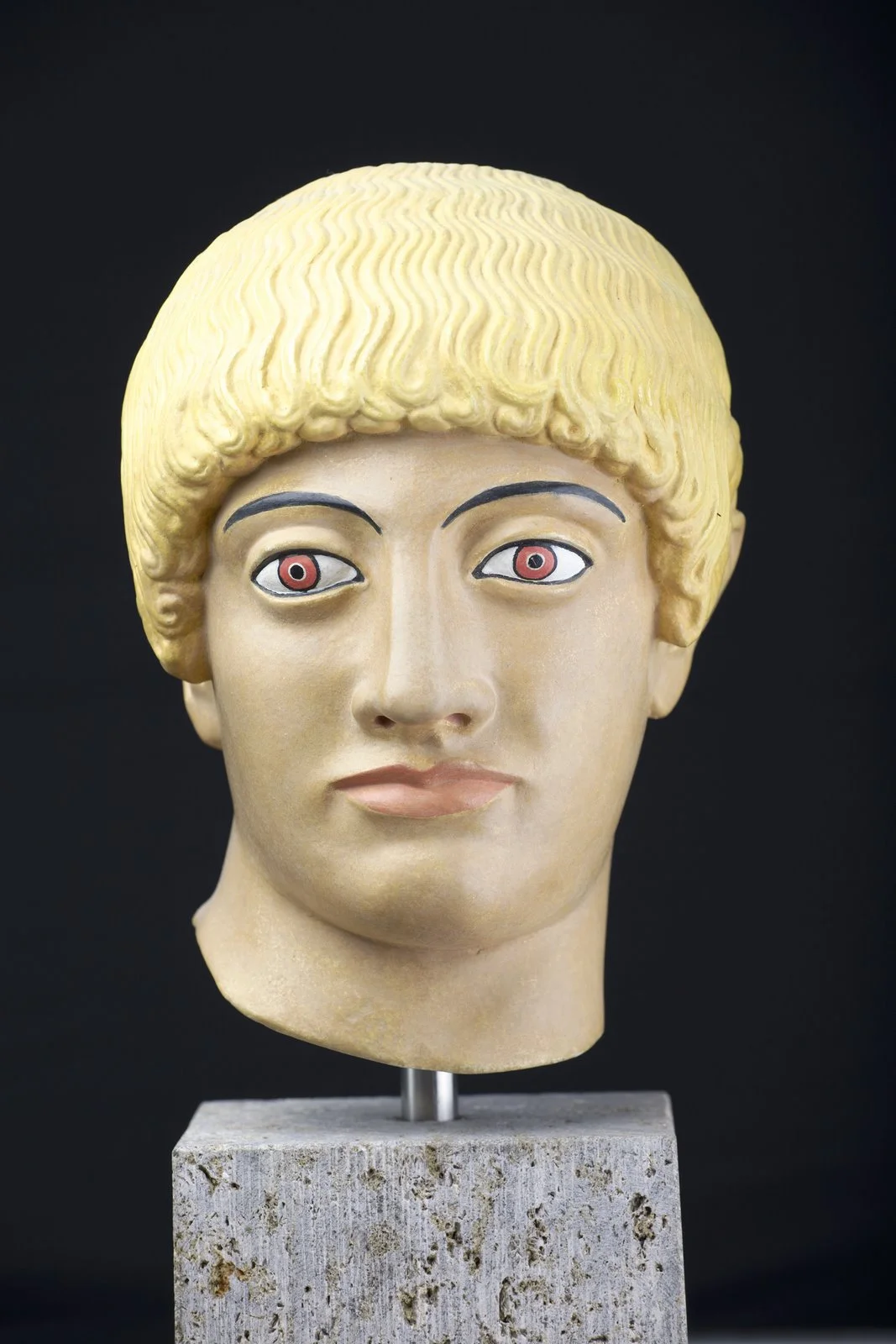

Blond Kouros's Head of the Acropolis
We have been taught to picture ancient Greece in white. Gleaming temples, pale marble gods, the bleached purity that museums and neoclassical architects loved. The truth is gaudier, and this small marble head proves it. Carved around 480 BC and unearthed on the Acropolis, the head of a young man still carries faint traces of yellow paint in its curls. The Greeks painted their statues. They painted them boldly. And this fragment earned its nickname - the Blond Kouros - from the pigment that time nearly erased.
A Face From the Threshold
The head belongs to a kouros, the standing male nude that defined Greek sculpture for generations - young, idealized, eternally poised between boyhood and manhood. But this one stands at a threshold of its own. Carved around 480 BC, it sits at the seam between the stiff, formulaic Archaic style and the new naturalism of the Severe style that would open the Classical age. The curling, ornamental hair still belongs to the older world. The face, calmer and more human, leans toward what comes next. It measures just 25 centimeters tall, a fragment of a figure otherwise lost, with only part of the pelvis surviving alongside it.
The Color We Forgot
Run your eye over the curls and you may catch what remains of the yellow. That faded wash is why scholars named the piece the Blond Kouros, and it is far more than a curiosity. Greek marble statues were routinely painted in vivid colors - skin tones, dark eyes, patterned garments, hair in gold and red and brown. Weather, burial and centuries of cleaning stripped most of it away, leaving the white marble that later ages mistook for the original intent. The German researcher Vinzenz Brinkmann built much of his career reconstructing this lost polychromy, and copies of the Blond Kouros have been repainted to show how startling the original would have looked: a living, colored face, not a ghost in stone.
A Hand Near the Masters
Whoever carved this head worked at the highest level of the craft, in the same Athenian world that would soon produce the greatest sculptors of antiquity. The piece has been attributed, tentatively, to one of the teachers of Phidias - the master who would later oversee the sculptures of the Parthenon. Hegias of Athens and Ageladas of Argos have both been proposed. The attribution can never be certain, but it places this fragment in extraordinary company, at the very root of the tradition that gave the world its idea of classical beauty.
Where It Rests
The head was found in 1923, northeast of where the Acropolis Museum now stands, having lain buried in the sacred rock for nearly two and a half thousand years. Today it sits in that museum, a short walk from the spot where it was carved and broken. Visitors pass it easily, a small head among grander works. But linger, and the faint yellow in the hair becomes a window - proof that the marble world we imagine in silent white once blazed with color, and that this young man's curls were never meant to be pale at all.
From the Air
The Acropolis Museum stands at roughly 37.9686°N, 23.7281°E, at the southeastern foot of the Acropolis in central Athens; the head was found nearby on the rock itself. The Acropolis is the dominant landmark of the city from the air - a flat limestone outcrop topped by the Parthenon, ringed by the dense Athenian basin. Nearest airport is Athens International (LGAV), about 33 km to the east-southeast. Visibility is typically excellent in the dry summer months, with occasional haze pooling over the city in calm weather.
Nearby Stories
- Great Sand Beach 5 km away
- Battle of Delium 7.7 km away
- Tower of Aliartos 9 km away
- HMHS Britannic 10 km away
- Saronic Gulf 15 km away
- Sousaki Volcano 17 km away
- Sanctuary of Apollo Maleatas 24 km away
- Skyros 66 km away