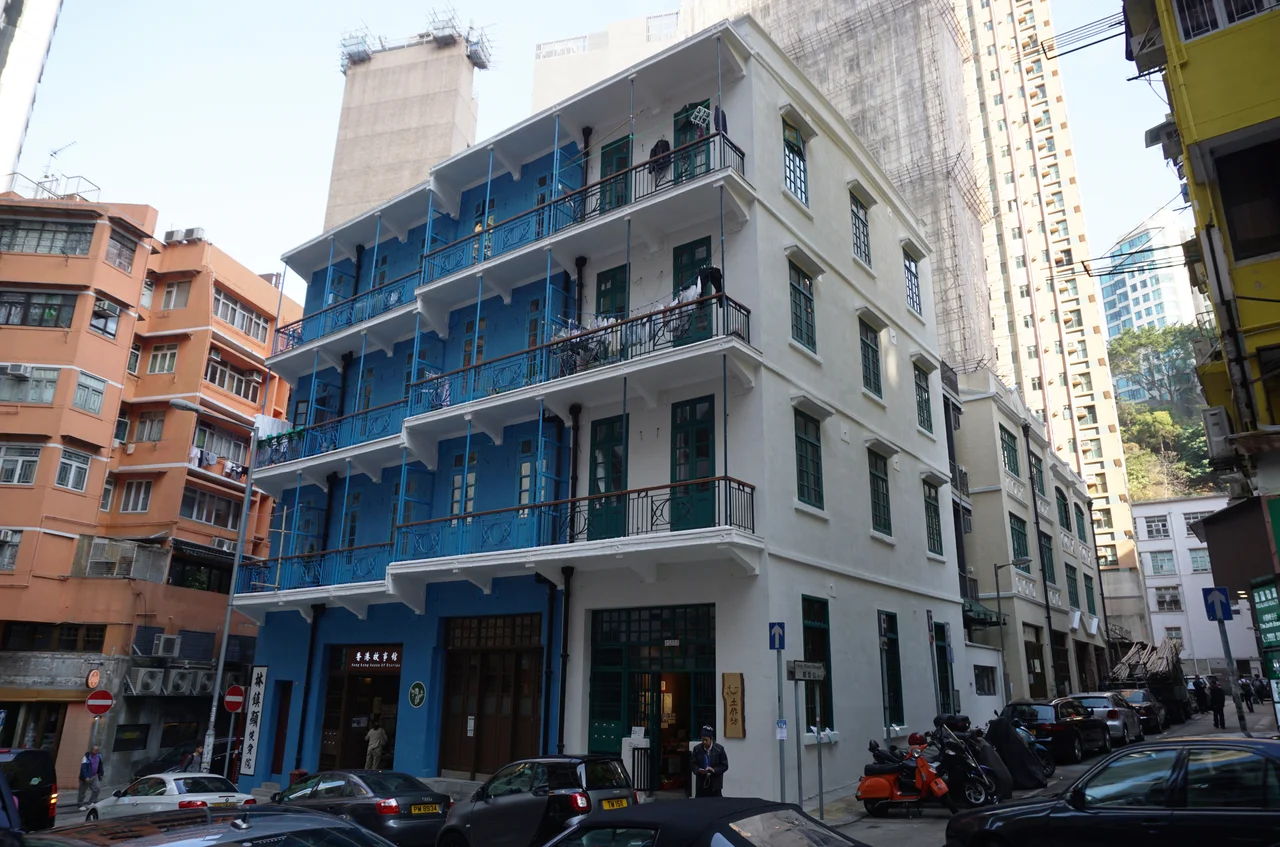

Blue House (Hong Kong)
The colour came from leftover paint. In the 1990s, when the government repainted the building at 72–74A Stone Nullah Lane, the only paint available in sufficient quantity was government-issue blue — the kind used on hospitals and public works. The name stuck. It is not the most romantic origin story for one of Wan Chai's most photographed buildings, but it fits: the Blue House has always been practical first, beautiful second, and improbably durable throughout.
Physicians, Physicians' Gods, and Martial Artists
The land beneath the Blue House has a long medical history. From the 1860s, the site held the Wah To Hospital — also known as the Wan Chai Kai Fong Hospital — which may have been the first hospital in the Wan Chai district, providing Chinese medical services to local residents. When the hospital closed in 1886, the building became a temple to Wah To himself: the revered physician of the Three Kingdoms period, a historical figure who became a deity of healing in southern Chinese folk religion.
The two-storey structure was demolished in 1920 and replaced by four four-storey tenement blocks completed in 1922. After the Japanese occupation ended in 1945, the building was taken over by Lam Cho, the adopted nephew of the legendary kung fu master Lam Sai-wing, who operated a martial arts school and a Dit Da clinic — a traditional bone-setting and bruise treatment practice — on the premises. The lineage connected the building directly to the Hung Gar tradition that Lam Sai-wing had helped popularize across southern China.
What a Tong Lau Looks Like
Tong lau — literally "Chinese building" in Cantonese — is the architectural form that defined Hong Kong's pre-war urban streetscape: narrow shophouses two to four storeys tall, with ground-floor commercial space and residential floors above, and balconies projecting over the pavement to create covered walkways. The balcony-type variant, of which the Blue House is one of the last surviving examples, added a continuous front veranda on the upper floors.
The Blue House's upper floors are timber-framed structures, which is unusual for a building of this age and one reason its preservation required such care. The two original wooden staircases, with their early-twentieth-century elements intact, are still in use. When the building closed for renovation in 2015, preservationists catalogued every original detail that could be saved. The building reopened in 2016 and won Hong Kong's architectural prize for 2017–2018.
The Fight to Stay
For most of the early 2000s, the Blue House's residents faced the realistic prospect of being displaced. Urban renewal in Wan Chai had cleared many of the neighbourhood's remaining pre-war buildings, and the development pressure on Stone Nullah Lane was visible. In 2007, the Urban Renewal Authority and the Development Bureau made a significant decision: residents could stay. The building would be revitalized around its community rather than emptied and redeveloped.
This was not a given. Preservation schemes in Hong Kong have often required residents to vacate while heritage buildings are converted into boutique hotels, restaurants, or government offices. The Blue House's "Viva Blue House" community proposal — organized by residents and the St. James' Settlement, which operates a community centre at 85 Stone Nullah Lane nearby — successfully argued for a model that kept living heritage alive rather than freezing it in amber. The ground floor became the Wan Chai Livelihood Place in 2007, later renamed the Hong Kong House of Stories in 2012.
A Corner That Holds Its Ground
The Blue House sits at the intersection of Stone Nullah Lane, King Sing Street, and Hing Wan Street, a few minutes' walk from the Old Wan Chai Market building on Queen's Road East. The surrounding streets are still recognizable as Wan Chai's older self: low-rise, locally-owned, street-level commerce rather than the glass towers that define the district's waterfront. A non-profit community art space, the Wan Chai Visual Archive, operated nearby at 9 Hing Wan Street from 2012 — a collaboration between Hong Kong Polytechnic University and the building's owner, bringing exhibitions and events to a neighbourhood that academic researchers have studied as a case in heritage-led urban preservation.
Grade I historic building status recognizes the Blue House's architectural significance. Being one of the last balcony-type tong lau in existence in Hong Kong makes it singular. But what has kept the building in the conversation for twenty years is something less easy to categorize: the tenacity of the people who refused to leave, and the argument they made — successfully — that a building lived in is a building understood.
From the Air
The Blue House is located at approximately 22.27°N, 114.17°E in Wan Chai on Hong Kong Island's northern shore. At low altitude from the northwest, the Wan Chai district is identifiable by its mix of older low-rise blocks along the hillside and the taller commercial towers nearer the harbour. Hong Kong International Airport (VHHH) is approximately 28 km to the west-northwest on Lantau Island. Victoria Harbour and the Wan Chai Ferry Pier are visible to the north.
Nearby Stories
- Lok Ma Chau Loop 2.3 km away
- Portas do Cerco 2.3 km away
- Kweilin Incident 17 km away
- Wanshan Archipelago Campaign 34 km away
- Nanxiong Formation 115 km away
- Battle of Nanpeng Island 148 km away
- Heyuan 169 km away
- Cape Maobitou 632 km away