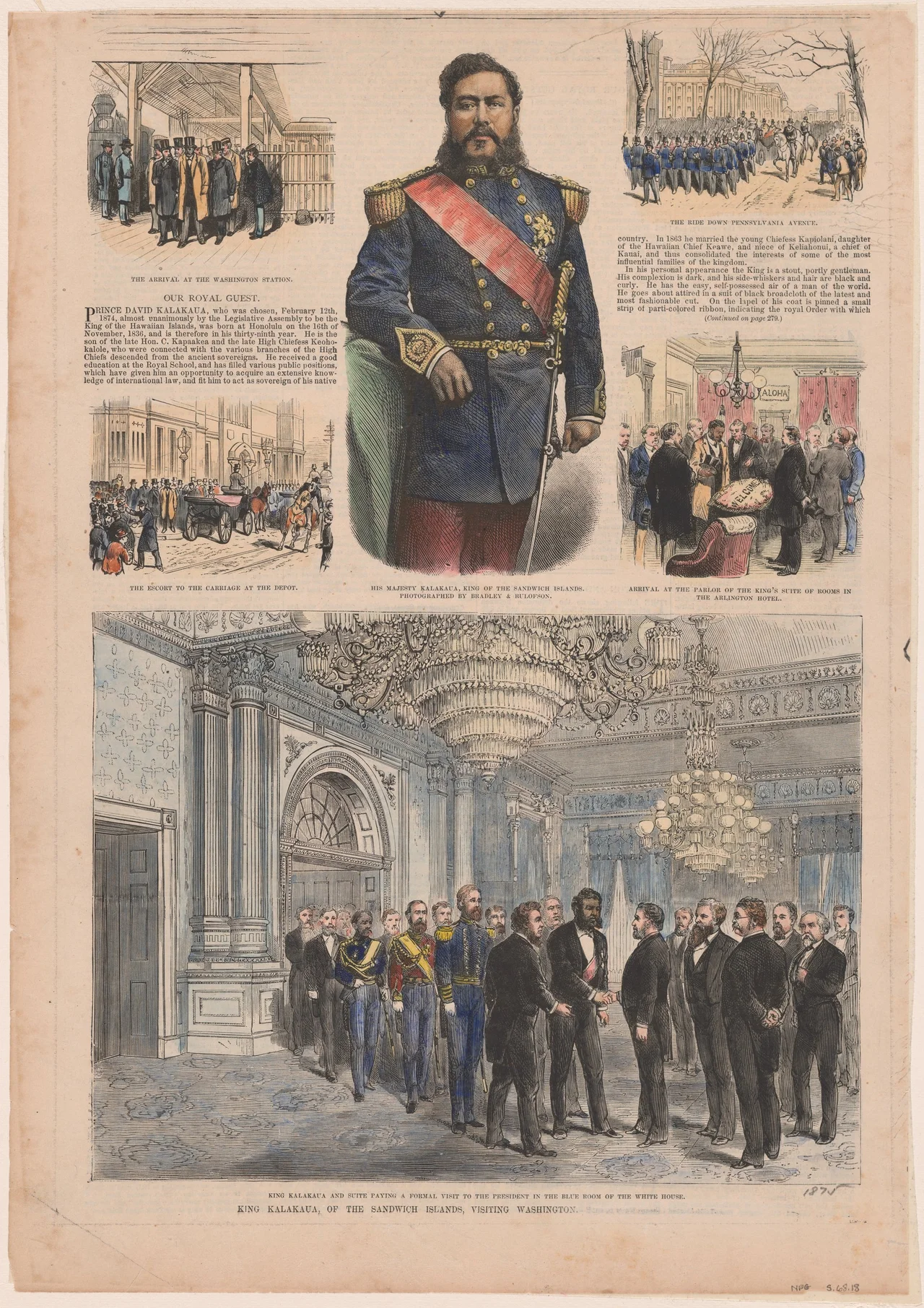

Blue Room (White House)
On June 2, 1886, Grover Cleveland stood with Frances Folsom under the gilded French chandelier and married her in this room. He was forty-nine. She was twenty-one. It is the only wedding of a sitting president that has ever taken place in the White House. The room they used is shaped like an egg laid on its side, thirty feet across at its widest, six doors leading out, three windows looking south across the lawn toward the Washington Monument. It has been blue since 1837, when Martin Van Buren chose the color and made it tradition. Every First Lady since has had her chance to redecorate. Most of them took it.
An Oval by Hoban
The Irish architect James Hoban designed the White House in 1792 with three stacked oval rooms running down its south side: the Diplomatic Reception Room on the ground floor, the Blue Room in the middle, and the Yellow Oval Room above. Of the three, the Blue Room sits at the center of the State Floor, where it functions as the principal reception room of the executive mansion. John Adams used it as a south entrance hall in 1800. James Madison hired Benjamin Latrobe to fill it with classical-revival furniture; the British burned everything in August 1814. When James Monroe rebuilt the room after the fire, he chose the French Empire style and ordered eight gilded beech chairs from Pierre-Antoine Bellange of Paris, made in 1817. The original Bellange chairs were upholstered in crimson, not blue. The blue would come later.
Van Buren's Choice
It was Martin Van Buren, in 1837, who first carpeted and wallpapered the room in blue, and the choice stuck. Every redecoration since has either embraced or pushed against that tradition. James Buchanan, a lifelong bachelor whose niece Harriet Lane ran the social side of his presidency, refurbished the room in heavy Victorian Rococo Revival just before the Civil War. McKim, Mead and White stripped it back to Empire under Theodore Roosevelt in 1902 and cut two new doorways through its walls. Truman gutted and rebuilt the entire White House between 1950 and 1952, and his designers chose a deep blue silk patterned with gold urns. The Truman Balcony added in the same period shades the South Portico just outside the Blue Room's windows.
Mrs. Kennedy's Pier Table
Jacqueline Kennedy reshaped the White House interior more than any First Lady before her, and the Blue Room was where her French interior designer Stephane Boudin had nearly free hand. Researching in early 1961, Mrs. Kennedy came across a 1946 French magazine article that mentioned the lost Bellange suite. She asked the White House staff to look. They found one battered pier table buried in storage. Boudin's firm, Maison Jansen, restored it for free with a new white marble top. The pier table went back to its 1817 location opposite the fireplace and became the anchor of the entire restoration. One of the original 1817 armchairs surfaced in Pennsylvania and was donated. Two side chairs at the Adams National Historical Park were not given up, but Charles Francis Adams IV paid for thirteen reproductions. Boudin assembled the room around the recovered Empire pieces, with blue silk taffeta drapes, a French Empire chandelier, and gilt bronze sconces flanking newly acquired portraits of Jefferson, Monroe, and Jackson.
The Christmas Print That Was Never Sent
The Kennedys had commissioned the artist Edward Lehman to paint the Blue Room as the 1964 Christmas gift print for the White House staff. They had done the Red Room in 1962 and the Green Room in 1963. Lehman brought the painting to the White House in August 1963 for review. The president told him then that the Blue Room was his favorite room in the house. Three months later he was dead in Dallas. The Blue Room print was never distributed. About one thousand were made, numbered, and signed before the project was cancelled. Some made their way to collectors. The painting itself, the room as Boudin and Mrs. Kennedy had wanted it to look forever, survives in the prints.
Continued Revisions
Pat Nixon redecorated the room in 1971, putting wallpaper on the walls for the first time in over a century. Critics savaged Boudin's work after he was gone, and White House Curator Clement Conger called the Kennedy-era Blue Room a failure. Hillary Clinton oversaw the current renovation in 1995, choosing the sapphire-blue silk that drapes the room today and adapting the gold eagle medallion on the chair backs from a Monroe-era portrait. The Bellange chairs are still here, still in the same places. The Healy portrait of John Tyler hangs over the Monroe sofa. The Hannibal clock on the mantel was made by Deniere et Matelin in Paris around 1817. And on January 20, 2013, a Sunday, Barack Obama stood in this room with his wife and daughters and was sworn in for his second term by Chief Justice John Roberts. The public inaugural was the next day, on the Capitol steps, in the cold. The real oath was taken between blue silk walls, two centuries of First Ladies looking on.
From the Air
The Blue Room sits on the south side of the White House State Floor at 38.8975 degrees north, 77.0365 degrees west. Best viewed at 1,500 to 2,500 feet AGL from authorized routes; the room is on the south side, looking out across the South Lawn toward the Washington Monument. Reagan National (KDCA) lies about four nautical miles south across the Potomac. The White House complex is the heart of the P-56 prohibited area, the most restricted civil airspace in the United States. Direct overflight is not permitted; the room can only be glimpsed from compliant approaches along the river.
Nearby Stories
- Gunston Hall 1.1 km away
- 2023 Baltimore Shooting 4.9 km away
- Battle of Middleburg 6.6 km away
- Crownsville Hospital Center 10 km away
- Battle of Loudoun Heights 13 km away
- First Battle of Rappahannock Station 20 km away
- Howard County, Maryland 21 km away
- Harriet Tubman Underground Railroad 50 km away