
Bodmin
In 1497 a Cornish blacksmith and a Bodmin lawyer led an army of perhaps 15,000 men from this town to the edge of London. Michael An Gof and Thomas Flamank had decided that Henry VII's war taxes were intolerable, and the working people of Cornwall agreed. They marched east, met the king's army at Blackheath, and were cut down. Both leaders were hanged, drawn, and quartered. It was not the last time Bodmin would shake the throne. Over the next half-century the town hosted Perkin Warbeck's claim to be King Richard IV, then in 1549 became the staging ground for the Prayer Book Rebellion, in which 4,000 Cornish and Devonian people were killed for preferring Latin mass to Edward VI's new English liturgy. For a small Cornish market town, Bodmin has had a remarkably violent relationship with the English crown.
Dwelling of the Monks
St Petroc founded a monastery here in the 6th century, and Bodmin grew up around it as Petrockstow, the place of Petroc. The town's later Cornish name, Bod-meneghy, means dwelling of or by the sanctuary of monks, recorded in early forms like Botmenei in 1100 and Bodmen in 1253. Bodmin is the only large Cornish settlement listed in the Domesday Book of 1086, by which time the monastery still held eighteen manors including Padstow and Rialton. The Norman Conquest stripped the priory of some of its lands but left it powerful. In the 15th century the church of St Petroc was largely rebuilt and emerged as one of the largest parish churches in Cornwall, second only to Truro Cathedral after that was built in the late 19th century. The Norman tower survives at the north side, with a 15th-century upper stage. A 150-foot spire stood here until 1699, when it was removed. Inside, a 12th-century font carved in elvan and a black Delabole slate memorial to Richard Durant, his wives, and twenty children record centuries of Cornish piety in stone.
Three Rebellions
Bodmin became the centre of three Cornish uprisings in just over fifty years. The Cornish Rebellion of 1497 began with resistance to a war tax raised to fund a Scottish campaign that meant nothing to Cornish workers. Michael An Gof, a blacksmith from St Keverne, joined forces with Thomas Flamank, a Bodmin lawyer, and the army that gathered here marched to defeat at Blackheath in London. In the autumn of the same year Perkin Warbeck, a young man claiming to be one of the Princes in the Tower and thus the rightful king, was proclaimed Richard IV in Bodmin; Henry had little trouble suppressing him. In 1549 came the Prayer Book Rebellion. Edward VI's Protestant reformers introduced an English-language Book of Common Prayer, and the still-Catholic working people of Cornwall and Devon revolted. A Cornish army was raised in Bodmin and marched into Devon to besiege Exeter. The rebellion was crushed; 4,000 people died. The same year, the Crown rejected a proposal to translate the new prayer book into Cornish, an act of cultural suppression that helped accelerate the long decline of the Cornish language.
Plague, Asylum, Gaol
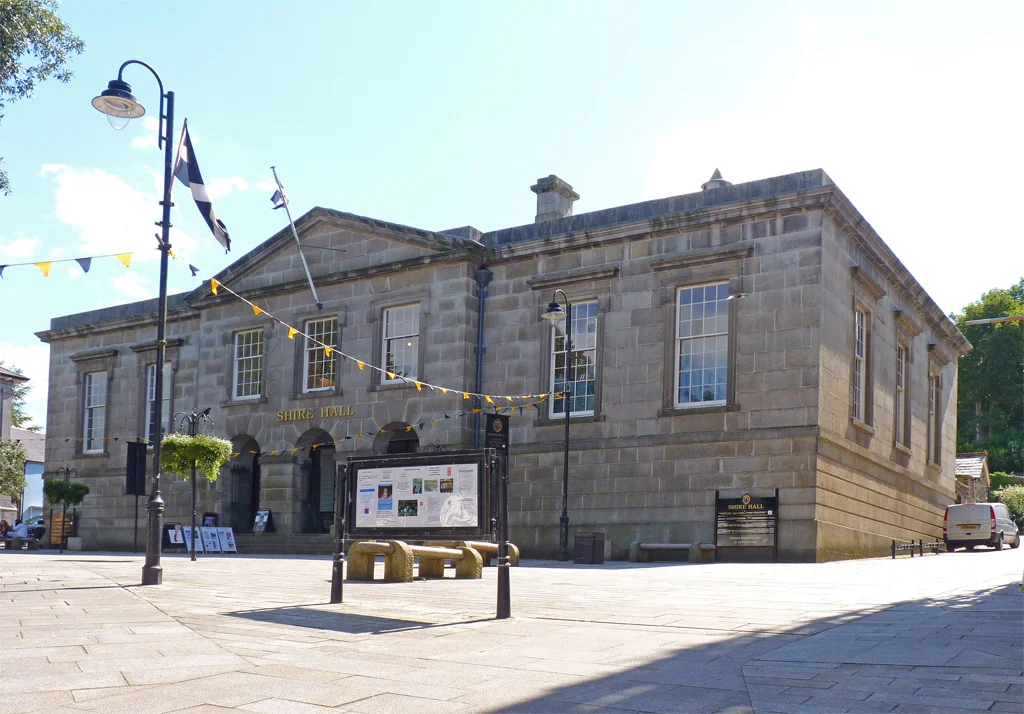
The Black Death killed half of Bodmin's population in the mid-14th century, around 1,500 people. The town recovered, but its later history reads as a chronicle of institutions. Bodmin Gaol, where Matthew Weeks was hanged for the 1844 murder of Charlotte Dymond on Bodmin Moor, became known across Cornwall as the place of executions. Bodmin County Lunatic Asylum, later St Lawrence's Hospital, was designed by John Foulston in the 19th century and run for a time by the humorist William Robert Hicks. Victoria Barracks served as the depot of the Duke of Cornwall's Light Infantry from the 18th century until the regiment was disbanded; the Honey Street drill hall sent reservists to the Western Front in 1914. Walker Lines, named for Lieutenant-General Harold Walker, housed men evacuated from Dunkirk in 1940 and later troops preparing for D-Day. Bodmin's role as the administrative capital of Cornwall began in 1838 when the assizes moved here from Launceston and the new Shire Hall opened. The role started slipping away in 1889, when the new Cornwall County Council chose Truro; the assizes followed in 1972, and the courthouse finally closed in 1988.
The Silver Ball
Every five years or so, the Mayor of Bodmin stands beside a body of water called the Salting Pool and throws a silver ball into it. The game of Cornish hurling follows, a free-for-all in which there are no teams and anyone can carry the ball along a set route through the old A30, Callywith Road, Castle Street, Church Square, and Honey Street to the Turret Clock on Fore Street. Whoever delivers the ball wins a 10 pound reward from the mayor. The hurling concludes Beating the Bounds, an older custom revived in 1865-66 by William Robert Hicks during his term as mayor. Bodmin has been a great centre for Cornish wrestling for centuries; the Bodmin Wrestling Association helped set up the county Cornish Wrestling Association in 1923, and the wrestling ring on the Beacon hill above town is thought by some to have been a medieval plen-an-gwary, the Cornish performance space of the late Middle Ages. Bodmin Community College students built the robot Roadblock in 1997 that won the first series of Robot Wars on television. The town that sent three armies against the crown still likes to throw things, organized or not, and let the rules sort themselves out.
What Endures
Modern Bodmin lives in the long shadow of its institutions and its rebellions. Some areas of the town show real deprivation; the proportion of children in poverty exceeds the Cornish average, and county lines drug trafficking has reached even this corner of the southwest. The town twins with Bederkesa in Germany, Grass Valley in California, and Le Relecq-Kerhuon in Brittany, a Celtic counterpart across the channel. Notable people from Bodmin have spread far: William Hamley founded the Hamleys toyshop empire from his Cornish boyhood; Sir Arthur Quiller-Couch shaped English literary studies; Peter D. Mitchell won the Nobel Prize in Chemistry in 1978 and spent the latter part of his career here; James Henry Finn earned the Victoria Cross at the Battle of Mesopotamia in World War I. The Bodmin and Wenford Railway, run from Bodmin General station, still operates steam trains across the moor's southern edge. The Beacon, a 44-metre granite monument to Sir Walter Raleigh Gilbert built by the townspeople in 1857, marks the highest point above town. From its base you can see most of mid-Cornwall, and most of what Bodmin used to be.
From the Air
Bodmin sits at 50.47 N, 4.72 W in mid-Cornwall, just southwest of Bodmin Moor. Approach from Newquay (EGHQ) about 18 nautical miles west-northwest, or Exeter (EGTE) roughly 47 nautical miles east-northeast. From 2,000 feet AGL the town reads as a compact urban grid set against the dark mass of Bodmin Moor to the northeast and rolling Cornish farmland to the south. The Beacon's 44-metre granite obelisk is the most distinctive landmark, visible on a hill on the southeast edge of town. Bodmin Parkway railway station lies 3.5 nautical miles southeast on the Cornish Main Line. The A30 dual carriageway runs along the moor edge to the north. Clear flying typical year-round, with moor weather often more changeable than the town conditions.
Nearby Stories
- Gunnislake 1.5 km away
- Tehidy Country Park 4.2 km away
- Caerhays Castle 8.1 km away
- Bude 15 km away
- Hope Cove Lifeboat Station 26 km away
- Appledore Lifeboat Station 29 km away
- Godrevy Lighthouse 34 km away
- Action of 17 November 1917 82 km away