
Bogor Botanical Gardens
Four oil palm seeds arrived at the garden in 1848. They came from West Africa, unassuming cargo on a long sea voyage. From those four seeds grew the mother trees of Southeast Asia's palm oil industry -- an industry that would eventually reshape the economies and landscapes of Indonesia, Malaysia, and beyond. The last original mother tree died in 1933, but by then its descendants had spread across the archipelago. This is the kind of thing that happened at Bogor Botanical Gardens: plants arrived, were studied, propagated, and sent back out into the world, and the consequences rippled for centuries. Founded in 1817 under Dutch colonial rule, the garden sits 60 kilometers south of Jakarta in the city of Bogor, adjoining the presidential palace and covering 87 hectares of land where it rains nearly every day, even in the dry season.
Before the Botanists
The land beneath the garden is older than the garden itself -- considerably older. The area was once a samida, a man-made forest established during the reign of Sri Baduga Maharaja, the Sundanese king who ruled from 1482 to 1521. As recorded in the nearby Batutulis inscription, the samida was created to protect seeds of rare trees. When the Sunda Kingdom fell to the sultanates of Banten and Cirebon in the 16th century, the forest was neglected but not entirely destroyed. In 1744, the Dutch East India Company built an estate on the site, and after the British interlude of 1811 to 1816 -- during which Stamford Raffles remodeled the grounds into an English-style garden -- the returning Dutch established a formal botanical institution. The garden was officially founded on May 18, 1817, through the efforts of the German-born botanist Caspar Georg Carl Reinwardt, making it the oldest botanical garden in Southeast Asia.
The Engine of Empire
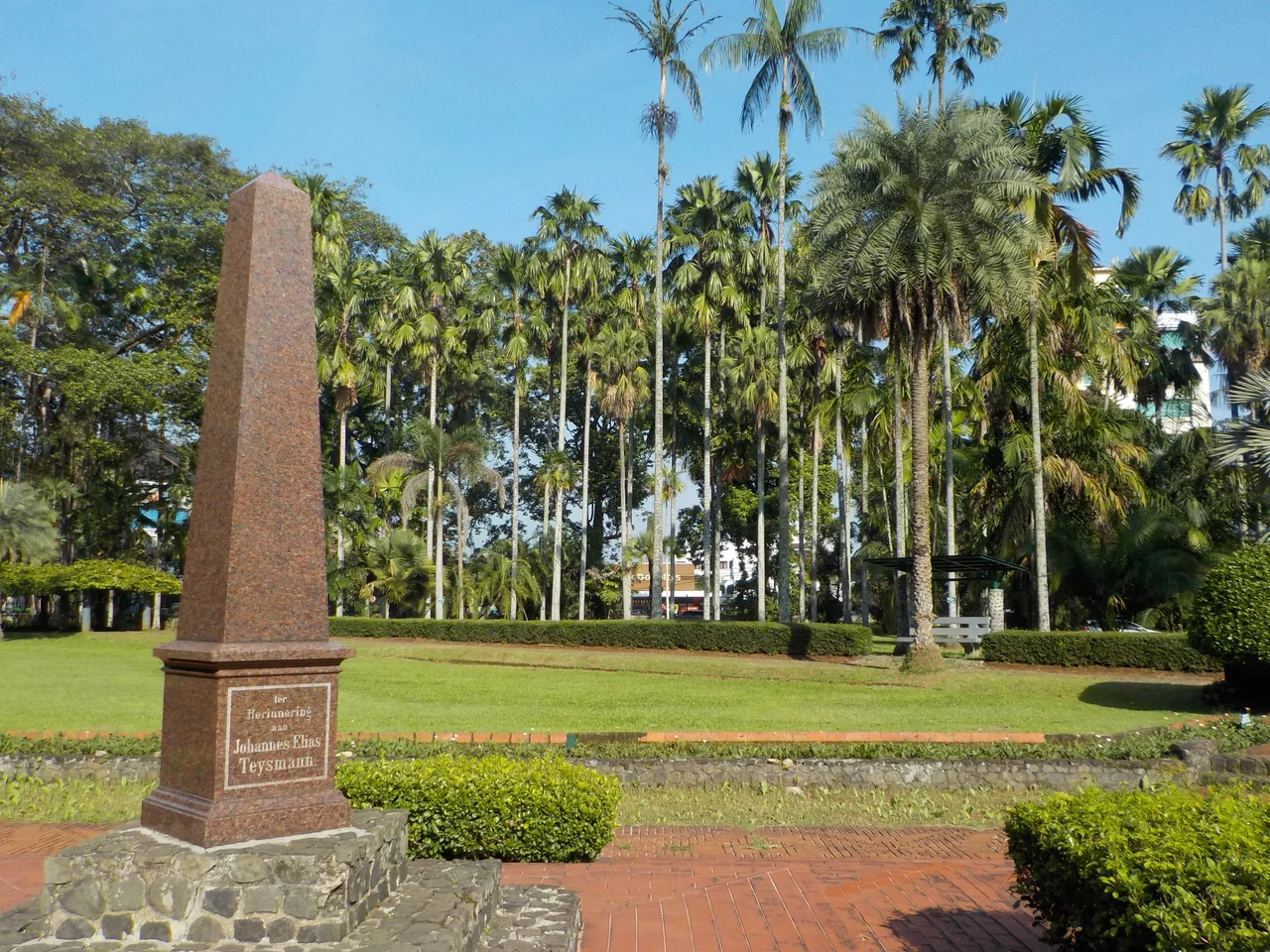
For the Dutch colonial government, Bogor was not a park. It was an engine of agricultural research and economic transformation. Johannes Elias Teijsmann arrived as curator in 1830 and spent more than fifty years developing the garden, expanding it with a mountain branch at Cibodas in 1852 and cataloging more than 2,800 species by 1844. His assistant Justus Carl Hasskarl reorganized the plantings by taxonomic family and established the Bibliotheca Bogoriensis in 1842 and the Herbarium Bogoriense in 1844 -- institutions that turned the garden into a genuine research center. In 1854, the garden introduced Cinchona trees to Java. Cinchona bark produces quinine, the only effective malaria treatment of its era, and Java would eventually become the world's largest producer. Under director Melchior Treub, who served from 1880 to 1910, the garden attracted scientists from across Europe and cemented its reputation as one of the world's premier tropical research stations.
Surviving the Storm
When the Japanese army marched into Bogor in March 1942, the garden faced an existential threat. Japanese soldiers wanted the trees cut down for war lumber. Two Japanese botanists -- Professor Takenoshin Nakai as director and Kanehira as head of the herbarium -- fought to protect the collections, navigating the tension between military necessity and scientific preservation. The garden survived the occupation, was renamed Shokubutsuen, and endured until the Dutch returned after Japan's surrender. After Indonesia won sovereignty, the garden was renamed Kebun Raya -- Great Garden -- and Kusnoto Setyodiwirjo became its first Indonesian curator. The transition from colonial instrument to national institution was not merely administrative. Under Indonesian management, the garden maintained its research mission while taking on new meaning as a symbol of inherited knowledge, a place where the colonial past was not erased but repurposed.
Living Collections
Today the garden holds 13,983 specimens of trees and plants across 3,373 species, 1,257 genera, and 218 families. The numbers alone are impressive, but the garden's character lies in its specific treasures. There are 288 species of palms lining the avenues. The orchid collection numbers roughly 500 wild species from over 100 genera, including Grammatophyllum speciosum, the largest orchid species in the world. Five specimens of Amorphophallus titanum -- the titan arum, whose rare blooms produce a stench of rotting flesh that draws crowds whenever one opens -- are maintained in the collection, all originally from Pagar Alam in South Sumatra. A small Dutch cemetery near the bamboo section holds 42 gravestones, the oldest dating to 1784. Nearby, a garden of desert plants -- cacti, agave, yucca -- seems almost absurd in a city where rain falls daily. The Ciliwung River divides the garden, crossed by three bridges, and more than 50 species of birds shelter in the canopy alongside colonies of bats.
Rain City's Green Heart
Bogor earns its nickname Kota Hujan -- Rain City -- honestly. The near-daily rainfall that makes the city occasionally miserable for commuters is exactly what makes it ideal for growing tropical plants, and the garden exploits this advantage relentlessly. From the air, the 87-hectare rectangle of the botanical garden appears as a dark green island within Bogor's dense urban sprawl, its canopy distinct from the surrounding rooftops. The presidential palace sits at the garden's northern edge, its grounds adding another 28.4 hectares of protected green space. Mount Salak rises to the south through its characteristic veil of cloud. The Treub Laboratory, built in its current form in 1914, still functions as a research facility with molecular, anatomy, seed conservation, and ecological conservation labs. Two centuries after Reinwardt proposed a garden next to the governor-general's palace, the institution he founded remains what it has always been: a place where the patient work of understanding tropical nature continues, one specimen at a time.
From the Air
Bogor Botanical Gardens is located at 6.598S, 106.799E in the city of Bogor, West Java, approximately 60km south of Jakarta. The 87-hectare garden is clearly visible from the air as a large dark-green rectangle within Bogor's urban fabric, adjacent to the white presidential palace compound at the northern edge. The Ciliwung River bisects the garden. Mount Salak (2,211m) rises prominently to the south. Nearest major airports include Soekarno-Hatta International (WIII) approximately 70km northwest and Halim Perdanakusuma (WIHH) approximately 50km north. Best viewed from 3,000-5,000 feet; the garden's rectangular shape and dense canopy make it one of the most recognizable features in Bogor from above.
Nearby Stories
- Japanese Migration to Indonesia 4.8 km away
- Rawagede Massacre 11 km away
- Through the Cidepong Hills 30 km away
- The Scholar's Mosque 31 km away
- Kawah Putih 40 km away
- Gunung Padang: Java's Stairway to the Ancient World 42 km away
- The Pepper Kingdom's Ghost 61 km away
- 2010 Christmas Island Boat Disaster 400 km away