
Boipeba
The only engine noise on Boipeba belongs to an ambulance, a police motorbike, and three shared tractors that haul luggage through roads of soft white sand. Everything else moves at the speed of flip-flops. The island sits in the Tinharé archipelago south of Salvador, pressed between the open Atlantic on one side and the brown estuary of the Inferno River on the other, and the Tupi who named it called it mboi pewa - flat snake - after the sea turtles that curl in its shallow reef pools. Arriving here means surrendering a clock. The slow boat from Valença takes four hours. The fast boat takes ninety minutes. Once you're on the sand, those distinctions stop mattering.
A World Between Reefs
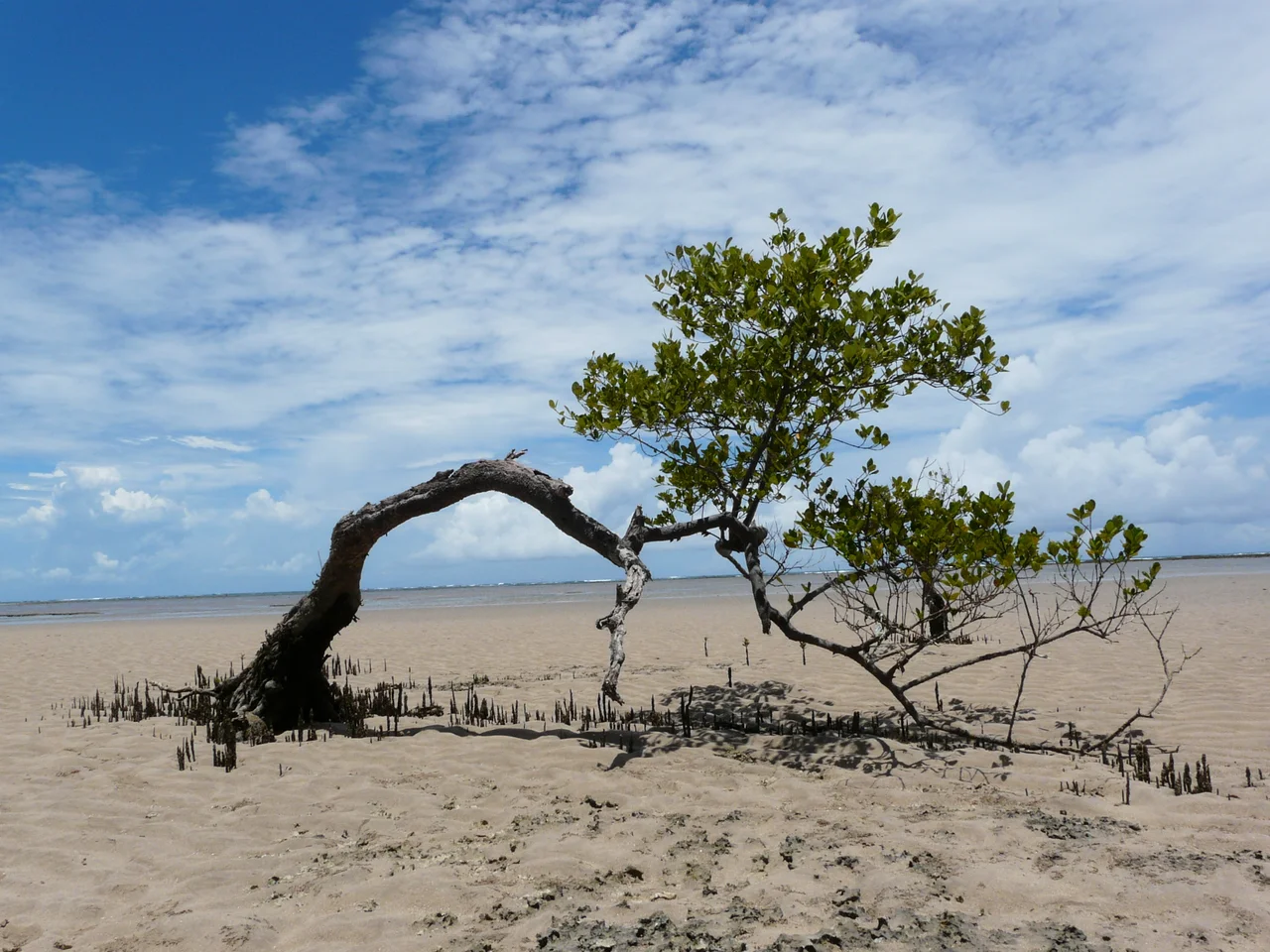
Boipeba is less a single beach than a series of ecosystems stitched together by tide. Long reefs run parallel to the shore, breaking the Atlantic swell before it reaches the coconut palms and filling the shallows with warm, clear pools shot through with coral, algae, sea urchins, and starfish. Behind the beach the land changes quickly: dense patches of Atlantic rainforest, then saltmarsh, then mangrove channels reaching inland toward the Inferno River estuary. Sea turtles nest on the quieter stretches, and birders who walk the forest trails pick up armadillo tracks in the sand and the rustle of small reptiles in the leaf litter. The whole island was declared an Area of Environmental Protection by the state of Bahia in June 1992, a designation that the residents themselves helped shape through Amabo, the local Association of Residents and Friends of Boipeba, to keep tourism from doing to their reefs what it has done elsewhere.
Getting In, Slowly
There is no ferry straight from Salvador. You catch the ferry across the Baía de Todos-os-Santos to Bom Despacho (about 45 minutes), a bus down the coast to Valença (about two hours), and then a boat for the last leg. The slow boat is the village ferry in all but name - four hours of Brazilian coastline and cargo and conversation. The speedboat does the same run in about 90 minutes. The other way in is more picturesque: from Morro de São Paulo, a 4x4 jeep rattles down the spine of Tinharé before handing you off to a short river crossing by launch. Either way the island meets you the same: a wooden pier, the slap of water, and a welcome committee of guesthouse owners with hand-drawn signs. The village's internal roads are soft sand - cyclists curse them, walkers learn to stick to the harder edges - and the police bike outnumbers the patrol car by one to zero.
Miereles and the Empty Miles
The village clusters around the port at Velha Boipeba, and everything gets quieter as you walk south. By the time you reach Moreré the crowds thin to a handful of pousadas; continue past the tide pools, where horse riders lead you across shallow channels at low tide, and you arrive eventually at the beach of Cueira and then Ponta dos Castelhanos at the island's southern tip. Snorkeling is how most visitors meet the reef - there is no scuba operation on the island, so this is a mask-and-fins kind of place. The best mornings start early, when the rising tide still leaves the pools accessible and the sun has not yet turned the sand into a griddle. Watch for bicho-de-pé, the tiny burrowing parasite that prefers bare feet to shoes; a little caution is all the island asks in return for giving you the reef.
Wood Ovens and Generator Evenings
Because there are no cars, food on Boipeba arrives by boat and by memory. Restaurants serve family-size portions meant to share - the high tag on a moqueca makes sense once you see the clay pot come out bubbling for three. A beach shack near the main port sells sandwiches for walkers; the Family Guest House delivers wood-oven pizza on weekends, summoned by WhatsApp and carried across the sand on foot. Lodging clusters in two zones: near the port for convenience, near Miereles for quiet. The Abaquar Hostel, run by a Belgian-Portuguese couple named Peter and Fernanda, serves the kind of breakfast - garden eggs, tropical fruit, strong coffee - that is meant to carry you through to sunset. Generators hum in the evenings because the island has no fixed grid. When they switch off, the Milky Way leans down over the reef, and you remember why you came.
From the Air
Boipeba lies at 13.62°S, 38.91°W, in the Tinharé archipelago south of Salvador. For a scenic pass, approach from the north at 3,500 to 4,500 feet to see the ribbon of reefs offshore, the curve of Morro de São Paulo, and the Inferno River estuary cutting inland. The nearest major airport is Salvador (SBSV) about 50 nautical miles north; Ilhéus (SBIL) is about 85 nautical miles south. Small strips near Valença (SNVB) serve the region but offer limited services. Coastal Bahia typically enjoys good VFR weather from May to October, with afternoon cumulus building inland; haze can cut visibility in the austral summer wet season.
Nearby Stories
- Battle of 4 May 29 km away
- Itacaré 46 km away
- 2019 Northeast Brazil Oil Spill 52 km away
- Praia do Forte 121 km away
- Pé de Serra 172 km away
- Vitória da Conquista 192 km away
- Sincura 211 km away
- SS Principessa Mafalda 344 km away