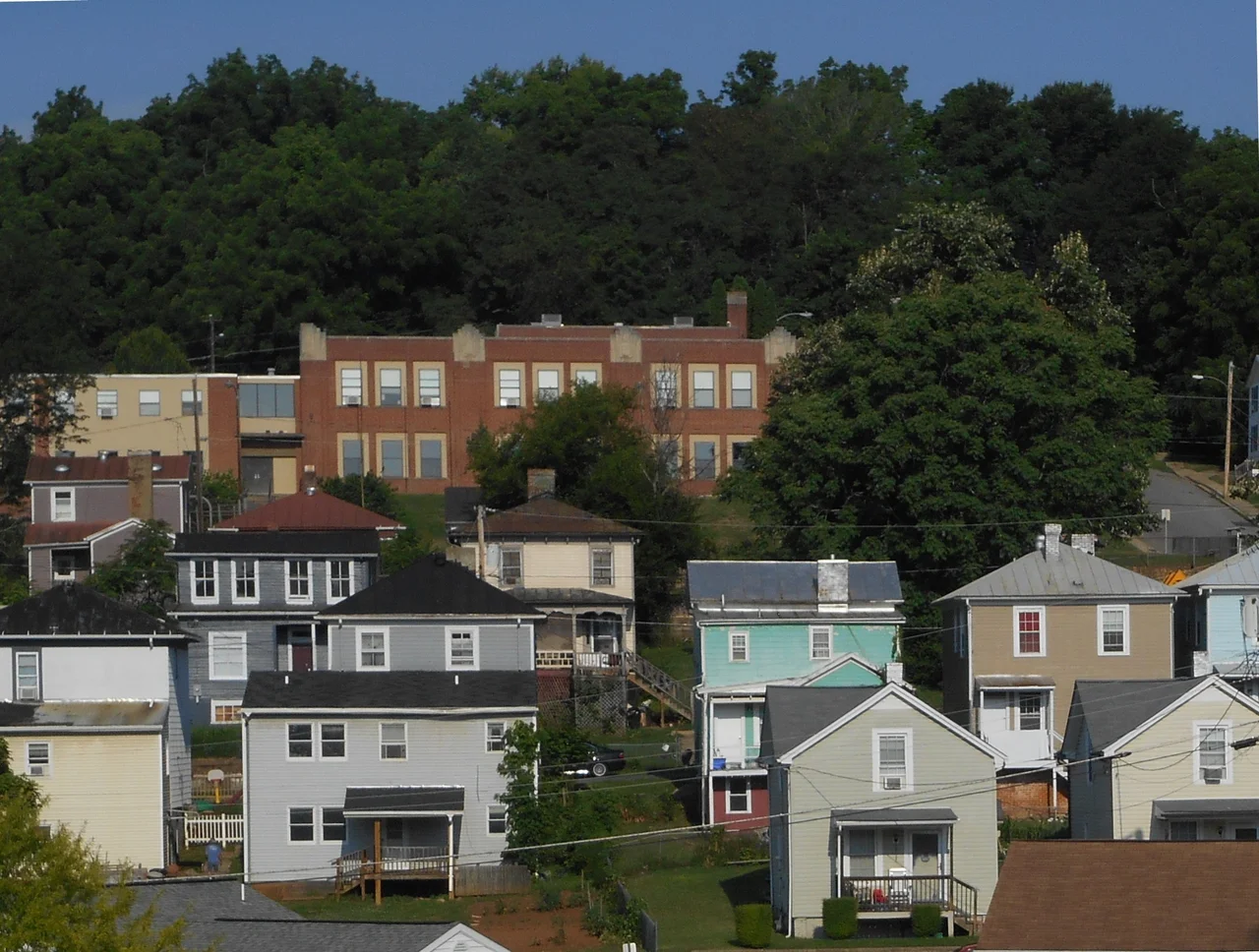

Booker T. Washington Community Center
For thirty years, this was the only high school an African American student in Staunton was allowed to attend. The building at 1114 West Johnson Street opened in 1936, a two-story Art Deco brick structure designed by Raymond V. Long, and it carried a heavy name: the Booker T. Washington High School for Coloreds. The wording on official documents fixes the era exactly. Virginia public schools would remain segregated by law until well into the 1960s. For the families who sent their children here, the building was both a hard reality and a hard-won achievement - a real high school, with real teachers and a real auditorium, in a state that had spent decades insisting Black education barely needed funding at all.
An Art Deco School in Jim Crow Virginia
Raymond V. Long designed the school in a restrained Art Deco style - clean brick lines, stepped massing, a modest geometric ornament that announced this was a public building meant to last. In a school system that systematically underfunded Black education, the fact of a proper, architect-designed building was itself contested ground; Staunton's Black community had pushed for it for years. A rear addition in 1960 added more classrooms in a flatter, more modern idiom. The school served students from across the surrounding region, since smaller towns lacked any Black high school at all. Students from places like Waynesboro, Stuarts Draft, and Verona traveled to Staunton each day to attend, sometimes by special bus arrangements their families had to negotiate themselves.
More Than a School
In a segregated city, a Black high school was often the only public building Black residents could fully use. Booker T. Washington High doubled as the meeting place for civic organizations, mutual aid societies, churches without buildings of their own, and political groups. Graduations were community events. Sporting events were de facto social occasions for adults too. When civil rights organizing accelerated in Virginia in the 1950s and early 1960s, gathering places like this one - small, contained, run by people who knew everyone in the room - mattered more than their square footage suggested. The building was a school for thirty years and an institution for considerably longer.
Closure and a Different Use
Staunton's public schools desegregated in the 1960s under federal pressure. As Black students were admitted to formerly white high schools, the Booker T. Washington school's role narrowed. It closed as a high school in 1966. Then came an awkward chapter: from 1967 to 1986, the building housed the Staunton Police Department. The school that had been the heart of a community became the city's headquarters for law enforcement during years when the relationship between Black communities and police was particularly fraught nationally. Photographs from this period show patrol cars parked in front of the Art Deco facade that students of an earlier era walked past on their way to class.
Coming Back
After the police department left in 1986, the building was reclaimed by the community that had built it. It became the Booker T. Washington Community Center, a meeting place for the neighborhood and a vessel for memory. Alumni groups and local historians worked to document the school's history. In 2014, the building was added to the National Register of Historic Places. The listing acknowledged what the building represented - one of the relatively few surviving school buildings in Virginia where the segregated era can be examined directly, in brick and original windows. Walk the halls now and the photographs on the walls do most of the talking: class portraits, sports teams, faculty groups from a school that no longer exists but whose alumni are still around to name everyone in the picture.
From the Air
Located at 38.1478N, 79.0814W on West Johnson Street in Staunton, Virginia. The building sits in a residential neighborhood on the western side of the city in the Shenandoah Valley. Recommended viewing altitude is 3,500 to 5,500 feet for an overhead of downtown Staunton and the surrounding street grid. Nearest airport is Shenandoah Valley Regional (KSHD) about 4 nm north; Charlottesville-Albemarle (KCHO) is 30 nm east. Watch for valley haze in summer.
Nearby Stories
- Rockingham County 4.8 km away
- Shenandoah: The Skyline Drive Through America's Oldest Mountains 5.6 km away
- 2023 Virginia Cessna Citation Crash 16 km away
- Highland County, Virginia 16 km away
- Montpelier 20 km away
- Fork Union Military Academy 26 km away
- Battle of Greenbrier River 28 km away
- Alleghany County, Virginia 53 km away