
Border Force National Museum
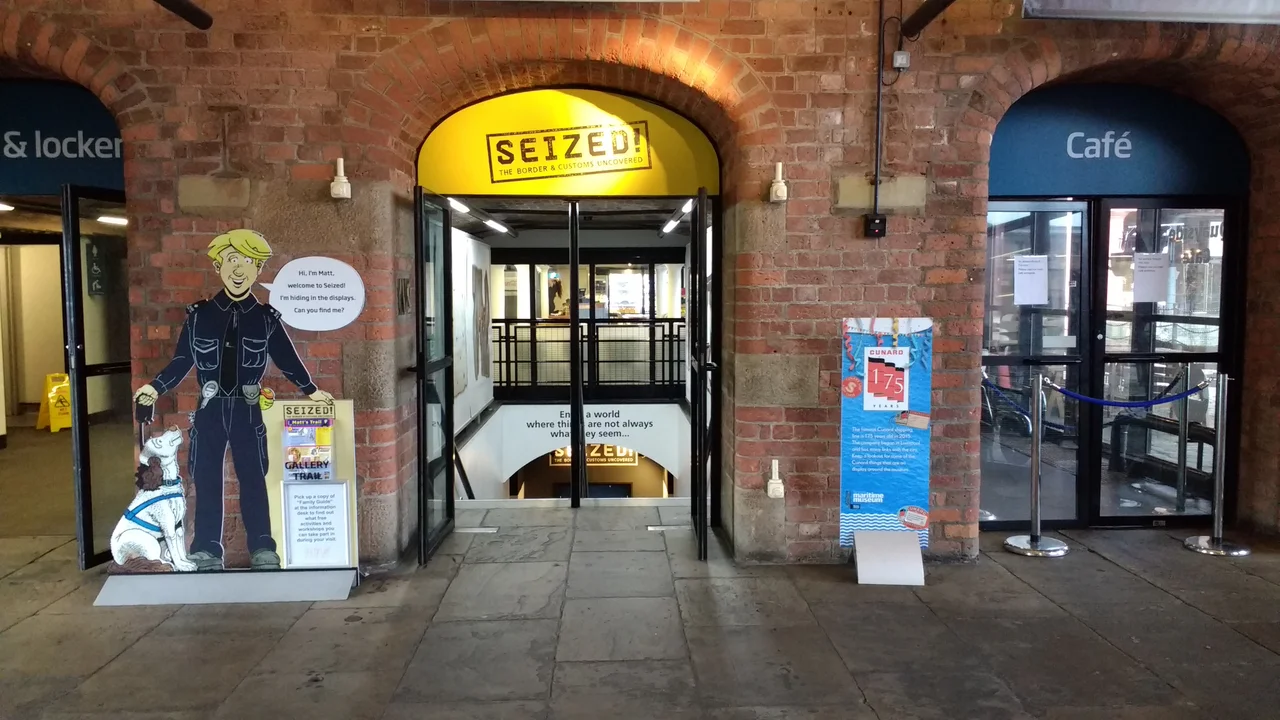
Walk down the stairs to the basement of the Merseyside Maritime Museum at the Royal Albert Dock and the first thing you see is a hollowed-out tin of pineapple. Pry it open and there is the white residue of cocaine. Across the gallery, a teddy bear is split down the back to show how something else was concealed inside. A pair of ivory tusks, seized at Manchester Airport, lie in a case that explains how they came up the supply chain. This is Seized! The Border and Customs Uncovered, the public face of the Border Force National Museum, and it holds the national collection of HM Revenue and Customs, one of the most important collections of its type in the world.
Three Centuries of Smuggling
The exhibits begin in the eighteenth century, with brandy kegs and tea chests and the small lanterns that signalled across coastal coves on moonless nights. The trade in contraband shaped Britain's coast as much as it shaped its trade laws, and the museum is unsentimental about both sides of that story. There are revenue cutters in model form, the fast-sailing vessels that hunted smugglers off Cornwall and the Lancashire shore. There are pistols and cutlasses that customs officers carried because the men they were chasing were armed too. The collection moves century by century into the present, where the contraband is no longer brandy but cocaine, heroin, counterfeit currency, ivory, and the protected species that international treaties were written to save.
The Interrogation Room
One of the most striking exhibits is a replicated customs interrogation room, a small grey space with a desk, two chairs, and the kind of bare overhead light that gives the whole arrangement an air of forensic calm. Visitors can sit on either side. The displays around it walk through the cues that officers learn to read, the inconsistencies in stories, the body language, the bag that is too heavy for what it claims to contain. There are also recordings, anonymised, of real interviews. The museum does not pretend this work is glamorous. It is patient, repetitive, and occasionally dangerous, and the room is honest about that.
An Albert Dock Home
The museum sits inside one of the great Victorian buildings of England. The Albert Dock was opened in 1846, designed by Jesse Hartley, and was the first non-combustible structure in Britain, built entirely of brick, stone, and iron. After commercial shipping outgrew it, the complex fell derelict, and only in the 1980s did restoration begin. Today the warehouses around the dock house Tate Liverpool, the Merseyside Maritime Museum, and the International Slavery Museum, with the customs collection occupying the maritime museum's basement floor since May 2008. Fraser Randall handled the £500,000 refurbishment, fitting out interactive screens and family-friendly displays alongside the original objects.
From Customs to Border Force
The collection itself is older than its current name. It began in 1994 as the HM Customs & Excise National Museum, a partnership between National Museums Liverpool and the customs service. In 2005 the customs service merged with the Inland Revenue to form HM Revenue and Customs, and the museum's name followed: it became Seized! Revenue and Customs Uncovered in May 2008. Then in 2009, with the UK Border Agency taking the lead partnership role, the title shifted again. When that agency was reorganised into Border Force in 2012, the museum took its current name. The objects have hardly moved. The signs have been updated several times.
What People Try to Smuggle
The most quietly horrifying exhibits are the ones from the contemporary cases. Cocaine pressed into the soles of trainers. Heroin packed into hollowed-out books, into the frames of suitcases, into the engine blocks of cars driven onto cross-channel ferries. Cigarettes by the millions, often the bulk of any given week's seizures by value. Endangered animals dead and alive: turtle shells, rhino horn, live finches in tubes. The cases name no specific traveller, but each item is a real seizure, and the labels are precise about how the concealment was found. Walk out into the Albert Dock afterwards, into the bright open air over the water, and the city looks the same as it did an hour earlier. It only feels different.
From the Air
The Royal Albert Dock complex sits on Liverpool's waterfront south of the Pier Head and the Three Graces, at 53.40°N, 2.99°W. The Merseyside Maritime Museum occupies one of the brick-and-cast-iron Victorian warehouses around the dock; the Border Force gallery is in the basement. Best viewed from 1,500-3,000 ft. Liverpool John Lennon Airport (EGGP) is 7 nm south-southeast; Hawarden (EGNR) is 13 nm south-southwest. Look for the rectangular dock basin between the Pier Head and the Echo Arena.
Nearby Stories
- RAF Wrexham 3.3 km away
- Birkdale Palace Hotel 3.7 km away
- Turton Tower 4.1 km away
- Tatton Park 5.6 km away
- Abergele Rail Disaster 9.6 km away
- Diglake Colliery Disaster 13 km away
- Ysbyty Ifan 16 km away
- Celtic Array 62 km away