
Boringdon Hall
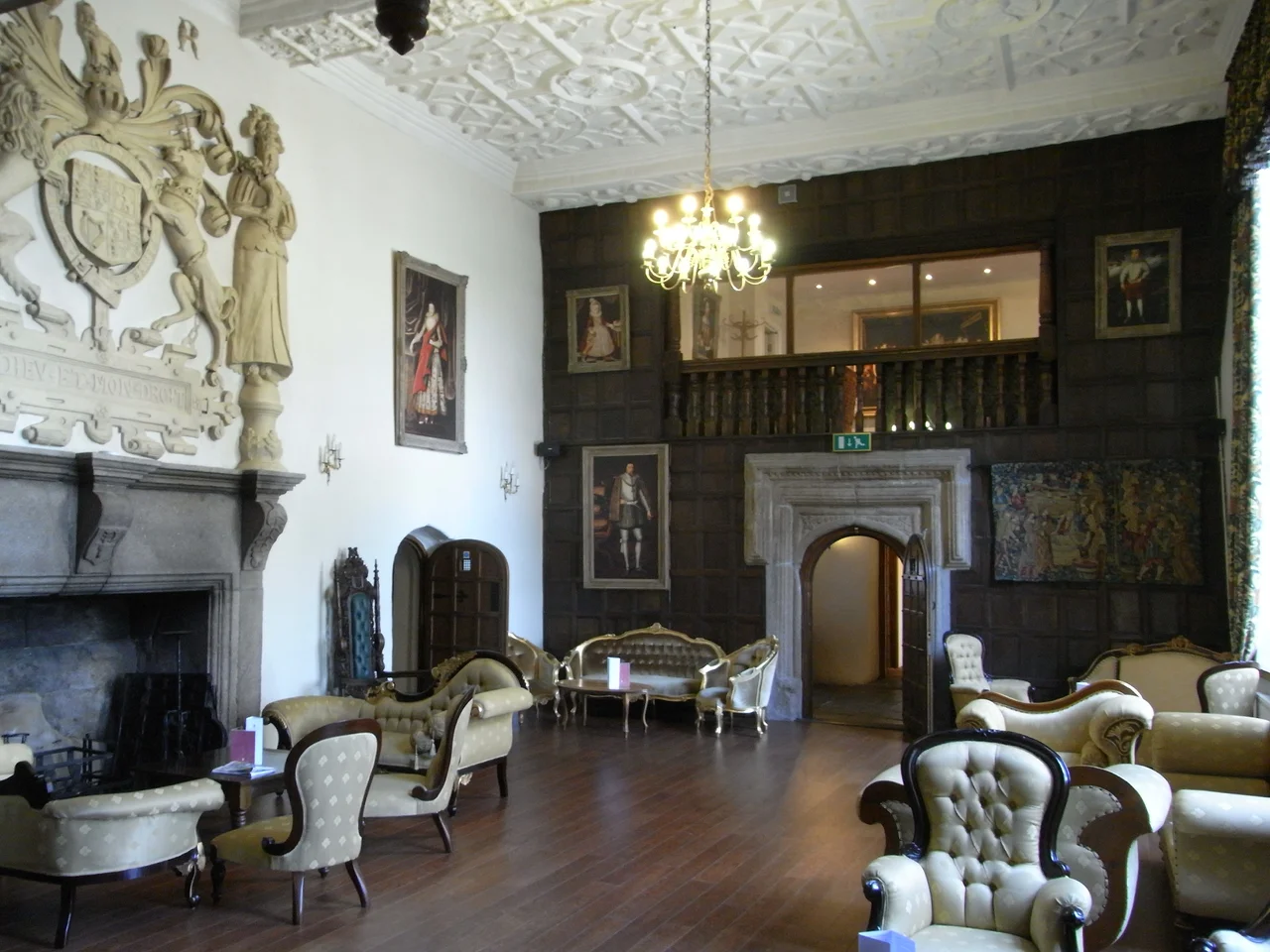
King Charles I's coat of arms still presides over the great fireplace at Boringdon Hall, dated 1640 and flanked by two larger-than-life female figures: Peace on the left, Plenty on the right with her cornucopia. Two years after the plaster was set, civil war broke out, and Cromwell's soldiers came calling. The Parker family had backed the wrong king. Cromwell's men demolished the entire eastern wing of the house, leaving only the western half standing for the next three centuries. The royal arms survived because they were on the wall the soldiers chose to spare.
A House the Historian Found Irritating
Nikolaus Pevsner, the great chronicler of England's buildings, called Boringdon "irritating for the historian." The house refuses to date itself cleanly. Bits of medieval stonework sit alongside Tudor windows and Victorian repairs. The entrance porch has a semicircular Norman-style arch that the 19th-century antiquary John Britton believed had been hauled in from some neighbouring church, possibly Plympton Castle. The granite door-frames have been moved and rearranged so many times that one now functioning as the great hall entrance was previously a fireplace in a different room. The result is what Pevsner described, with the slight chill of a German scholar denied his chronology, as "a superficially convincing instant patina."
The Parker Centuries
The manor came to the Parker family in 1582, when Frances Mayhew married John Parker of North Molton in North Devon. Five years later, they finished remodelling the house. The Parkers would hold Boringdon for the next three and a half centuries, rising through Barons Boringdon to Earls of Morley. They expanded the village of Colebrooke to house their estate workers. They commissioned Robert Adam to design a Roman-style triumphal arch in 1783, marking the road that connected Boringdon to their grander seat at Saltram. But Boringdon's prominence faded once Saltram was built: by the 1920s the old manor was being used as a farmhouse, and in 1957 the family handed Saltram itself, plus 291 acres, to the National Trust to settle death duties.
Ruin to Rebirth
By 1980, Boringdon was little more than four walls and a memory. Restoration began in 1986, and just three years later, in March 1989, a major fire tore through the partially restored building. It was rebuilt again. In 2011 the property went on the market for three million pounds: forty-one bedrooms, four banqueting suites, seven acres. The Nettleton Collection bought it. Today the great hall hosts weddings beneath the same plaster Charles I that watched Cromwell's soldiers approach. The hotel has a Michelin-starred restaurant called Àclèaf and a spa called Gaia. The Robert Adam arch a mile away has fared less well: it sits on the English Heritage at Risk Register, offered for sale in 2014 with no takers found.
From the Air
Boringdon Hall sits at 50.40 degrees north, 4.06 degrees west, about two miles north of Plympton on the eastern edge of Plymouth. Approach from the south reveals the manor tucked among trees with the Plym Valley to the west and Dartmoor's edge rising to the north-east. Nearest airfield is Plymouth (EGHD), about 7 nm to the south-west; Exeter (EGTE) lies 35 nm to the north-east. Best viewing altitude is 2,000-3,000 feet, where the Adam arch, the manor, and the Saltram estate can all be picked out together.
Nearby Stories
- Davidstow Circuit 3.7 km away
- Golden Hind 3.9 km away
- Powderham Castle 4.4 km away
- Fowey Lifeboat Station 5.1 km away
- Okehampton Castle 12 km away
- Battle of Plymouth (1652) 19 km away
- Goonhilly Satellite Earth Station 44 km away
- German Submarine U-672 73 km away