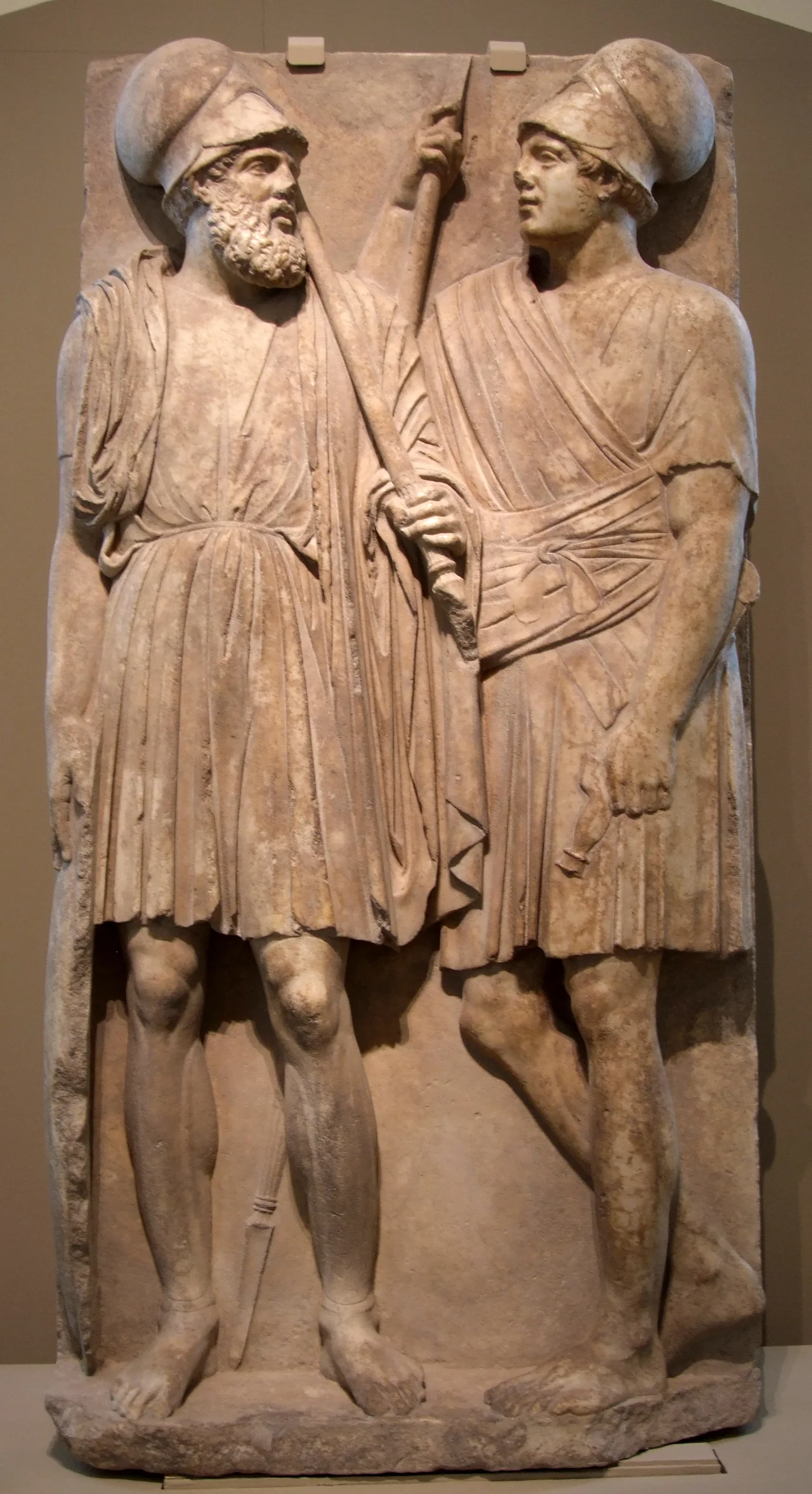

Bosporan Kingdom
The kings of this realm had a trick of speaking out of both sides of their mouths, and it worked for centuries. To their Greek subjects in the marble cities along the strait, the rulers of the Bosporan Kingdom styled themselves merely archons, elected magistrates in the modest republican tradition. To the Scythian and Sindian tribes of the surrounding steppe, the very same men called themselves outright kings. Historians consider this double identity almost unique in the ancient world, and it captures exactly what the Bosporan Kingdom was: a hybrid civilization straddling the Cimmerian Bosporus, the strait now called Kerch, where Greek letters and nomad horsemanship fused into something entirely their own.
The Bread Basket of Athens
Wealth here was measured in wheat. The Bosporan Kingdom grew rich on grain, fish, and the trade in enslaved people, and became the economic heart of the Black Sea, an ancient jewel of the region. When the Peloponnesian War strained distant Athens and left the great city hungry, it was Bosporan grain that helped feed the Athenian democracy, shipped across the sea in exchange for silver and the fine goods of the Greek mainland. The profits built a class of astonishing wealth, and that wealth followed its owners into the ground. Across the steppe rise hundreds of burial mounds called kurgans, and even today they yield spectacular Greco-Sarmatian treasures, gold work, painted vases carried from Athens, delicate carpentry and inlay. The finest of these now glitter in the Hermitage Museum in St. Petersburg, a hoard of buried splendor pulled from beneath the grass.
Kings, Poison, and the Fall of Mithridates
The kingdom began around 480 BCE under the Archaeanactid dynasty and expanded under the Spartocids, whose armies reflected the realm itself: a few thousand Greek and Thracian mercenaries fighting alongside tens of thousands of Scythian horsemen. By the first century BCE the Bosporus had been absorbed into the ambitions of Mithridates VI of Pontus, Rome's most relentless eastern enemy. It was here, in the city of Phanagoria, that rebellion finally broke against the aging king shortly before his death. His sons, holding the citadel, were forced to surrender. Afterward the kingdom bent toward Rome, and in a moment that reveals its whole character, it became the longest-surviving Roman client kingdom of them all. Rome once briefly swallowed it outright under Nero, from 63 to 68 CE, before deciding the arrangement worked better with a local king on the throne.
The Kingdom That Would Not Die
Roman patronage bought the Bosporus a second golden age in the first two centuries CE, and its cities became a crossroads of peoples and faiths. Jewish communities flourished, especially at Tanais, and a curious local cult of the "Most High God" preached a monotheism that belonged to no single religion. Then came the storms of the great migrations, the Goths and Borani seizing Bosporan ships in the 250s, the Huns arriving later still. The kingdom was long thought to have died in the fourth century, yet an inscription from a ruler named Douptounos around 483 proves the old line of kings outlasted every prediction of its end. Only in the sixth century did Byzantine armies finally fold the strait into the empire. Even then the cities lived on: Phanagoria became the capital of Old Great Bulgaria, and Tmutarakan rose across the water as a principality of Kievan Rus.
From the Air
The heart of the Bosporan Kingdom straddled the Kerch Strait around 45.26°N, 37.04°E, with the Taman Peninsula on the east and the Crimean city of Kerch (ancient Panticapaeum, the capital) on the west. From altitude, orient on the strait linking the Black Sea to the Sea of Azov and the low, kurgan-dotted steppe on either shore. Nearest airports are Anapa-Vityazevo (URKA) and Krasnodar (URKK) to the east, with Kerch's airfield across the strait.
Nearby Stories
- Tuzla Island 1.1 km away
- Battle of Kerch Strait (1790) 13 km away
- Soviet Cruiser Mikhail Kutuzov 34 km away
- Novorossiysk 62 km away
- Koktebel 104 km away
- Arabat Spit 123 km away
- Byriuchyi Island 168 km away
- Beriev 208 km away